Book information
- Publisher
- Open Book Publishers
- Publication
- Published 1 March 2021
- Place
- Cambridge, UK
- Catalogue record
- View in the catalogue
Abstract
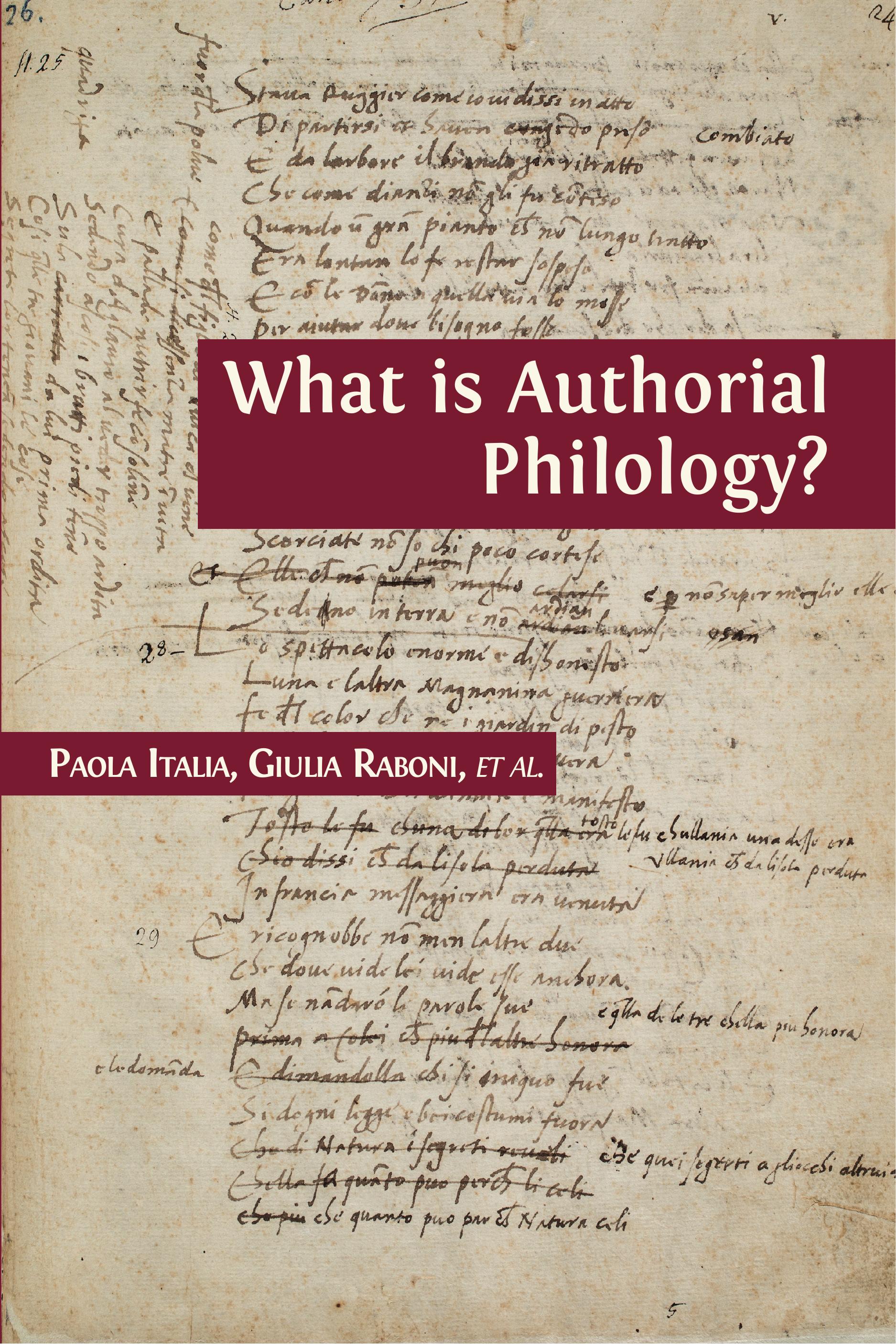
A stark departure from traditional philology, What is Authorial Philology? is the first comprehensive treatment of authorial philology as a discipline in its own right. It provides readers with an excellent introduction to the theory and practice of editing ‘authorial texts’ alongside an exploration of authorial philology in its cultural and conceptual architecture. The originality and distinction of this work lies in its clear systematization of a discipline whose autonomous status has only recently been recognised (at least in Italy), though its roots may extend back as far as Giorgio Pasquali.
This pioneering volume offers both a methodical set of instructions on how to read critical editions, and a wide range of practical examples, expanding upon the conceptual and methodological apparatus laid out in the first two chapters. By presenting a thorough account of the historical and theoretical framework through which authorial philology developed, Paola Italia and Giulia Raboni successfully reconceptualize the authorial text as an ever-changing organism, subject to alteration and modification.
What is Authorial Philology? will be of great didactic value to students and researchers alike, providing readers with a fuller understanding of the rationale behind different editing practices, and addressing both traditional and newer methods such as the use of the digital medium and its implications. Spanning the whole Italian tradition from Petrarch to Carlo Emilio Gadda, this ground-breaking volume provokes us to consider important questions concerning a text’s dynamism, the extent to which an author is ‘agentive’, and, most crucially, about the very nature of what we read.
Chapters
| Chapter | Author | Institution at publication |
|---|---|---|
| Introduction | Paola Italia, Giulia Raboni | University of Bologna; University of Parma |
| 1. History | Paola Italia, Giulia Raboni | University of Bologna; University of Parma |
| 2. Methods | Paola Italia | University of Bologna |
| 3. Italian Examples | Paola Italia, Giulia Raboni | University of Bologna; University of Parma |
| 4.1 Lope de Vega’s La Dama Boba | Marco Presotto, Sònia Boadas | University of Bologna; Universitat Autònoma de Barcelona |
| 4.2 Percy Bysshe Shelley’s Poems | Margherita Centenari | University of Parma |
| 4.3 Jane Austen’s The Watsons | Francesco Feriozzi | |
| 4.4 Marcel Proust’s À la recherche du temps perdu | Carmela Marranchino | |
| 4.5 Samuel Beckett’s En attendant Godot / Waiting for Godot | Olga Beloborodova, Dirk Van Hulle, Pim Verhulst | University of Antwerp; University of Oxford |
Where its authors and editors are based
Countries of the institutions the book's authors, editors and chapter authors were affiliated to when it was published.
- AUTHORS / EDITORS
- CITATIONS Phase 2
- USAGE Phase 3
| Country | Authors / editors |
|---|---|
| Italy | 4 |
| United Kingdom | 2 |
| Belgium | 1 |
| Spain | 1 |
About this data
These figures cover 10 works. Each value comes from the most trusted source that has it; a correction made by OJC or OBC staff outranks every source.
| Source | Confidence | Works |
|---|---|---|
| Thoth | 90 / 100 | 10 |
| Works with a publication date | 100% |
|---|---|
| Works with a DOI | 100% |
| Works with a funder recorded | 10% |
| Authors with an affiliation | 88% |
| Affiliations matched to an institution (ROR) | 100% |
| Affiliations with a country | 100% |
Countries come from the institution each author was affiliated to when they published, as recorded in ROR. A country is never guessed, so authors without a matched institution are not counted on the maps.
Funders come from OpenAlex for articles and Thoth for books, where publishers recorded them. Most works record none, so a funder's figures show what is recorded, not everything it funded.
Chapters count as works: their authors and editors, and the countries of their institutions, are in every figure where Thoth records an affiliation for them.
Citations (Phase 2) and usage (Phase 3) are not collected yet.