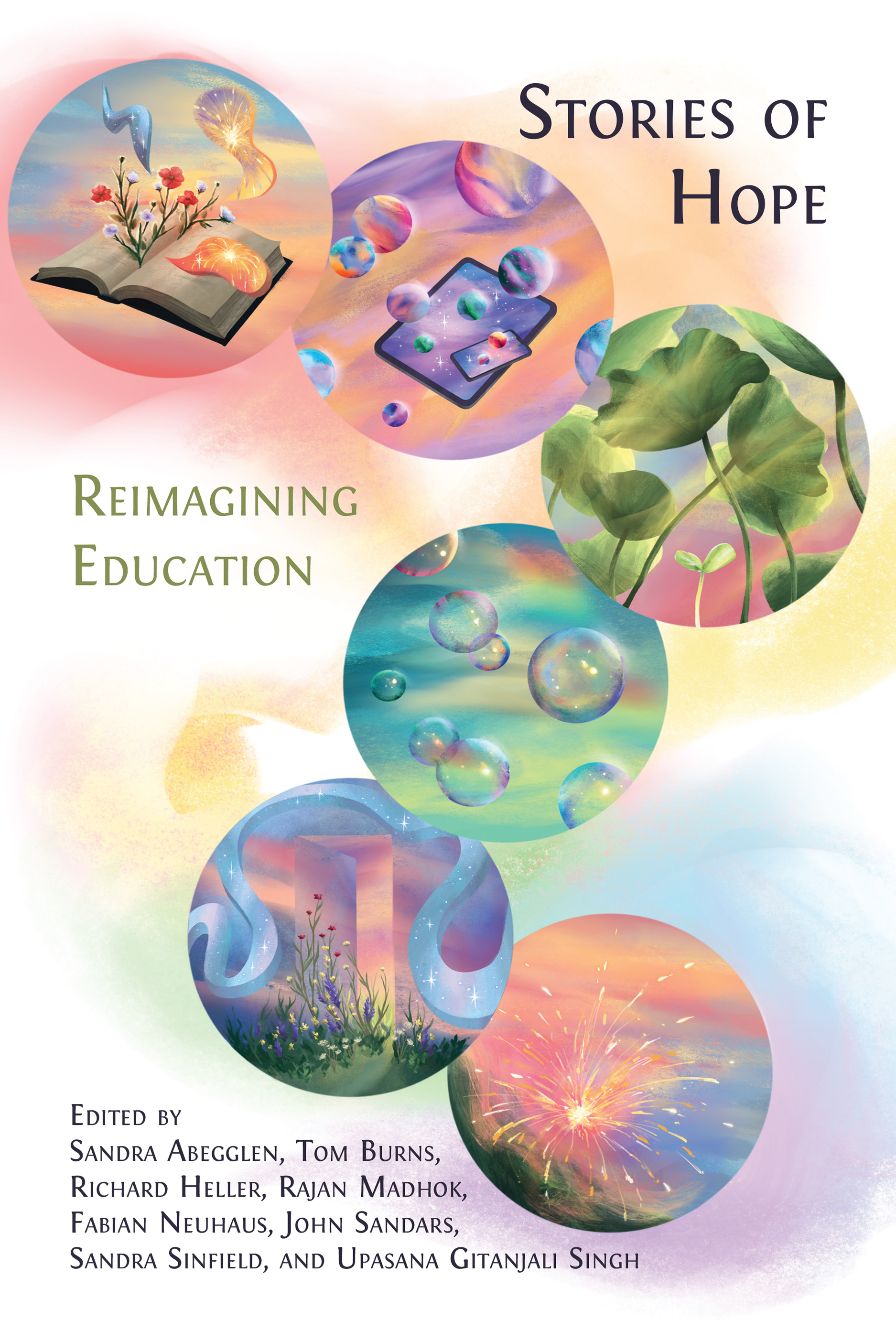
Cover of Stories of Hope

Book information

Publication
Published 2 July 2025
Place
Cambridge, UK
Catalogue record
View in the catalogue
57 Chapters FULL LIST: Chapters
Total citations Phase 2: not collected yet
Total usage Phase 3: not collected yet

Abstract

Higher education is in crisis. Students are disengaged, lecturers are burned out, and universities seem more preoccupied with rankings and revenue than with knowledge and wellbeing. But rather than dwell on the problems, this book focuses on solutions—on hope.

Bringing together a diverse range of educators and practitioners, this collection showcases real-world innovations that challenge the status quo and offer glimpses of a more humane and inspiring educational future. From rethinking systems and curriculum design to fostering imaginative collaboration and exploring the role of technology, the book highlights practical, hopeful interventions that are already making a difference.

This is not a manifesto of complaints but an invitation to reimagine education. The contributors offer fresh perspectives from around the world, illustrating how small but meaningful changes can transform learning spaces, empower educators, and inspire students. For academics, teachers, administrators, and anyone invested in the future of education, this book serves as both a source of inspiration and a call to action. It is an evolving ecosystem of ideas—grounded in practice, rich with possibility, and rooted in radical hope. Now is the time to create the change we wish to see.

Chapters

ChapterAuthorInstitution at publication
Foreword Mary O’Kane
Introduction Sandra Abegglen, Tom Burns, Richard F. Heller, Rajan Madhok, Fabian Neuhaus, John Sandars, Sandra Sinfield, Upasana Gitanjali Singh University of Calgary; University of Newcastle Australia; London Metropolitan University; University of KwaZulu-Natal
1. Inverting the distribution of Higher Education Richard F. Heller, Stephen Leeder University of Newcastle Australia
2. A critical pedagogy for a critical time Jane Booth University of Wolverhampton
3. Serious fun Sarah Honeychurch University of Glasgow
4. Fostering hope and humanity through transformative education Shivaani Chugh, Anurag Mishra, Aashima Dabas, Chandini Chugh
5. Creating hope through T-shaped values Earle Abrahamson, Nina Namaste, Corinne Green, Mayi Arcellana-Panlilio, Lisa Hatfield, Michelle Eady University of Hertfordshire; Elon University; University of South Australia; University of Calgary; University of Wollongong
6. The human and nothing but the whole human Nathalie Tasler University of Glasgow
7. Becoming wildly nomadic with the Nomadic Detective Agency-Assemblage Mark Ingham
8. Playful Higher Education futures Kim Holflod
9. The emotional impact of nature seen through the lenses of virtual reality (VR) and revealed through the power of expressive art Gabriella Rodolico, Fiona McGregor
10. CanadARThistories Johanna Amos, Alena Buis Queen's University; Kwantlen Polytechnic University
11. PhDForum Donna Peach
12. “The art of conversation” Oliver Burney, Jennifer Hillman, Mark Kershaw, Stephanie Newton, Elizabeth Shakespeare, Sean Starbuck Open University
13. Hope Street Laura Bissell, David Overend Royal Conservatoire of Scotland; University of Edinburgh
14. The other F word Victoria Fritz University of Guelph
15. “Armed love” Chris Cachia
16. The XXXX game Louise Sheridan
17. Reimagining the sage–guide dichotomy Katherine Herbert, Yeslam Al-Saggaf Charles Sturt University
18. Playing with learning John Parkin Anglia Ruskin University
19. Making plants cool again Geyan Surendran, Adam Bromley, James Connorton, Lian X. Liu, Paul A. Townsend, Michael Heinrich, Shelini Surendran University of Reading; University of Surrey; University of Stirling; University College London
20. Putting theory into (proposed) action Luke Ray Di Marco Campbell University of Glasgow
21. Freedom to learn Agnese Di Domenico, Aidan Harvey, Beth Karp, Elizabeth Shakespeare, Ingeborg van Knippenberg, John Cowan, Zack Moir Open University; Edinburgh Napier University
22. Hope in an art school Simone Maier London Metropolitan University
23. Embracing compassion Anna Troisi University of the Arts London
24. Better Together Nikita Asnani, Inca Hide-Wright, Jess Humphreys, Bo Kelestyn, Jean Mutton University of Warwick
25. Peer review Debbie Holley Bournemouth University
26. Co-creating networks of hope in an interdisciplinary degree for mature students Catherine Bates, Tracy Campbell, Colin Webb, Lucy Yeboa University of Leeds; Leeds Beckett University
27. A quiet hope Siobhán O’Neill, Laura Lee University College Cork
28. The moongazers Sandra Abegglen, Tom Burns, Sandra Sinfield University of Calgary; London Metropolitan University
29. Learning vs education Akitav Sharma
30. Belonging through compassion Vikki Hill, Liz Bunting Queen Margaret University; University of the Arts London
31. Humanising student and instructor experiences to nurture relationships and improve engagement Umme Mansoory Thompson Rivers University
32. The ten wellness spheres to support student and staff health and wellbeing in a modern, post-1992 university in, though, and outside of the study lifecycle Michelle Morgan University of East London
33. Unlocking a new generation of leaders Nayiri Keshishi University of Surrey
34. The pedagogy of joy and engaged presence Phoenix Perry
35. “Resilience Finders” Rachel Delta Higdon, Hilary Thomson
36. Storying the silences of social mobility Karen Arm Southampton Solent University
37. How can you know what you don’t know? Stephanie Jury
38. An imperfect practice? What barriers are there to providing outdoor education opportunities for primary-aged children? Megan McGee
39. Moving, making, and mingling Susannah McKee, Marie Stephenson London Metropolitan University
40. Food for thought Hilda Mulrooney
41. “It’s a bit like academic me-time” Aspasia Eleni Paltoglou, Alison Williams, Arriarne Pugh, Rossella Sorte Manchester Metropolitan University
42. The opportunity of constraint Joshua Thorpe University of Stirling
43. Addressing the challenges of the new, internationalised Higher Education ecosystem by applying successful teacher adaptation strategies Rita Koris, Marta Folmeg, Imre Fekete, Ágnes Pál Budapest University of Economics and Business
44. If the tomatoes don’t grow, we don’t blame the plant Mâir Bull, Stephanie Aldred, Sophie Bessant, Sydney Duignan, Eileen Pollard Manchester Metropolitan University
45. Embracing compassion and self-care Lee Fallin University of Hull
46. Decoloniality and nonviolence as a pedagogy of hope Gaston Bacquet
47. Avengers Assemble! Zak Liddell, Leigh Kilpert University College London
48. “If you know, you know” Rachael O’Connor University of Leeds
Beyond the curriculum John Sandars
Creative curriculum design Tom Burns, Sandra Sinfield, Sandra Abegglen London Metropolitan University; University of Calgary
Examples of system change Rajan Madhok
Focus on the teachers Richard F. Heller University of Newcastle Australia
How technology can shape the future Upasana Gitanjali Singh University of KwaZulu-Natal
Imaginative collaboration and co-creation Sandra Abegglen, Tom Burns, Sandra Sinfield University of Calgary; London Metropolitan University
Conclusion Sandra Abegglen, Tom Burns, Richard F. Heller, Rajan Madhok, Fabian Neuhaus, John Sandars, Sandra Sinfield, Upasana Gitanjali Singh University of Calgary; University of Newcastle Australia; London Metropolitan University; University of KwaZulu-Natal

Where its authors and editors are based

Countries of the institutions the book's authors, editors and chapter authors were affiliated to when it was published.

  • AUTHORS / EDITORS
  • CITATIONS Phase 2
  • USAGE Phase 3
Authors / editors by country
CountryAuthors / editors
United Kingdom43
Canada7
The Netherlands6
Australia5
Hungary4
Ireland2
South Africa1
United States1
About this data

These figures cover 58 works. Each value comes from the most trusted source that has it; a correction made by OJC or OBC staff outranks every source.

Sources
SourceConfidenceWorks
Thoth90 / 10058
Completeness
Works with a publication date100%
Works with a DOI100%
Works with a funder recorded0%
Authors with an affiliation65%
Affiliations matched to an institution (ROR)92%
Affiliations with a country100%

Countries come from the institution each author was affiliated to when they published, as recorded in ROR. A country is never guessed, so authors without a matched institution are not counted on the maps.

Funders come from OpenAlex for articles and Thoth for books, where publishers recorded them. Most works record none, so a funder's figures show what is recorded, not everything it funded.

Chapters count as works: their authors and editors, and the countries of their institutions, are in every figure where Thoth records an affiliation for them.

Citations (Phase 2) and usage (Phase 3) are not collected yet.