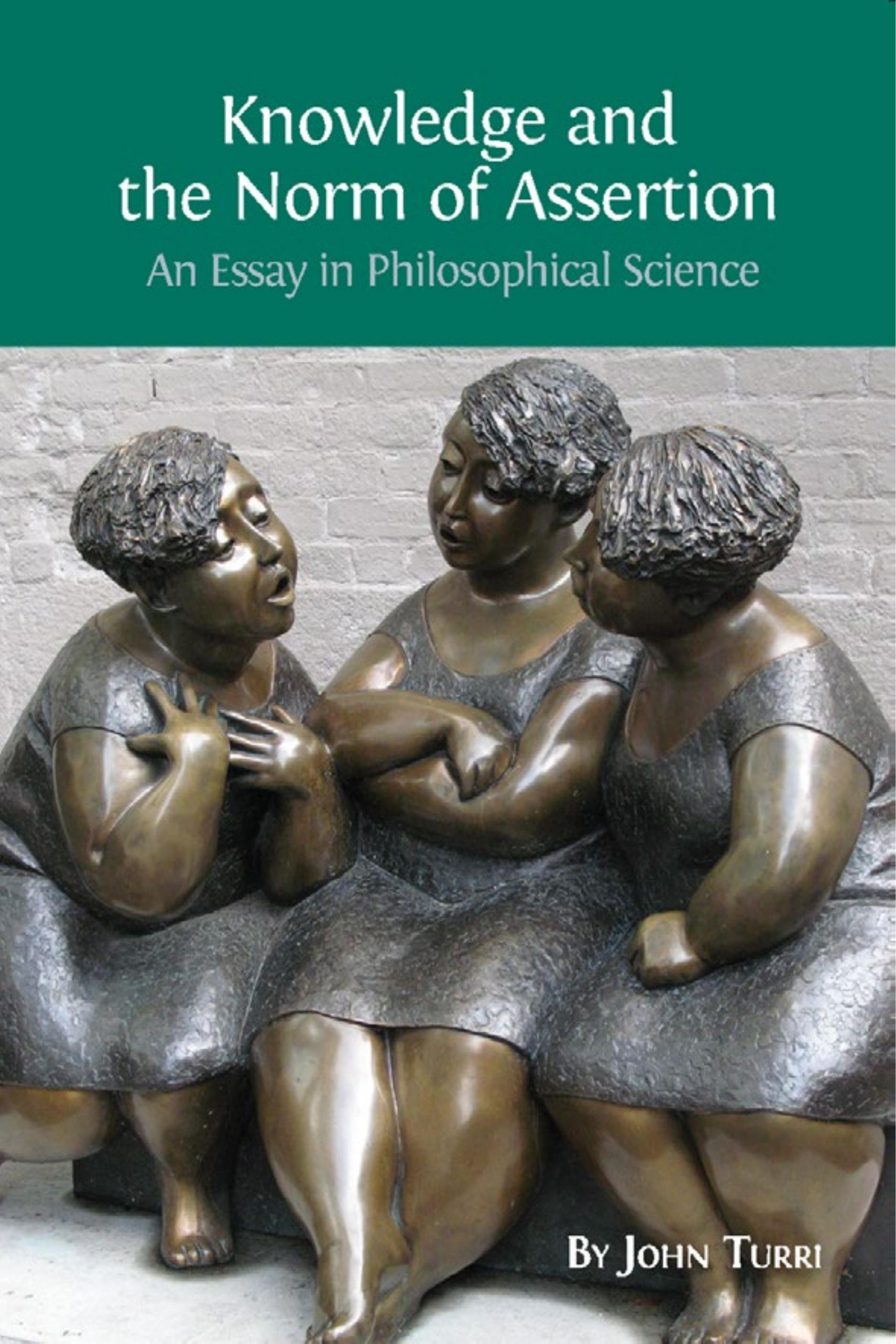
Book information
- Publisher
- Open Book Publishers
- Publication
- Published 26 February 2016
- Place
- Cambridge, UK
- Catalogue record
- View in the catalogue
Abstract
Language is a human universal reflecting our deeply social nature. Among its essential functions, language enables us to quickly and efficiently share information. We tell each other that many things are true—that is, we routinely make assertions. Information shared this way plays a critical role in the decisions and plans we make. In Knowledge and the Norm of Assertion, a distinguished philosopher and cognitive scientist investigates the rules or norms that structure our social practice of assertion. Combining evidence from philosophy, psychology, and biology, John Turri shows that knowledge is the central norm of assertion and explains why knowledge plays this role.
Concise, comprehensive, non-technical, and thoroughly accessible, this volume quickly brings readers to the cutting edge of a major research program at the intersection of philosophy and science. It presupposes no philosophical or scientific training. It will be of interest to philosophers and scientists, is suitable for use in graduate and undergraduate courses, and will appeal to general readers interested in human nature, social cognition, and communication.
Chapters
| Chapter | Author | Institution at publication |
|---|---|---|
| Introduction | John Turri | University of Waterloo |
| 1. Evidence and Argument | John Turri | University of Waterloo |
| 2. Extensions and Connections | John Turri | University of Waterloo |
| 3. Objections and Replies | John Turri | University of Waterloo |
| 4. Prospects and Horizons | John Turri | University of Waterloo |
| Coda | John Turri | University of Waterloo |
Where its authors and editors are based
Countries of the institutions the book's authors, editors and chapter authors were affiliated to when it was published.
- AUTHORS / EDITORS
- CITATIONS Phase 2
- USAGE Phase 3
| Country | Authors / editors |
|---|---|
| Canada | 1 |
About this data
These figures cover 7 works. Each value comes from the most trusted source that has it; a correction made by OJC or OBC staff outranks every source.
| Source | Confidence | Works |
|---|---|---|
| Thoth | 90 / 100 | 7 |
| Works with a publication date | 100% |
|---|---|
| Works with a DOI | 100% |
| Works with a funder recorded | 14% |
| Authors with an affiliation | 100% |
| Affiliations matched to an institution (ROR) | 100% |
| Affiliations with a country | 100% |
Countries come from the institution each author was affiliated to when they published, as recorded in ROR. A country is never guessed, so authors without a matched institution are not counted on the maps.
Funders come from OpenAlex for articles and Thoth for books, where publishers recorded them. Most works record none, so a funder's figures show what is recorded, not everything it funded.
Chapters count as works: their authors and editors, and the countries of their institutions, are in every figure where Thoth records an affiliation for them.
Citations (Phase 2) and usage (Phase 3) are not collected yet.