Book view
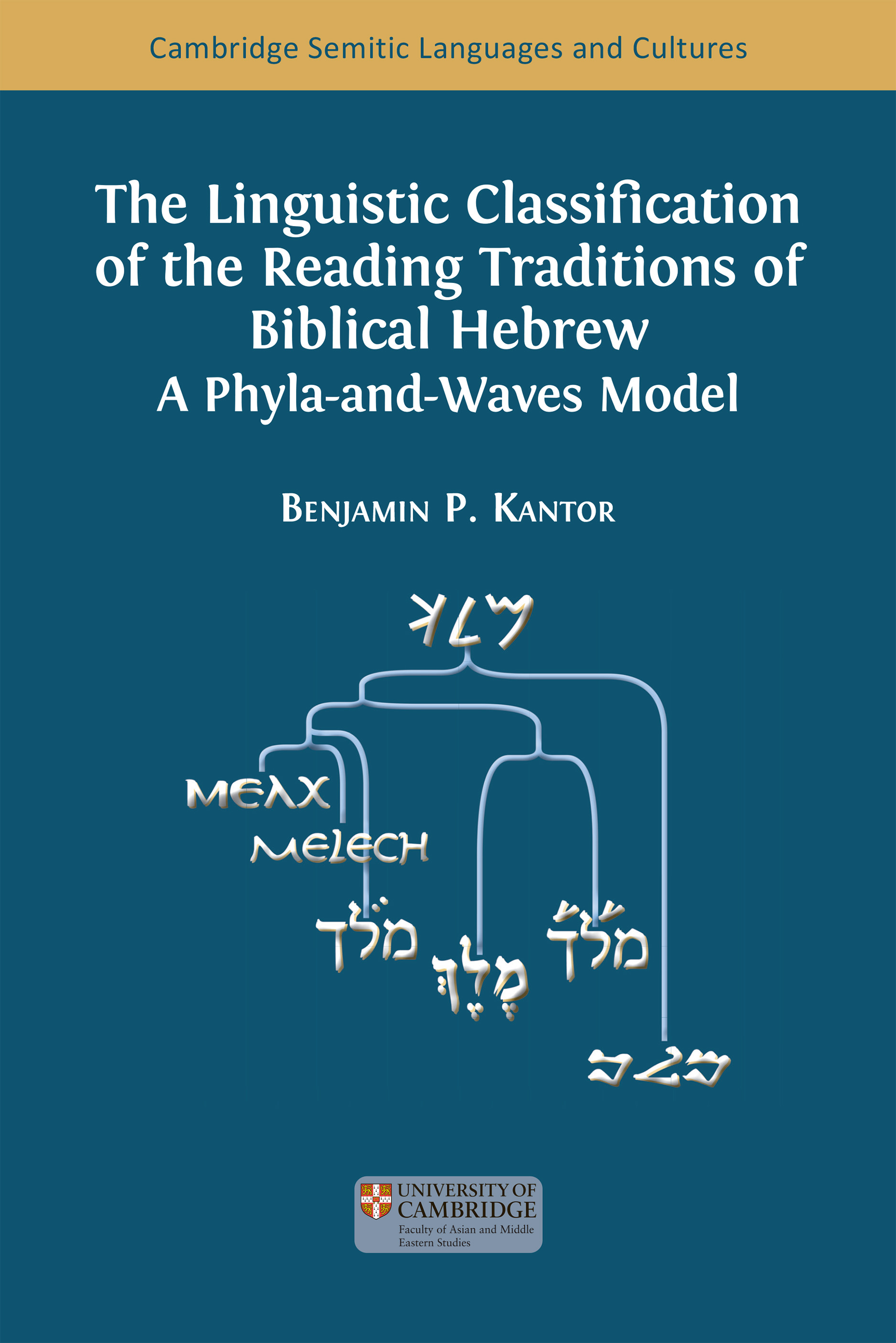
The Linguistic Classification of the Reading Traditions of Biblical Hebrew
A Phyla-and-Waves Model
Book information
- Publisher
- Open Book Publishers
- Publication
- Published 30 August 2023
- Place
- Cambridge, UK
- Series
- Semitic Languages and Cultures
- Catalogue record
- View in the catalogue
Abstract
In recent decades, the field of Biblical Hebrew philology and linguistics has been witness to a growing interest in the diverse traditions of Biblical Hebrew. Indeed, while there is a tendency for many students and scholars to conceive of Biblical Hebrew as equivalent with the Tiberian pointing of the Leningrad Codex as it appears in Biblia Hebraica Stuttgartensia (BHS), there are many other important reading traditions attested throughout history.
Origen’s Secunda reflects a late Roman reading tradition of Biblical Hebrew transcribed into Greek letters. Occasional transcriptions of Biblical Hebrew into Latin letters in Jerome’s commentaries similarly reflect a reading tradition from early Byzantine Palestine. In the medieval period, alongside Tiberian Hebrew we also find the Babylonian tradition and the Palestinian tradition. The modern oral reading tradition of the Samaritan community also likely has roots in the Second Temple period.
Aside from these primary attestations of the reading traditions, there are a whole host of other modern reading traditions of Biblical Hebrew, from Ashkenazi, to Sephardi, and Yemenite. Despite the rich diversity of traditions of Biblical Hebrew at our fingertips, the linguistic relationship between them has never been mapped out. In this book, then, the phyla-and-waves methodology, which has been used for Semitic language classification, is used to map out the relationship between the main reading traditions of Biblical Hebrew throughout history.
Chapters
| Chapter | Author | Institution at publication |
|---|---|---|
| 1. Introduction | Benjamin Paul Kantor | University of Cambridge |
| 2. Methodology | Benjamin Paul Kantor | University of Cambridge |
| 3. The Historical Attestations of the Biblical Hebrew Reading Traditions | Benjamin Paul Kantor | University of Cambridge |
| 4. PHYLA: ‘Shared Innovations’ among the Reading Traditions | Benjamin Paul Kantor | University of Cambridge |
| 5. WAVES: Influence, Contact, and Convergence | Benjamin Paul Kantor | University of Cambridge |
| 6. Relationship of the Reading Traditions | Benjamin Paul Kantor | University of Cambridge |
Where its authors and editors are based
Countries of the institutions the book's authors, editors and chapter authors were affiliated to when it was published.
- AUTHORS / EDITORS
- CITATIONS Phase 2
- USAGE Phase 3
| Country | Authors / editors |
|---|---|
| United Kingdom | 1 |
About this data
These figures cover 7 works. Each value comes from the most trusted source that has it; a correction made by OJC or OBC staff outranks every source.
| Source | Confidence | Works |
|---|---|---|
| Thoth | 90 / 100 | 7 |
| Works with a publication date | 100% |
|---|---|
| Works with a DOI | 100% |
| Works with a funder recorded | 0% |
| Authors with an affiliation | 100% |
| Affiliations matched to an institution (ROR) | 100% |
| Affiliations with a country | 100% |
Countries come from the institution each author was affiliated to when they published, as recorded in ROR. A country is never guessed, so authors without a matched institution are not counted on the maps.
Funders come from OpenAlex for articles and Thoth for books, where publishers recorded them. Most works record none, so a funder's figures show what is recorded, not everything it funded.
Chapters count as works: their authors and editors, and the countries of their institutions, are in every figure where Thoth records an affiliation for them.
Citations (Phase 2) and usage (Phase 3) are not collected yet.