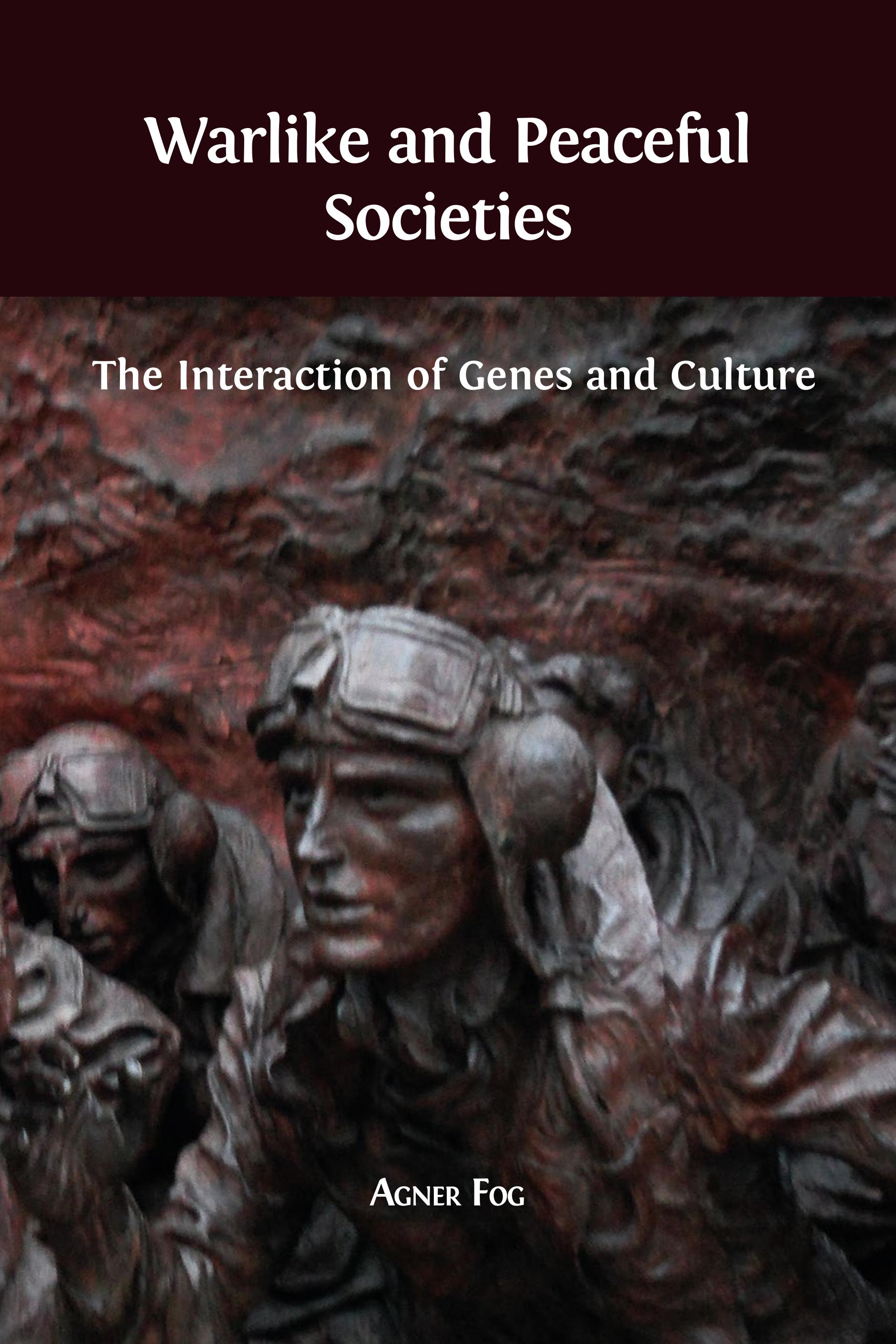
Book information
- Publisher
- Open Book Publishers
- Publication
- Published 16 October 2017
- Place
- Cambridge, UK
- Catalogue record
- View in the catalogue
Abstract
Are humans violent or peaceful by nature? We are both.
In this ambitious and wide-ranging book, Agner Fog presents a ground-breaking new argument that explains the existence of differently organised societies using evolutionary theory. It combines natural sciences and social sciences in a way that is rarely seen.
According to a concept called regality theory, people show a preference for authoritarianism and strong leadership in times of war or collective danger, but desire egalitarian political systems in times of peace and safety. These individual impulses shape the way societies develop and organise themselves, and in this book Agner argues that there is an evolutionary mechanism behind this flexible psychology. Incorporating a wide range of ideas including evolutionary theory, game theory, and ecological theory, Agner analyses the conditions that make us either strident or docile. He tests this theory on data from contemporary and ancient societies, and provides a detailed explanation of the applications of regality theory to issues of war and peace, the rise and fall of empires, the mass media, economic instability, ecological crisis, and much more.
Warlike and Peaceful Societies: The Interaction of Genes and Culture draws on many different fields of both the social sciences and the natural sciences. It will be of interest to academics and students in these fields, including anthropology, political science, history, conflict and peace research, social psychology, and more, as well as the natural sciences, including human biology, human evolution, and ecology.
Chapters
| Chapter | Author | Institution at publication |
|---|---|---|
| 1. Introduction | Agner Fog | Technical University of Denmark |
| 2. The Theory of Regal and Kungic Cultures | Agner Fog | Technical University of Denmark |
| 3. Contributions from Other Theories | Agner Fog | Technical University of Denmark |
| 4. Different Kinds of War in Human History | Agner Fog | Technical University of Denmark |
| 5. Economic Determinants of Conflict and Fear | Agner Fog | Technical University of Denmark |
| 6. Strategic Uses of Fear | Agner Fog | Technical University of Denmark |
| 7. Regality Theory Applied to Ancient Cultures | Agner Fog | Technical University of Denmark |
| 8. Statistical Testing of Regality Theory | Agner Fog | Technical University of Denmark |
| 9. Discussion and Conclusion | Agner Fog | Technical University of Denmark |
Where its authors and editors are based
Countries of the institutions the book's authors, editors and chapter authors were affiliated to when it was published.
- AUTHORS / EDITORS
- CITATIONS Phase 2
- USAGE Phase 3
| Country | Authors / editors |
|---|---|
| Denmark | 1 |
About this data
These figures cover 10 works. Each value comes from the most trusted source that has it; a correction made by OJC or OBC staff outranks every source.
| Source | Confidence | Works |
|---|---|---|
| Thoth | 90 / 100 | 10 |
| Works with a publication date | 100% |
|---|---|
| Works with a DOI | 100% |
| Works with a funder recorded | 0% |
| Authors with an affiliation | 100% |
| Affiliations matched to an institution (ROR) | 100% |
| Affiliations with a country | 100% |
Countries come from the institution each author was affiliated to when they published, as recorded in ROR. A country is never guessed, so authors without a matched institution are not counted on the maps.
Funders come from OpenAlex for articles and Thoth for books, where publishers recorded them. Most works record none, so a funder's figures show what is recorded, not everything it funded.
Chapters count as works: their authors and editors, and the countries of their institutions, are in every figure where Thoth records an affiliation for them.
Citations (Phase 2) and usage (Phase 3) are not collected yet.