Book view
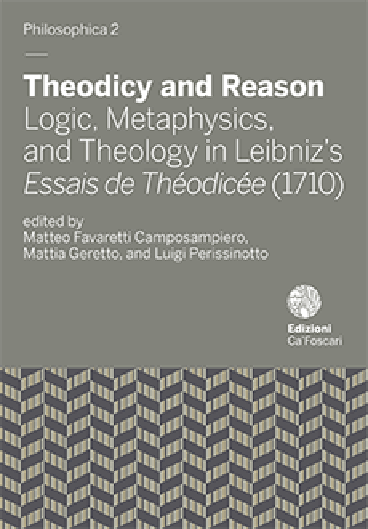
Theodicy and Reason
Logic, Metaphysics, and Theology in Leibniz’s Essais de Théodicée (1710)
Edited by Matteo Favaretti Camposampiero, Mattia Geretto, Luigi Perissinotto
Book information
- Publisher
- Edizioni Ca' Foscari
- Publication
- Published 30 June 2016
- Place
- Venice, Italy
- Series
- Philosophica. Nuova serie
- Catalogue record
- View in the catalogue
Abstract
Leibniz’s Theodicy is both a work of reason and a work on reason: reason as rational ground or justification, reason as universal order of the world, and reason as the human cognitive faculty, always in search of reasons. This book explores the depth of theodicean doctrines from the logical, metaphysical, and theological points of view. The first section is devoted to Leibniz’s argumentative style and rhetorical devices. The second section focuses on the metaphysical structures that underlie Leibniz’s vindication of God’s goodness. The third section offers new insights into Leibniz’s answer to one of the most difficult challenges faced by human reason: the existence of evil.
Where its authors and editors are based
Countries of the institutions the book's authors, editors and chapter authors were affiliated to when it was published.
- AUTHORS / EDITORS
- CITATIONS Phase 2
- USAGE Phase 3
| Country | Authors / editors |
|---|---|
| Italy | 3 |
About this data
These figures cover 1 work. Each value comes from the most trusted source that has it; a correction made by OJC or OBC staff outranks every source.
| Source | Confidence | Works |
|---|---|---|
| Thoth | 90 / 100 | 1 |
| Works with a publication date | 100% |
|---|---|
| Works with a DOI | 100% |
| Works with a funder recorded | 0% |
| Authors with an affiliation | 100% |
| Affiliations matched to an institution (ROR) | 100% |
| Affiliations with a country | 100% |
Countries come from the institution each author was affiliated to when they published, as recorded in ROR. A country is never guessed, so authors without a matched institution are not counted on the maps.
Funders come from OpenAlex for articles and Thoth for books, where publishers recorded them. Most works record none, so a funder's figures show what is recorded, not everything it funded.
Chapters count as works: their authors and editors, and the countries of their institutions, are in every figure where Thoth records an affiliation for them.
Citations (Phase 2) and usage (Phase 3) are not collected yet.