Book view
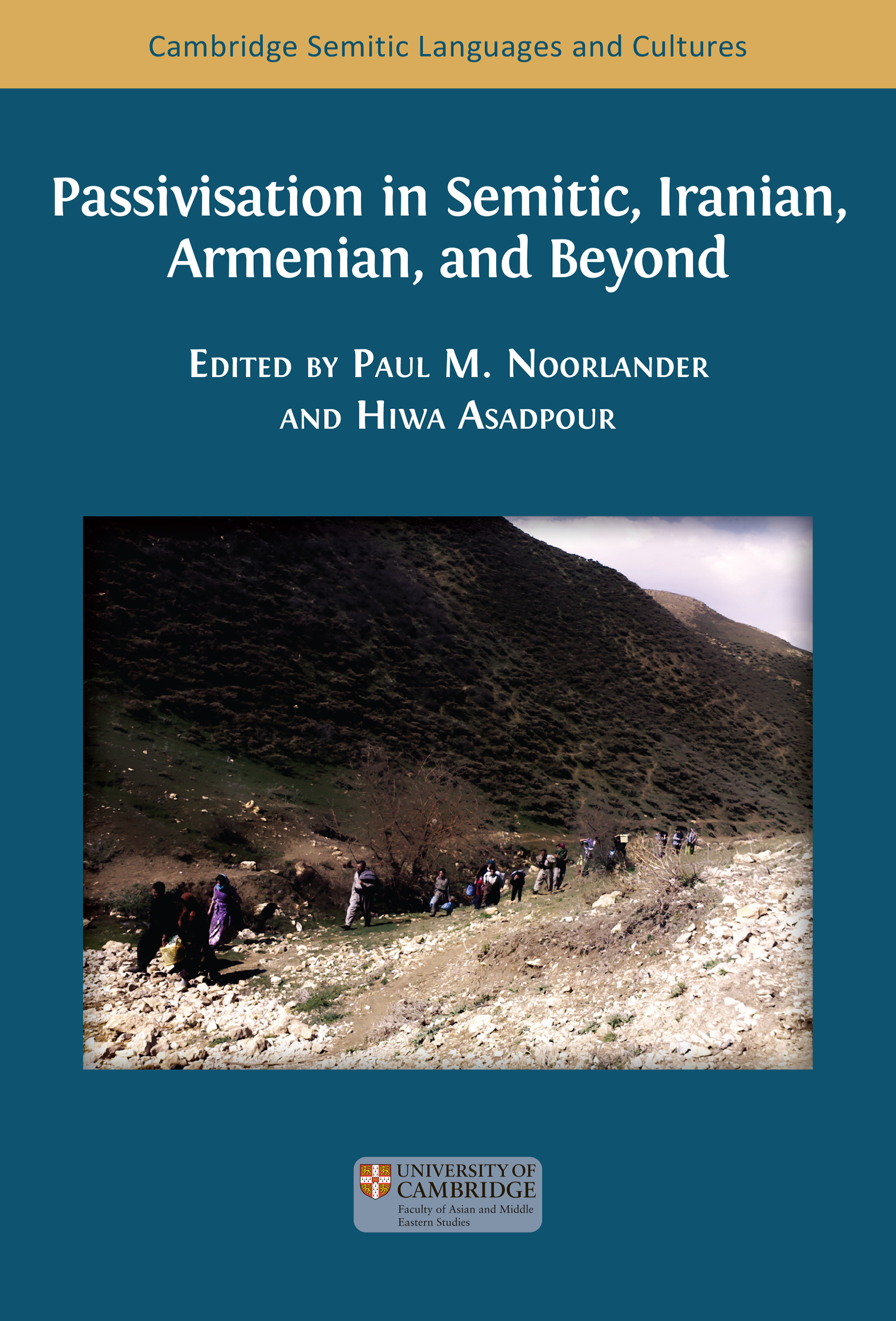
Passivisation in Semitic, Iranian, Armenian, and Beyond
Edited by Paul M. Noorlander, Hiwa Asadpour
Book information
- Publisher
- Open Book Publishers
- Publication
- Published 7 January 2026
- Place
- Cambridge, UK
- Series
- Semitic Languages and Cultures
- Catalogue record
- View in the catalogue
Abstract
This volume brings together research on passive voice constructions in low-resource languages of Western Asia, a region marked by extraordinary linguistic diversity as well as a long history of cultural suppression and marginalisation. The contributions showcase the passive voice in Semitic, Iranian, Armenian, Greek, and Turkic languages, many of which are endangered, understudied, or confined to diaspora communities and disappearing language islands. Education and cultural expression in these languages remained heavily restricted across parts of Turkey, Syria, Iraq, and Iran, underscoring the urgent need for documentation and revitalisation.
The chapters explore the rich typological variation of passive voice constructions, examining their typological traits, synchronic microvariation and diachronic developments. Drawing on Siewierska’s definition, the studies investigate processes of agent demotion and patient promotion, reductions in transitivity, and the fuzzy boundaries between passive and other detransitivisation strategies such as middles, anticausatives, statives and light verbs as well as impersonal subjects and agent omission. They also shed light on the impact of text genre, verbal aspect, and language contact on passivisation.
By integrating theoretical, typological, historical, and areal perspectives, the volume discusses the internal stability of detransitivisation strategies, their evolution from earlier source constructions, and their position in voice systems more broadly. It raises fundamental questions about whether cross-linguistic tendencies in passives reflect universal patterns or area-specific historical contingencies.
This collection thus provides an essential resource for scholars of all theoretical persuasions that are interested in voice and valency and/or in Western Asia’s linguistic diversity, while foregrounding the pressing need to support communities whose linguistic heritage is at risk.
Chapters
| Chapter | Author | Institution at publication |
|---|---|---|
| Introduction | Paul M. Noorlander, Hiwa Asadpour | University of Cambridge; Goethe University Frankfurt |
| 1. Passivisation in Semitic | Paul M. Noorlander | University of Cambridge |
| 2. Passive Voice in Ṭuroyo | Nikita Kuzin | |
| 3. Passivisation in Northeastern Neo-Aramaic | Paul M. Noorlander | University of Cambridge |
| 4. A Contact-Induced Structural Change with a Lexcial-Functional Asymmetry | Roohollah Mofidi, Hiwa Asadpour | Imam Khomeini International University; Goethe University Frankfurt |
| 5. Passive Constructions in Garrusi Kurdish | Hiwa Asadpour, Masoume Zarei | Goethe University Frankfurt; Allameh Tabataba'i University |
| 6. Passive in Armenian | Katherine Hodgson | University of Cambridge |
| 7. Passives in Asia Minor Greek | Nicolaos Neocleous | Aristotle University of Thessaloniki |
| 8. Passive Formation in Turkic | Murad Suleymanov | Institut National des Langues et Civilisations Orientales |
Where its authors and editors are based
Countries of the institutions the book's authors, editors and chapter authors were affiliated to when it was published.
- AUTHORS / EDITORS
- CITATIONS Phase 2
- USAGE Phase 3
| Country | Authors / editors |
|---|---|
| Iran | 2 |
| United Kingdom | 2 |
| France | 1 |
| Germany | 1 |
| Greece | 1 |
About this data
These figures cover 10 works. Each value comes from the most trusted source that has it; a correction made by OJC or OBC staff outranks every source.
| Source | Confidence | Works |
|---|---|---|
| Thoth | 90 / 100 | 10 |
| Works with a publication date | 100% |
|---|---|
| Works with a DOI | 100% |
| Works with a funder recorded | 0% |
| Authors with an affiliation | 93% |
| Affiliations matched to an institution (ROR) | 100% |
| Affiliations with a country | 100% |
Countries come from the institution each author was affiliated to when they published, as recorded in ROR. A country is never guessed, so authors without a matched institution are not counted on the maps.
Funders come from OpenAlex for articles and Thoth for books, where publishers recorded them. Most works record none, so a funder's figures show what is recorded, not everything it funded.
Chapters count as works: their authors and editors, and the countries of their institutions, are in every figure where Thoth records an affiliation for them.
Citations (Phase 2) and usage (Phase 3) are not collected yet.