Book view
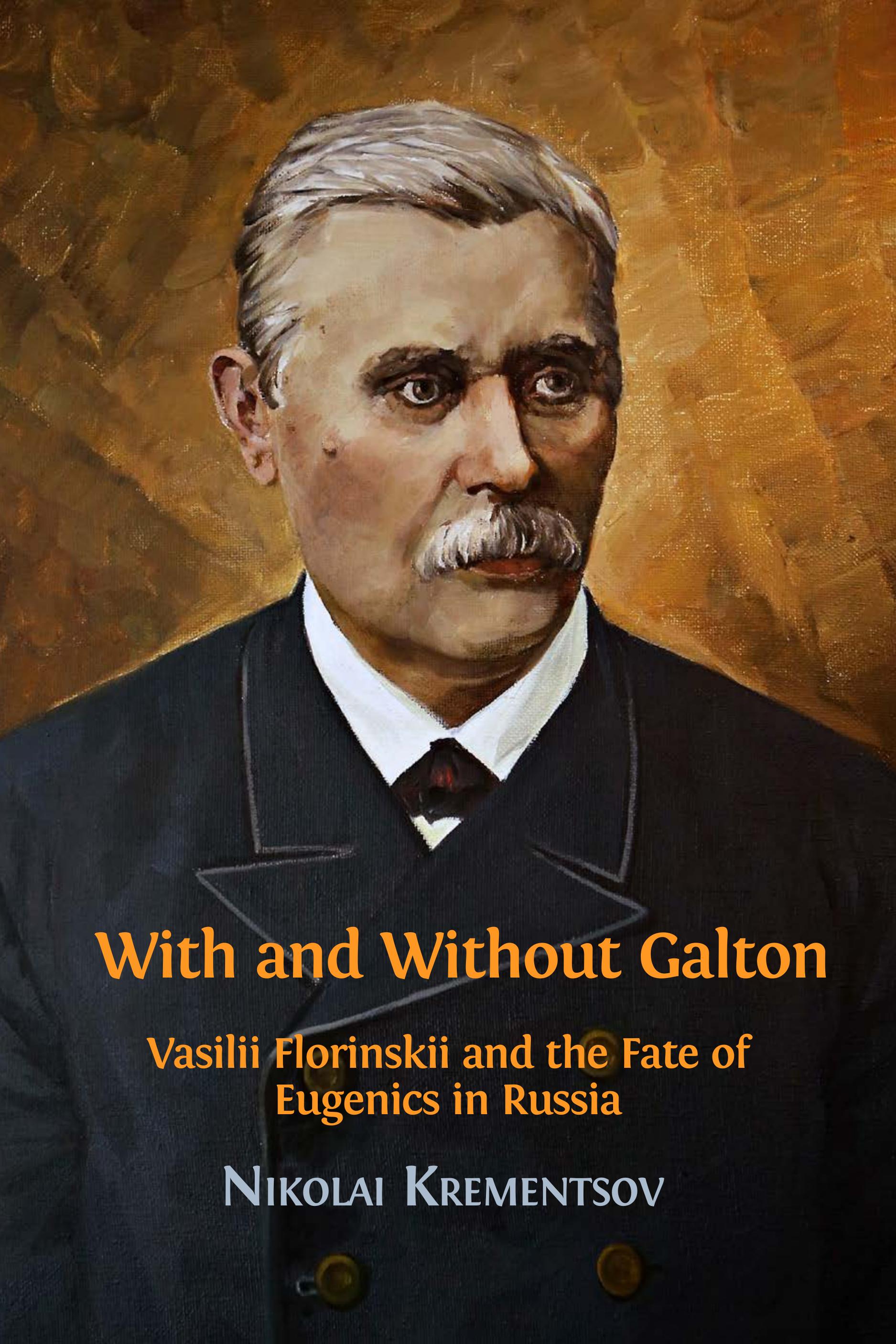
With and Without Galton
Vasilii Florinskii and the Fate of Eugenics in Russia
Book information
- Publisher
- Open Book Publishers
- Publication
- Published 24 September 2018
- Place
- Cambridge, UK
- Catalogue record
- View in the catalogue
Abstract
In 1865, British polymath Francis Galton published his initial thoughts about the scientific field that would become ‘eugenics.’ The same year, Russian physician Vasilii Florinskii addressed similar issues in a sizeable treatise, entitled Human Perfection and Degeneration. Initially unheralded, Florinskii’s book would go on to have a remarkable afterlife in twentieth- and twenty-first-century Russia. In this lucid and insightful work, Nikolai Krementsov argues that the concept of eugenics brings together ideas, values, practices, and fears energised by a focus on the future. It has proven so seductive to different groups over time because it provides a way to grapple with fundamental existential questions of human nature and destiny. With and Without Galton develops this argument by tracing the life-story of Florinskii’s monograph from its uncelebrated arrival amid the Russian empire’s Great Reforms, to its reissue after the Bolshevik Revolution, its decline under Stalinism, and its subsequent resurgence: first, as a founding document of medical genetics, and most recently, as a manifesto for nationalists and racial purists. Krementsov’s meticulously researched ‘biography of a book’ sheds light not only on the peculiar fate of eugenics in Russia, but also on its convoluted transnational history, elucidating the field’s protean nature and its continuing and contested appeal to diverse audiences, multiple local trajectories, and global trends. It is required reading for historians of eugenics, science, medicine, education, literature, and Russia, and it will also appeal to the general reader looking for a deeper understanding of this challenging subject.
Chapters
| Chapter | Author | Institution at publication |
|---|---|---|
| 1. The Author: Vasilii Florinskii | Nikolai Krementsov | University of Toronto |
| 2. The Publisher: Grigorii Blagosvetlov | Nikolai Krementsov | University of Toronto |
| 3. The Book: Darwinism and Social Hygiene | Nikolai Krementsov | University of Toronto |
| 4. The Hereafter: Words and Deeds | Nikolai Krementsov | University of Toronto |
| 5. Rebirth: Eugenics and Marxism | Nikolai Krementsov | University of Toronto |
| 6. Resonance: Euphenics, Medical Genetics, and Rassenhygiene | Nikolai Krementsov | University of Toronto |
| 7. Afterlife: Medical Genetics and “Racial” Eugenics | Nikolai Krementsov | University of Toronto |
| 8. Science of the Future: With and Without Galton | Nikolai Krementsov | University of Toronto |
| Apologia: The Historian’s Craft | Nikolai Krementsov | University of Toronto |
| Notes | Nikolai Krementsov | University of Toronto |
| The Faces of Eugenics: Local Mirrors and Global Reflections | Nikolai Krementsov | University of Toronto |
Where its authors and editors are based
Countries of the institutions the book's authors, editors and chapter authors were affiliated to when it was published.
- AUTHORS / EDITORS
- CITATIONS Phase 2
- USAGE Phase 3
| Country | Authors / editors |
|---|---|
| Canada | 1 |
About this data
These figures cover 12 works. Each value comes from the most trusted source that has it; a correction made by OJC or OBC staff outranks every source.
| Source | Confidence | Works |
|---|---|---|
| Thoth | 90 / 100 | 12 |
| Works with a publication date | 100% |
|---|---|
| Works with a DOI | 100% |
| Works with a funder recorded | 8% |
| Authors with an affiliation | 100% |
| Affiliations matched to an institution (ROR) | 100% |
| Affiliations with a country | 100% |
Countries come from the institution each author was affiliated to when they published, as recorded in ROR. A country is never guessed, so authors without a matched institution are not counted on the maps.
Funders come from OpenAlex for articles and Thoth for books, where publishers recorded them. Most works record none, so a funder's figures show what is recorded, not everything it funded.
Chapters count as works: their authors and editors, and the countries of their institutions, are in every figure where Thoth records an affiliation for them.
Citations (Phase 2) and usage (Phase 3) are not collected yet.