Book view
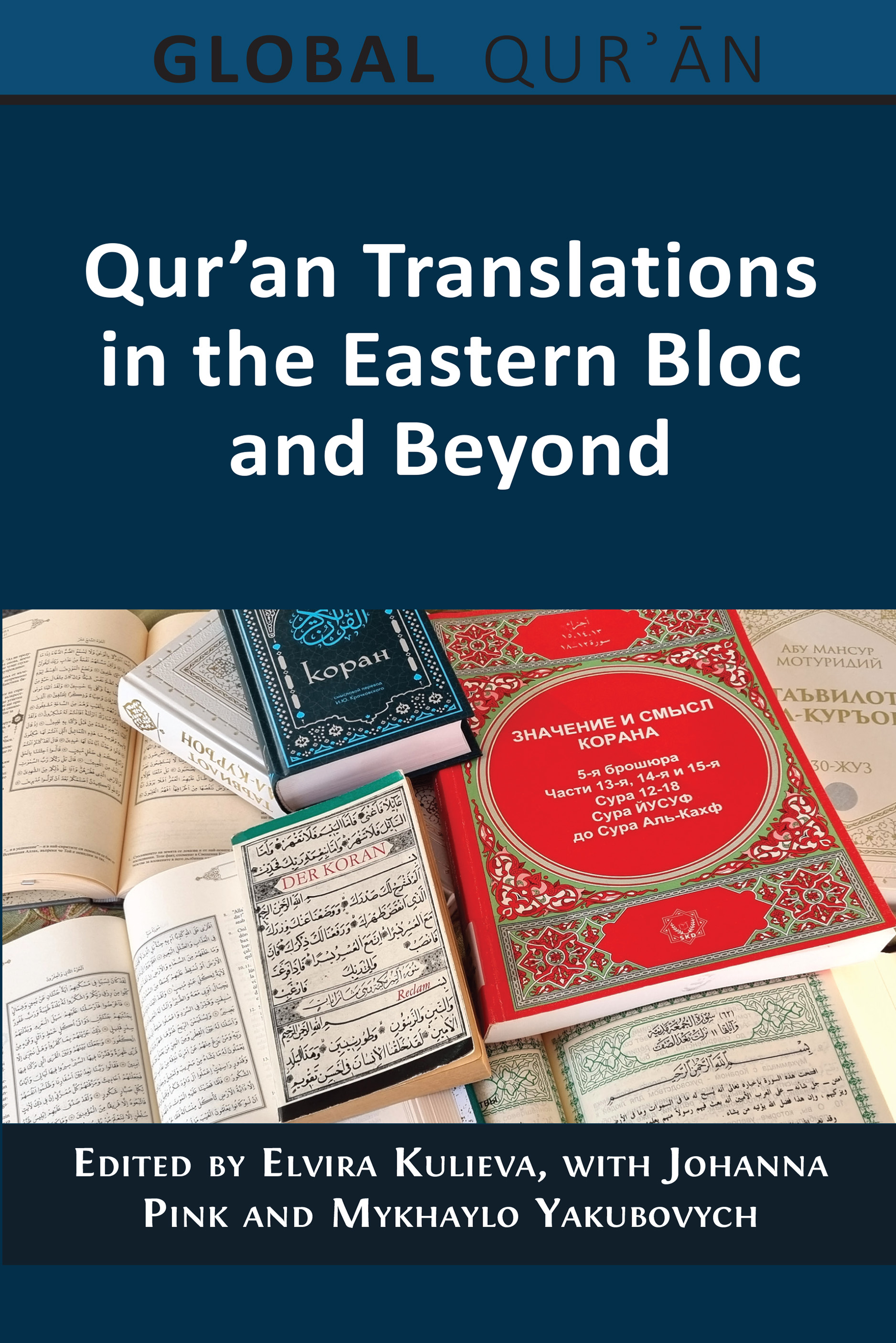
Qur’an Translations in the Eastern Bloc and Beyond
Edited by Elvira Kulieva, Johanna Pink, Mykhaylo Yakubovych
Book information
- Publisher
- Open Book Publishers
- Publication
- Published 21 May 2025
- Place
- Cambridge, UK
- Series
- The Global Qur'an
- Catalogue record
- View in the catalogue
Abstract
This book offers the first comprehensive exploration of Qur’an translations across the diverse landscapes of the former Eastern Bloc, from Uzbekistan to the German Democratic Republic. With a focus on how Islamic texts have been shaped by state policies, ideological shifts, and religious identities, it traces connections between these regions and the wider world, including Saudi Arabia, Turkey, and China. This volume draws on perspectives from both Sunni and Shia traditions, as well as contributions by non-Muslim scholars. Through archival research and close textual analysis, the contributors demonstrate how translations of the Qur’an have served not only as religious texts but also as reflections of profound transformations in national and religious identities in communist and post-communist societies.
Qur’an translations have gained prominence within the modern Muslim publishing world, and their analysis reveals a dynamic interplay between local politics and global Islamic discourse. They have become symbols of religious resurgence, cultural renewal, and intellectual exchange—but also objects of persecution and contestation. Based on multilingual sources, this collection is an essential resource for understanding Qur’an translations as a significant scholarly and cultural phenomenon in the modern era.
Chapters
| Chapter | Author | Institution at publication |
|---|---|---|
| Introduction | Elvira Kulieva, Johanna Pink | University of Freiburg |
| 1. Hybrid Subjectivity in a Translation of the Qur’an | Alfrid Bustanov | |
| 2. ‘Vernacular Qur’anic Space’ within Post-Soviet Uzbekistan | Filipp Khusnutdinov | al-Biruni Institute of Oriental Studies Academy of Sciences of the Republic of Uzbekistan |
| 3. ‘I Quenched the Thirst of Seventy Million’ | Elvira Kulieva | University of Freiburg |
| 4. The State, ‘Official’ ʿUlamāʾ and Tatar Qur’an Commentary-Translations in Russia | Elmira Akhmetova | Institute of Knowledge Integration |
| 5. A ‘Qur’an Race’ in the Cold War | Johanna Pink | University of Freiburg |
| 6. Constructing a Qur’an-Based sīra in Post-Soviet Azerbaijan | Elnura Azizova | Azerbaijan Institute of Theology |
| 7. Implications of Theological Diversity in Shii-Authored Translations of the Qur’an and tafsīrs into Russian | Akif Tahiiev | Goethe University Frankfurt |
Where its authors and editors are based
Countries of the institutions the book's authors, editors and chapter authors were affiliated to when it was published.
- AUTHORS / EDITORS
- CITATIONS Phase 2
- USAGE Phase 3
| Country | Authors / editors |
|---|---|
| Germany | 4 |
| Azerbaijan | 1 |
| Uzbekistan | 1 |
About this data
These figures cover 9 works. Each value comes from the most trusted source that has it; a correction made by OJC or OBC staff outranks every source.
| Source | Confidence | Works |
|---|---|---|
| Thoth | 90 / 100 | 9 |
| Works with a publication date | 100% |
|---|---|
| Works with a DOI | 100% |
| Works with a funder recorded | 0% |
| Authors with an affiliation | 92% |
| Affiliations matched to an institution (ROR) | 73% |
| Affiliations with a country | 91% |
Countries come from the institution each author was affiliated to when they published, as recorded in ROR. A country is never guessed, so authors without a matched institution are not counted on the maps.
Funders come from OpenAlex for articles and Thoth for books, where publishers recorded them. Most works record none, so a funder's figures show what is recorded, not everything it funded.
Chapters count as works: their authors and editors, and the countries of their institutions, are in every figure where Thoth records an affiliation for them.
Citations (Phase 2) and usage (Phase 3) are not collected yet.