Book information
- Publisher
- Open Book Publishers
- Publication
- Published 13 November 2024
- Place
- Cambridge, UK
- Catalogue record
- View in the catalogue
Abstract
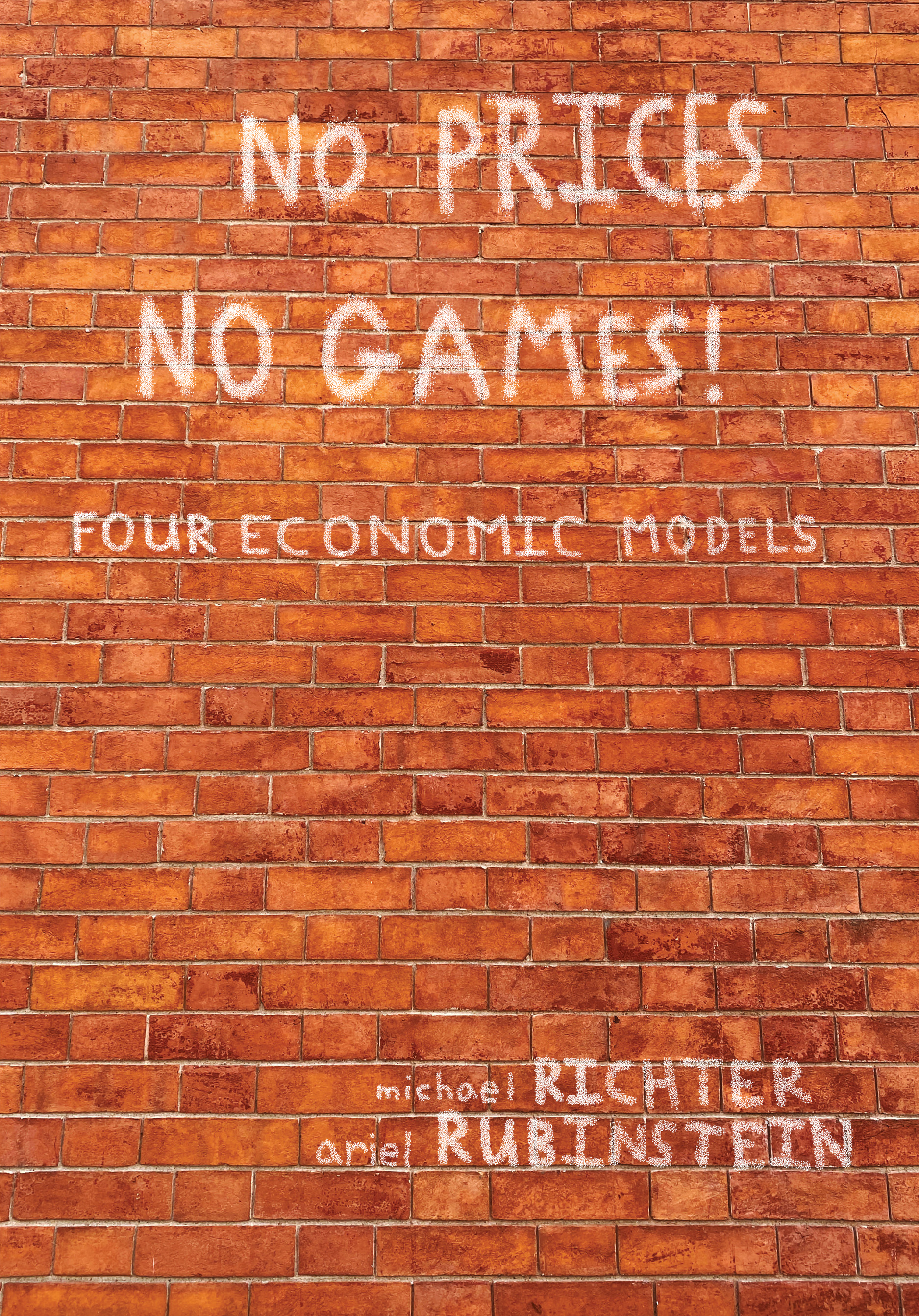
While current economic theory focuses on prices and games, this book models economic settings where harmony is established through one of the following societal conventions:
• A power relation according to which stronger agents are able to force weaker ones to do things against their will.
• A norm that categorizes actions as permissible or forbidden.
• A status relation over alternatives which limits each agent's choices.
• Systematic biases in agents' preferences.
These four conventions are analysed using simple and mathematically straightforward models, without any pretensions regarding direct applied usefulness. While we do not advocate for the adoption of any of these conventions specifically – we do advocate that when modelling an economic situation, alternative equilibrium notions should be considered, rather than automatically reaching for the familiar approaches of prices or games.
Chapters
| Chapter | Author | Institution at publication |
|---|---|---|
| 0. Introduction | Michael Richter, Ariel Rubinstein | Royal Holloway University of London; Tel Aviv University; New York University |
| 1. Equilibrium in the Jungle | Michael Richter, Ariel Rubinstein | Royal Holloway University of London; Tel Aviv University; New York University |
| 2. The Permissible and the Forbidden | Michael Richter, Ariel Rubinstein | Royal Holloway University of London; Tel Aviv University; New York University |
| 3. Status and Indoctrination | Michael Richter, Ariel Rubinstein | Royal Holloway University of London; Tel Aviv University; New York University |
| 4. Biased Preferences Equilibrium | Michael Richter, Ariel Rubinstein | Royal Holloway University of London; Tel Aviv University; New York University |
| 5. A Comparison to Game Theory | Michael Richter, Ariel Rubinstein | Royal Holloway University of London; Tel Aviv University; New York University |
Where its authors and editors are based
Countries of the institutions the book's authors, editors and chapter authors were affiliated to when it was published.
- AUTHORS / EDITORS
- CITATIONS Phase 2
- USAGE Phase 3
| Country | Authors / editors |
|---|---|
| Israel | 1 |
| United Kingdom | 1 |
| United States | 1 |
About this data
These figures cover 7 works. Each value comes from the most trusted source that has it; a correction made by OJC or OBC staff outranks every source.
| Source | Confidence | Works |
|---|---|---|
| Thoth | 90 / 100 | 7 |
| Works with a publication date | 100% |
|---|---|
| Works with a DOI | 100% |
| Works with a funder recorded | 0% |
| Authors with an affiliation | 100% |
| Affiliations matched to an institution (ROR) | 100% |
| Affiliations with a country | 100% |
Countries come from the institution each author was affiliated to when they published, as recorded in ROR. A country is never guessed, so authors without a matched institution are not counted on the maps.
Funders come from OpenAlex for articles and Thoth for books, where publishers recorded them. Most works record none, so a funder's figures show what is recorded, not everything it funded.
Chapters count as works: their authors and editors, and the countries of their institutions, are in every figure where Thoth records an affiliation for them.
Citations (Phase 2) and usage (Phase 3) are not collected yet.