Book view
Diachronic Variation in the Omani Arabic Vernacular of the Al-ʿAwābī District
From Carl Reinhardt (1894) to the Present Day
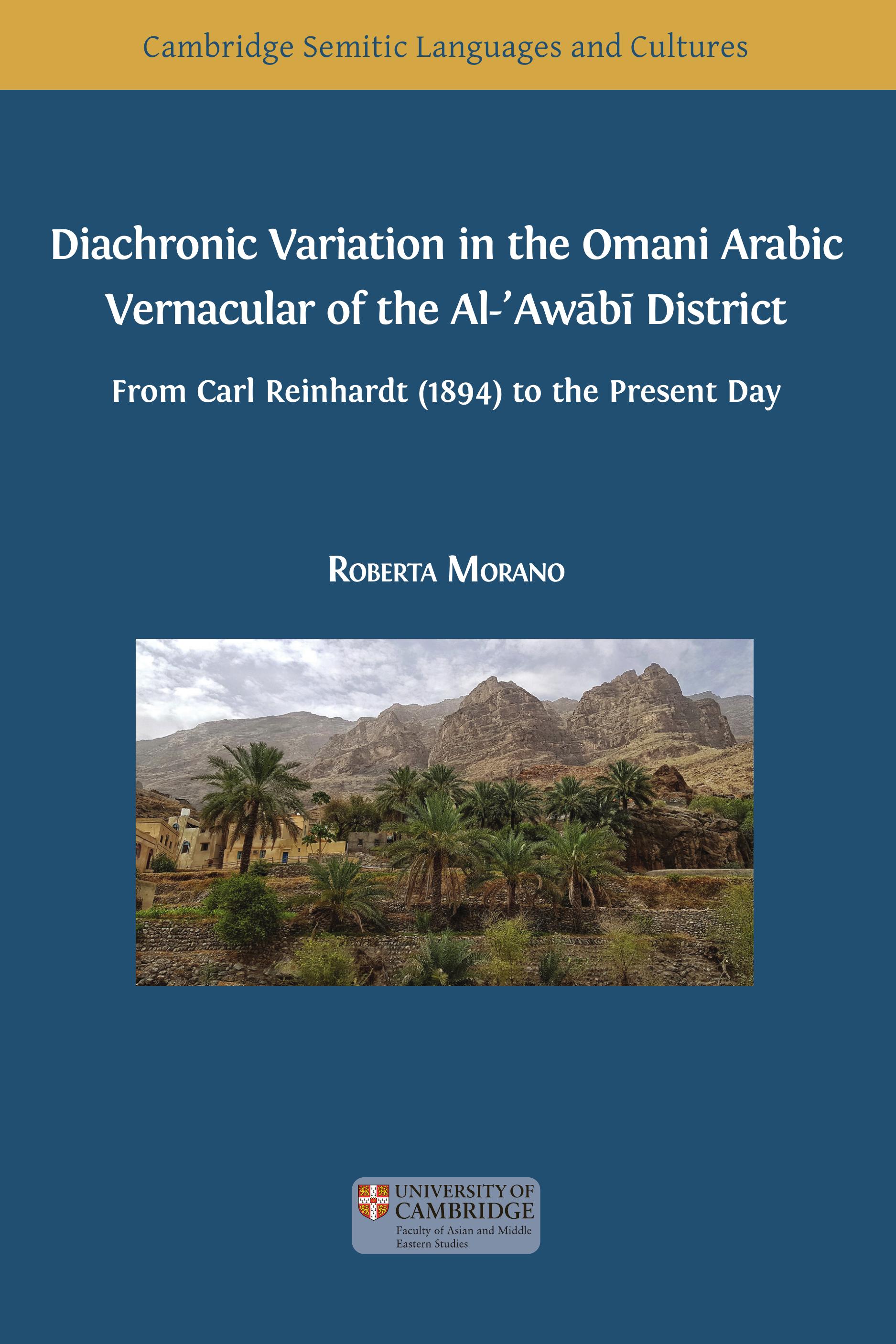
Book information
- Publisher
- Open Book Publishers
- Publication
- Published 13 October 2022
- Place
- Cambridge, UK
- Series
- Semitic Languages and Cultures
- Catalogue record
- View in the catalogue
Abstract
In this monograph, Roberta Morano re-examines one of the foundational works of the Omani Arabic dialectology field, Carl Reinhardt’s Ein arabischer Dialekt gesprochen in ‘Oman und Zanzibar (1894). This German-authored work was prolific in shaping our knowledge of Omani Arabic during the twentieth century, until the 1980s when more recent linguistic studies on the Arabic varieties spoken in Oman began to appear.
Motivated by an urgent need to expand and reinforce our understanding of Omani Arabic, the book provides a linguistic analysis of the Omani vernacular spoken in the al-ʿAwābī district (northern Oman), based on the speech of fifteen informants recruited throughout the area. It also provides a comparative analysis of the new data with that collected by Carl Reinhardt in 1894. This comparison enables the reader to appreciate the extent of diachronic linguistic variation in the region, and also sheds light on the threats that such variation poses to Omani-specific linguistic features.
Organised in four chapters, the book presents a sociolinguistic analysis of the Omani linguistic landscape followed by an examination of the phonology, morphology, and syntax of the al-ʿAwābī vernacular. Each chapter contains primary data collected by the author in situ compared, when applicable, with Carl Reinhardt’s materials. The appendix includes two sample texts extrapolated from the recordings, fourteen proverbs and one traditional song. This study will be of interest to those working in the fields of Omani Arabic, historical and comparative linguistics, translation and interpretation, or those with an interest in how languages develop over time.
Chapters
| Chapter | Author | Institution at publication |
|---|---|---|
| Introduction | Roberta Morano | University of Leeds |
| Chapter 1 | Roberta Morano | University of Leeds |
| Chapter 2 | Roberta Morano | University of Leeds |
| Chapter 3 | Roberta Morano | University of Leeds |
| Chapter 4 | Roberta Morano | University of Leeds |
| Appendix | Roberta Morano | University of Leeds |
| Conclusion | Roberta Morano | University of Leeds |
Where its authors and editors are based
Countries of the institutions the book's authors, editors and chapter authors were affiliated to when it was published.
- AUTHORS / EDITORS
- CITATIONS Phase 2
- USAGE Phase 3
| Country | Authors / editors |
|---|---|
| United Kingdom | 1 |
About this data
These figures cover 8 works. Each value comes from the most trusted source that has it; a correction made by OJC or OBC staff outranks every source.
| Source | Confidence | Works |
|---|---|---|
| Thoth | 90 / 100 | 8 |
| Works with a publication date | 100% |
|---|---|
| Works with a DOI | 100% |
| Works with a funder recorded | 0% |
| Authors with an affiliation | 100% |
| Affiliations matched to an institution (ROR) | 100% |
| Affiliations with a country | 100% |
Countries come from the institution each author was affiliated to when they published, as recorded in ROR. A country is never guessed, so authors without a matched institution are not counted on the maps.
Funders come from OpenAlex for articles and Thoth for books, where publishers recorded them. Most works record none, so a funder's figures show what is recorded, not everything it funded.
Chapters count as works: their authors and editors, and the countries of their institutions, are in every figure where Thoth records an affiliation for them.
Citations (Phase 2) and usage (Phase 3) are not collected yet.