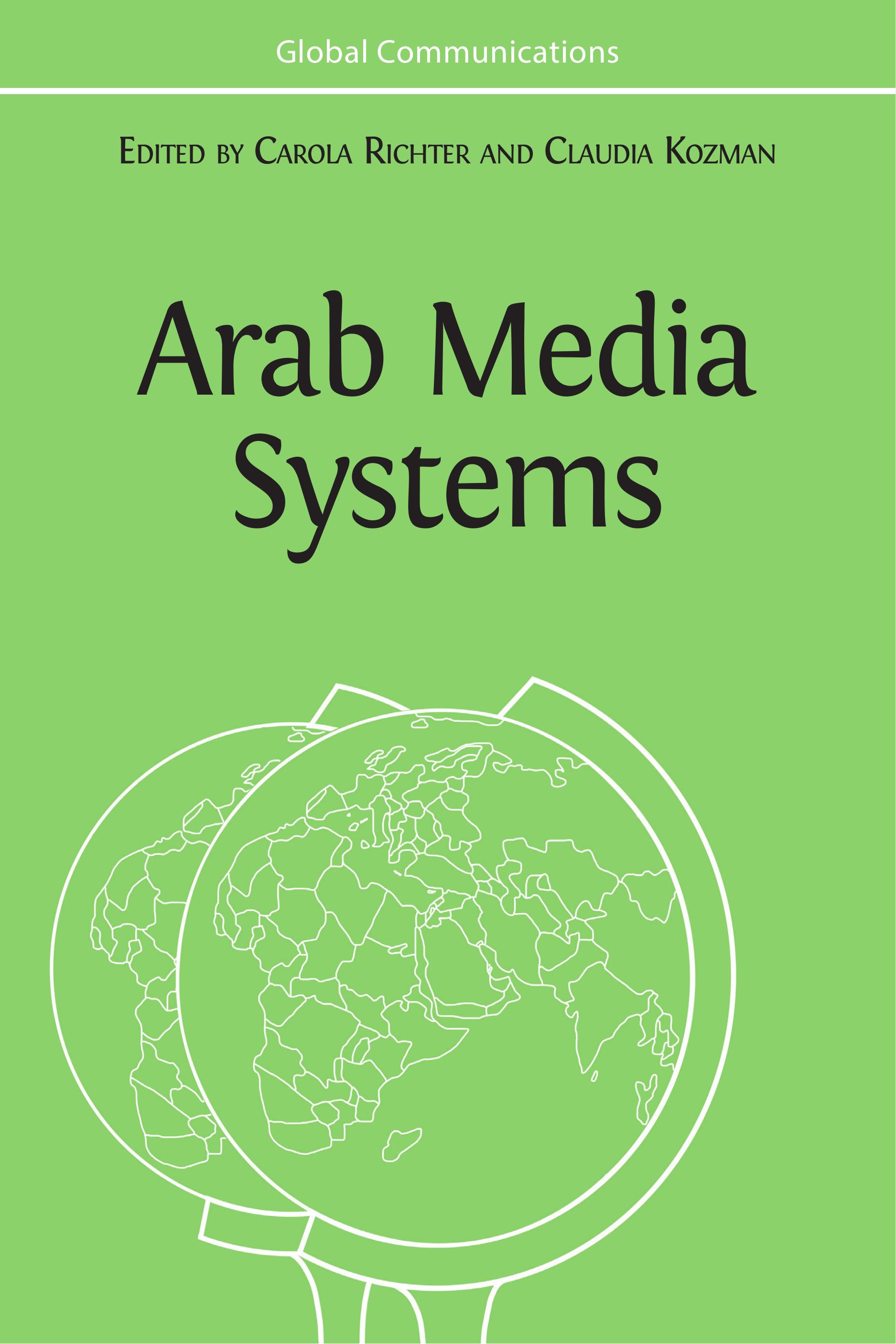
Book information
- Publisher
- Open Book Publishers
- Publication
- Published 3 March 2021
- Place
- Cambridge, UK
- Series
- Global Communications
- Catalogue record
- View in the catalogue
Abstract
This volume provides a comparative analysis of media systems in the Arab world, based on criteria informed by the historical, political, social, and economic factors influencing a country’s media. Reaching beyond classical western media system typologies, 'Arab Media Systems' brings together contributions from experts in the field of media in the Middle East and North Africa (MENA) to provide valuable insights into the heterogeneity of this region’s media systems. It focuses on trends in government stances towards media, media ownership models, technological innovation, and the role of transnational mobility in shaping media structure and practices.
Each chapter in the volume traces a specific country’s media – from Lebanon to Morocco – and assesses its media system in terms of historical roots, political and legal frameworks, media economy and ownership patterns, technology and infrastructure, and social factors (including diversity and equality in gender, age, ethnicities, religions, and languages).
This book is a welcome contribution to the field of media studies, constituting the only edited collection in recent years to provide a comprehensive and systematic overview of Arab media systems. As such, it will be of great use to students and scholars in media, journalism and communication studies, as well as political scientists, sociologists, and anthropologists with an interest in the MENA region.
This volume provides a comparative analysis of media systems in the Arab world, based on criteria informed by the historical, political, social, and economic factors influencing a country’s media. Reaching beyond classical western media system typologies, Arab Media Systems brings together contributions from experts in the field of media in the Middle East and North Africa (MENA) to provide valuable insights into the heterogeneity of this region’s media systems. It focuses on trends in government stances towards media, media ownership models, technological innovation, and the role of transnational mobility in shaping media structure and practices.
Each chapter in the volume traces a specific country’s media – from Lebanon to Morocco – and assesses its media system in terms of historical roots, political and legal frameworks, media economy and ownership patterns, technology and infrastructure, and social factors (including diversity and equality in gender, age, ethnicities, religions, and languages).
This book is a welcome contribution to the field of media studies, constituting the only edited collection in recent years to provide a comprehensive and systematic overview of Arab media systems. As such, it will be of great use to students and scholars in media, journalism and communication studies, as well as political scientists, sociologists, and anthropologists with an interest in the MENA region.
Chapters
| Chapter | Author | Institution at publication |
|---|---|---|
| Introduction | Carola Richter, Claudia Kozman | Freie Universität Berlin; Lebanese American University |
| 1. Lebanon | Sarah El-Richani | American University in Cairo |
| 2. Syria | Yazan Badran | Vrije Universiteit Brussel |
| 3. Palestine | Gretchen King | Lebanese American University |
| 4. Jordan | Basim Tweissi | Jordan Media Institute |
| 5. Iraq | Sahar Khalifa Salim | Iraqi University |
| 6. Saudi Arabia | Marwan M. Kraidy | Northwestern University in Qatar; Northwestern University |
| 7. United Arab Emirates | Mohammad Ayish | American University of Sharjah |
| 8. Qatar | Ehab Galal | University of Copenhagen |
| 9. Bahrain | Marc Owen Jones | Hamad bin Khalifa University |
| 10. Kuwait | Fatima Alsalem | Kuwait University |
| 11. Oman | Abdullah K. Al-Kindi | Sultan Qaboos University |
| 12. Yemen | Abdulrahman M. Al-Shami | Qatar University |
| 13. Egypt | Hanan Badr | Gulf University for Science & Technology; Cairo University |
| 14. Sudan | Mahmoud M. Galander | |
| 15. Libya | Carola Richter | Freie Universität Berlin |
| 16. Tunisia | Noureddine Miladi | Qatar University |
| 17. Algeria | Nacer-Eddine Layadi | University of Algiers 3 |
| 18. Morocco | Bouziane Zaid, Mohammed Ibahrine | University of Sharjah; American University of Sharjah |
| Conclusion | Carola Richter, Claudia Kozman | Freie Universität Berlin; Lebanese American University |
Where its authors and editors are based
Countries of the institutions the book's authors, editors and chapter authors were affiliated to when it was published.
- AUTHORS / EDITORS
- CITATIONS Phase 2
- USAGE Phase 3
About this data
These figures cover 21 works. Each value comes from the most trusted source that has it; a correction made by OJC or OBC staff outranks every source.
| Source | Confidence | Works |
|---|---|---|
| Thoth | 90 / 100 | 21 |
| Works with a publication date | 100% |
|---|---|
| Works with a DOI | 100% |
| Works with a funder recorded | 5% |
| Authors with an affiliation | 96% |
| Affiliations matched to an institution (ROR) | 100% |
| Affiliations with a country | 100% |
Countries come from the institution each author was affiliated to when they published, as recorded in ROR. A country is never guessed, so authors without a matched institution are not counted on the maps.
Funders come from OpenAlex for articles and Thoth for books, where publishers recorded them. Most works record none, so a funder's figures show what is recorded, not everything it funded.
Chapters count as works: their authors and editors, and the countries of their institutions, are in every figure where Thoth records an affiliation for them.
Citations (Phase 2) and usage (Phase 3) are not collected yet.