Book view
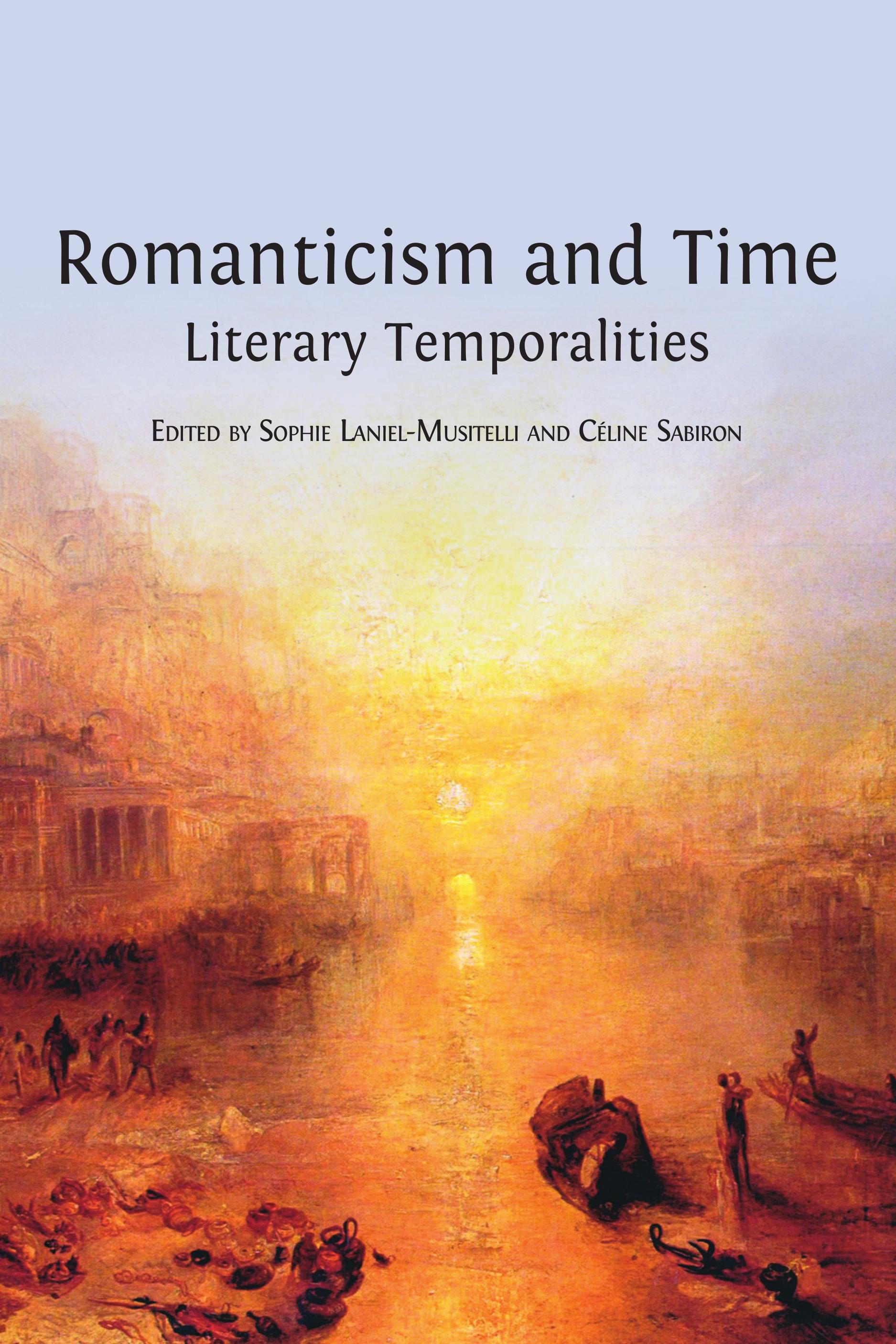
Romanticism and Time
Literary Temporalities
Edited by Sophie Laniel-Musitelli, Céline Sabiron
Book information
- Publisher
- Open Book Publishers
- Publication
- Published 10 March 2021
- Place
- Cambridge, UK
- Catalogue record
- View in the catalogue
Abstract
‘Eternity is in love with the productions of time’. This original edited volume takes William Blake’s aphorism as a basis to explore how British Romantic literature creates its own sense of time. It considers Romantic poetry as embedded in and reflecting on the march of time, regarding it not merely as a reaction to the course of events between the late-eighteenth and mid-nineteenth centuries, but also as a form of creative engagement with history in the making.
The authors offer a comprehensive overview of the question of time from a literary perspective, applying a diverse range of critical approaches to Romantic authors from William Blake and Percy Shelley to John Clare and Samuel Rodgers. Close readings uncover fresh insights into these authors and their works, including Frankenstein, the most familiar of Romantic texts.
Revising current thinking about periodisation, the authors explore how the Romantic poetics of time bears witness to the ruptures and dislocations at work within chronological time. They consider an array of topics, such as ecological time, futurity, operatic time, or the a-temporality of Venice. As well as surveying the Romantic canon’s evolution over time, these essays approach it as a phenomenon unfolding across national borders. Romantic authors are compared with American or European counterparts including Beethoven, Irving, Nietzsche and Beckett.
Romanticism and Time will be of great value to literary scholars and students working in Romantic Studies. It will be of further interest to philosophers and historians working on the connections between philosophy, history and literature during the nineteenth century.
Chapters
Where its authors and editors are based
Countries of the institutions the book's authors, editors and chapter authors were affiliated to when it was published.
- AUTHORS / EDITORS
- CITATIONS Phase 2
- USAGE Phase 3
| Country | Authors / editors |
|---|---|
| United Kingdom | 6 |
| France | 5 |
| United States | 3 |
| Czechia | 1 |
| Germany | 1 |
| Switzerland | 1 |
About this data
These figures cover 13 works. Each value comes from the most trusted source that has it; a correction made by OJC or OBC staff outranks every source.
| Source | Confidence | Works |
|---|---|---|
| Thoth | 90 / 100 | 13 |
| Works with a publication date | 100% |
|---|---|
| Works with a DOI | 100% |
| Works with a funder recorded | 0% |
| Authors with an affiliation | 100% |
| Affiliations matched to an institution (ROR) | 100% |
| Affiliations with a country | 100% |
Countries come from the institution each author was affiliated to when they published, as recorded in ROR. A country is never guessed, so authors without a matched institution are not counted on the maps.
Funders come from OpenAlex for articles and Thoth for books, where publishers recorded them. Most works record none, so a funder's figures show what is recorded, not everything it funded.
Chapters count as works: their authors and editors, and the countries of their institutions, are in every figure where Thoth records an affiliation for them.
Citations (Phase 2) and usage (Phase 3) are not collected yet.