Book view
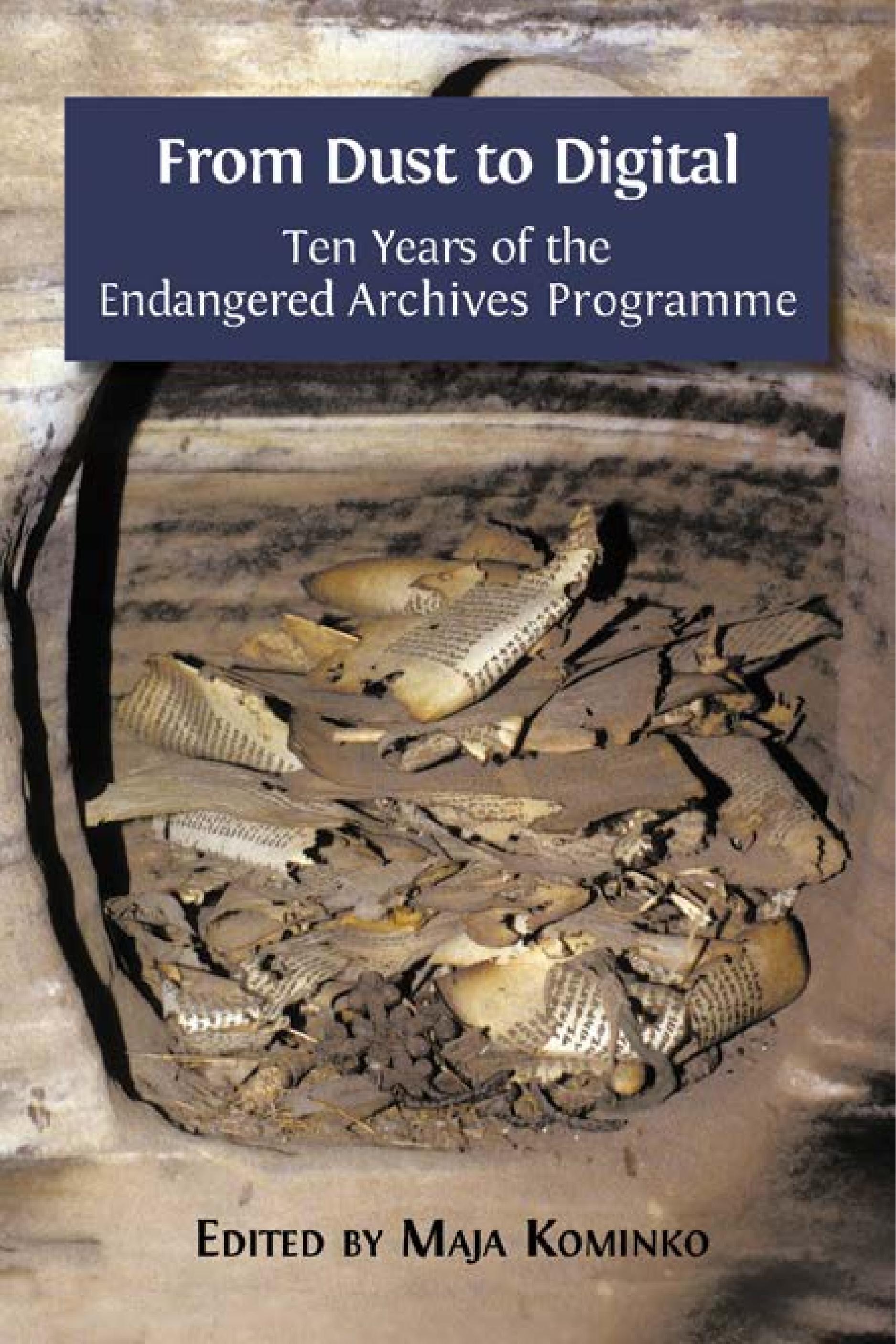
From Dust to Digital
Ten Years of the Endangered Archives Programme
Edited by Maja Kominko
Book information
- Publisher
- Open Book Publishers
- Publication
- Published 16 February 2015
- Place
- Cambridge, UK
- Catalogue record
- View in the catalogue
Abstract
Much of world’s documentary heritage rests in vulnerable, little-known and often inaccessible archives. Many of these archives preserve information that may cast new light on historical phenomena and lead to their reinterpretation. But such rich collections are often at risk of being lost before the history they capture is recorded. This volume celebrates the tenth anniversary of the Endangered Archives Programme at the British Library, established to document and publish online formerly inaccessible and neglected archives from across the globe.
From Dust to Digital showcases the historical significance of the collections identified, catalogued and digitised through the Programme, bringing together articles on 19 of the 244 projects supported since its inception. These contributions demonstrate the range of materials documented — including rock inscriptions, manuscripts, archival records, newspapers, photographs and sound archives — and the wide geographical scope of the Programme. Many of the documents are published here for the first time, illustrating the potential these collections have to further our understanding of history.
Chapters
Where its authors and editors are based
Countries of the institutions the book's authors, editors and chapter authors were affiliated to when it was published.
- AUTHORS / EDITORS
- CITATIONS Phase 2
- USAGE Phase 3
| Country | Authors / editors |
|---|---|
| United Kingdom | 8 |
| United States | 6 |
| Australia | 2 |
| Argentina | 1 |
| Canada | 1 |
| Colombia | 1 |
| Israel | 1 |
| Italy | 1 |
All 10 countries
| Country | Authors / editors |
|---|---|
| United Kingdom | 8 |
| United States | 6 |
| Australia | 2 |
| Argentina | 1 |
| Canada | 1 |
| Colombia | 1 |
| Israel | 1 |
| Italy | 1 |
| Norway | 1 |
| Spain | 1 |
About this data
These figures cover 24 works. Each value comes from the most trusted source that has it; a correction made by OJC or OBC staff outranks every source.
| Source | Confidence | Works |
|---|---|---|
| Thoth | 90 / 100 | 24 |
| Works with a publication date | 100% |
|---|---|
| Works with a DOI | 100% |
| Works with a funder recorded | 4% |
| Authors with an affiliation | 69% |
| Affiliations matched to an institution (ROR) | 96% |
| Affiliations with a country | 96% |
Countries come from the institution each author was affiliated to when they published, as recorded in ROR. A country is never guessed, so authors without a matched institution are not counted on the maps.
Funders come from OpenAlex for articles and Thoth for books, where publishers recorded them. Most works record none, so a funder's figures show what is recorded, not everything it funded.
Chapters count as works: their authors and editors, and the countries of their institutions, are in every figure where Thoth records an affiliation for them.
Citations (Phase 2) and usage (Phase 3) are not collected yet.