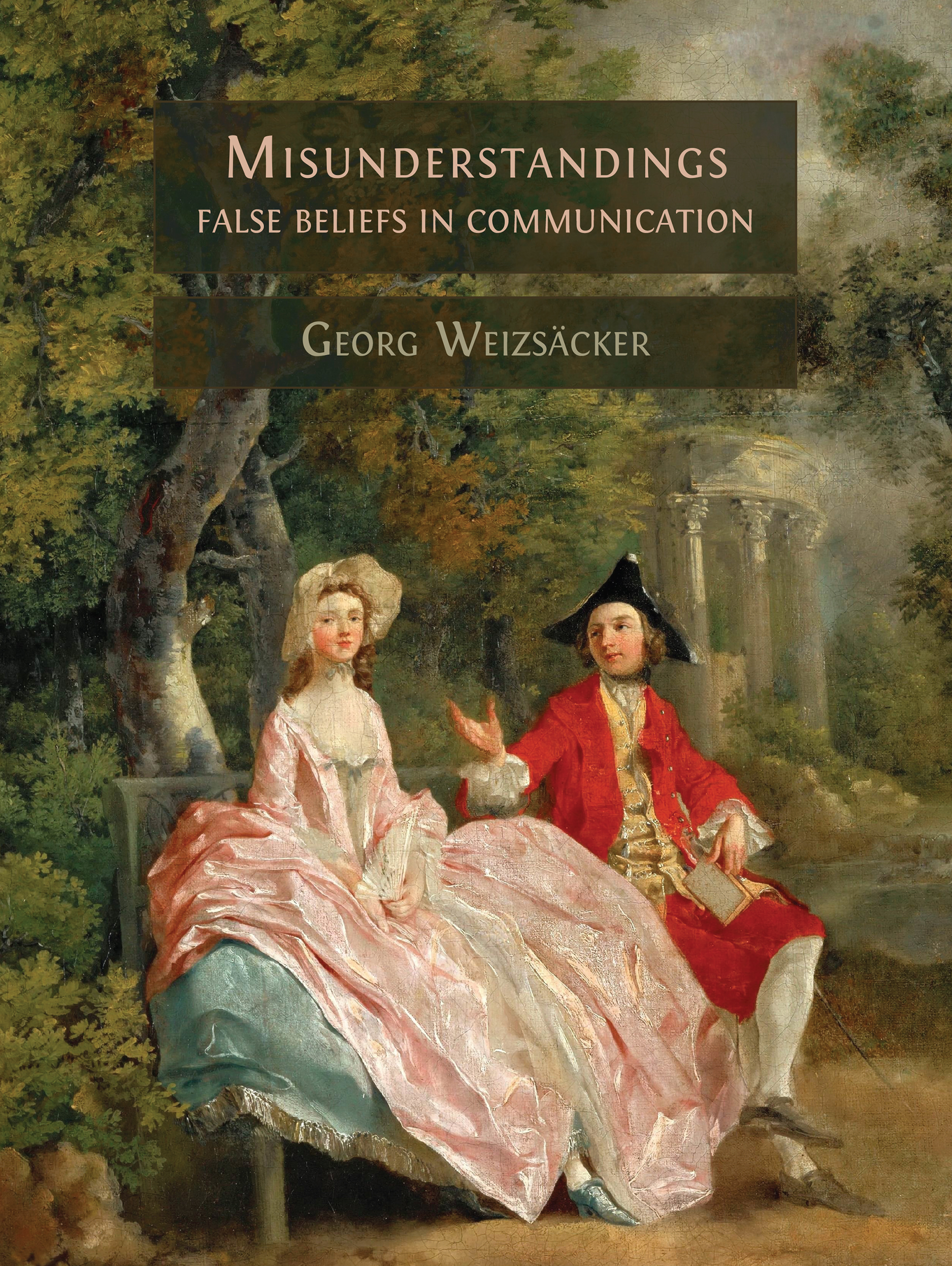
Book information
- Publisher
- Open Book Publishers
- Publication
- Published 7 November 2023
- Place
- Cambridge, UK
- Catalogue record
- View in the catalogue
Abstract
What do we expect when we say something to someone, and what do they expect when they hear it? When is a conversation successful? The book considers a wide set of two-person conversations, and a bit of game theory, to show how conversational statements and their interpretations are governed by beliefs. Thinking about beliefs is suitable for communication analysis because beliefs are well-defined and measurable, allowing to differentiate between successful understandings and their less successful counterparts: misunderstandings.
The book describes the theoretical framework and empirical measurements of misunderstandings – written by an economist, but in simple words and using interdisciplinary concepts. The material will benefit students and researchers of behavioural economics and its neighbouring fields, and anyone interested in human language.
Chapters
| Chapter | Author | Institution at publication |
|---|---|---|
| 1. Introduction | Georg Weizsäcker | Humboldt-Universität zu Berlin |
| 2. Having a conversation | Georg Weizsäcker | Humboldt-Universität zu Berlin |
| 3. Seeing what we don’t see | Georg Weizsäcker | Humboldt-Universität zu Berlin |
| 4. Talking | Georg Weizsäcker | Humboldt-Universität zu Berlin |
| 5. Listening | Georg Weizsäcker | Humboldt-Universität zu Berlin |
| 6. Seeing what they don’t see | Georg Weizsäcker | Humboldt-Universität zu Berlin |
| 7. Perceiving how they talk | Georg Weizsäcker | Humboldt-Universität zu Berlin |
| 8. Perceiving how they listen | Georg Weizsäcker | Humboldt-Universität zu Berlin |
| 9. In higher order | Georg Weizsäcker | Humboldt-Universität zu Berlin |
| 10. Conclusion | Georg Weizsäcker | Humboldt-Universität zu Berlin |
| 11. Bibliography and further reading | Georg Weizsäcker | Humboldt-Universität zu Berlin |
Where its authors and editors are based
Countries of the institutions the book's authors, editors and chapter authors were affiliated to when it was published.
- AUTHORS / EDITORS
- CITATIONS Phase 2
- USAGE Phase 3
| Country | Authors / editors |
|---|---|
| Germany | 1 |
About this data
These figures cover 12 works. Each value comes from the most trusted source that has it; a correction made by OJC or OBC staff outranks every source.
| Source | Confidence | Works |
|---|---|---|
| Thoth | 90 / 100 | 12 |
| Works with a publication date | 100% |
|---|---|
| Works with a DOI | 100% |
| Works with a funder recorded | 0% |
| Authors with an affiliation | 100% |
| Affiliations matched to an institution (ROR) | 100% |
| Affiliations with a country | 100% |
Countries come from the institution each author was affiliated to when they published, as recorded in ROR. A country is never guessed, so authors without a matched institution are not counted on the maps.
Funders come from OpenAlex for articles and Thoth for books, where publishers recorded them. Most works record none, so a funder's figures show what is recorded, not everything it funded.
Chapters count as works: their authors and editors, and the countries of their institutions, are in every figure where Thoth records an affiliation for them.
Citations (Phase 2) and usage (Phase 3) are not collected yet.