Book view
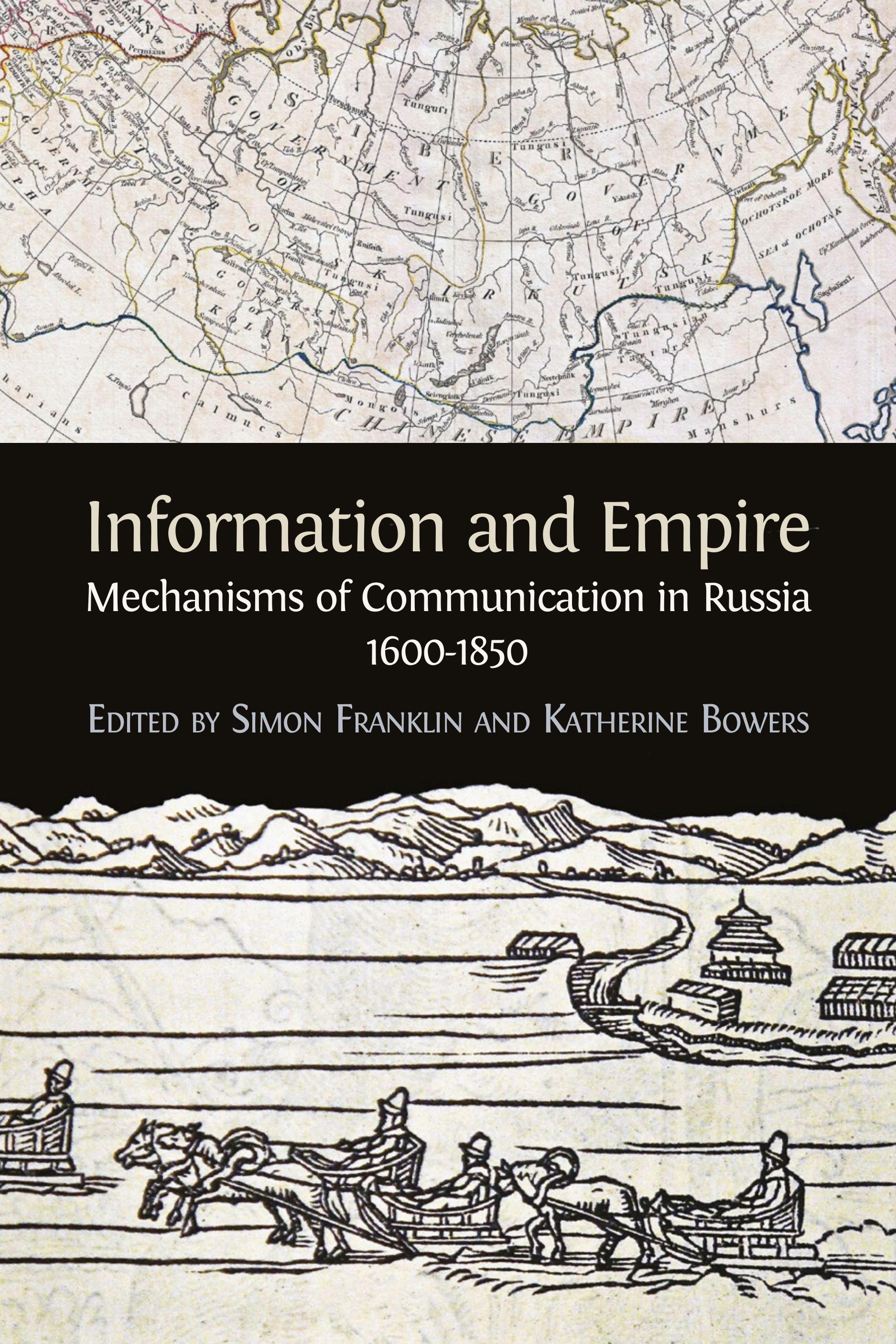
Information and Empire
Mechanisms of Communication in Russia, 1600-1854
Edited by Simon Franklin, Katherine Bowers
Book information
- Publisher
- Open Book Publishers
- Publication
- Published 27 November 2017
- Place
- Cambridge, UK
- Catalogue record
- View in the catalogue
Abstract
From the mid-sixteenth to the mid-nineteenth century Russia was transformed from a moderate-sized, land-locked principality into the largest empire on earth. How did systems of information and communication shape and reflect this extraordinary change?
Information and Mechanisms of Communication in Russia, 1600-1850 brings together a range of contributions to shed some light on this complex question. Communication networks such as the postal service and the gathering and circulation of news are examined alongside the growth of a bureaucratic apparatus that informed the government about its country and its people. The inscription of space is considered from the point of view of mapping and the changing public ‘graphosphere’ of signs and monuments. More than a series of institutional histories, this book is concerned with the way Russia discovered itself, envisioned itself and represented itself to its people.
Innovative and scholarly, this collection breaks new ground in its approach to communication and information as a field of study in Russia. More broadly, it is an accessible contribution to pre-modern information studies, taking as its basis a country whose history often serves to challenge habitual Western models of development. It is important reading not only for specialists in Russian Studies, but also for students and non-Russianists who are interested in the history of information and communications.
Chapters
Where its authors and editors are based
Countries of the institutions the book's authors, editors and chapter authors were affiliated to when it was published.
- AUTHORS / EDITORS
- CITATIONS Phase 2
- USAGE Phase 3
| Country | Authors / editors |
|---|---|
| United States | 3 |
| Canada | 2 |
| Russia | 2 |
| Kazakhstan | 1 |
| Sweden | 1 |
| United Arab Emirates | 1 |
| United Kingdom | 1 |
About this data
These figures cover 14 works. Each value comes from the most trusted source that has it; a correction made by OJC or OBC staff outranks every source.
| Source | Confidence | Works |
|---|---|---|
| Thoth | 90 / 100 | 14 |
| Works with a publication date | 100% |
|---|---|
| Works with a DOI | 100% |
| Works with a funder recorded | 0% |
| Authors with an affiliation | 94% |
| Affiliations matched to an institution (ROR) | 94% |
| Affiliations with a country | 100% |
Countries come from the institution each author was affiliated to when they published, as recorded in ROR. A country is never guessed, so authors without a matched institution are not counted on the maps.
Funders come from OpenAlex for articles and Thoth for books, where publishers recorded them. Most works record none, so a funder's figures show what is recorded, not everything it funded.
Chapters count as works: their authors and editors, and the countries of their institutions, are in every figure where Thoth records an affiliation for them.
Citations (Phase 2) and usage (Phase 3) are not collected yet.