Book view
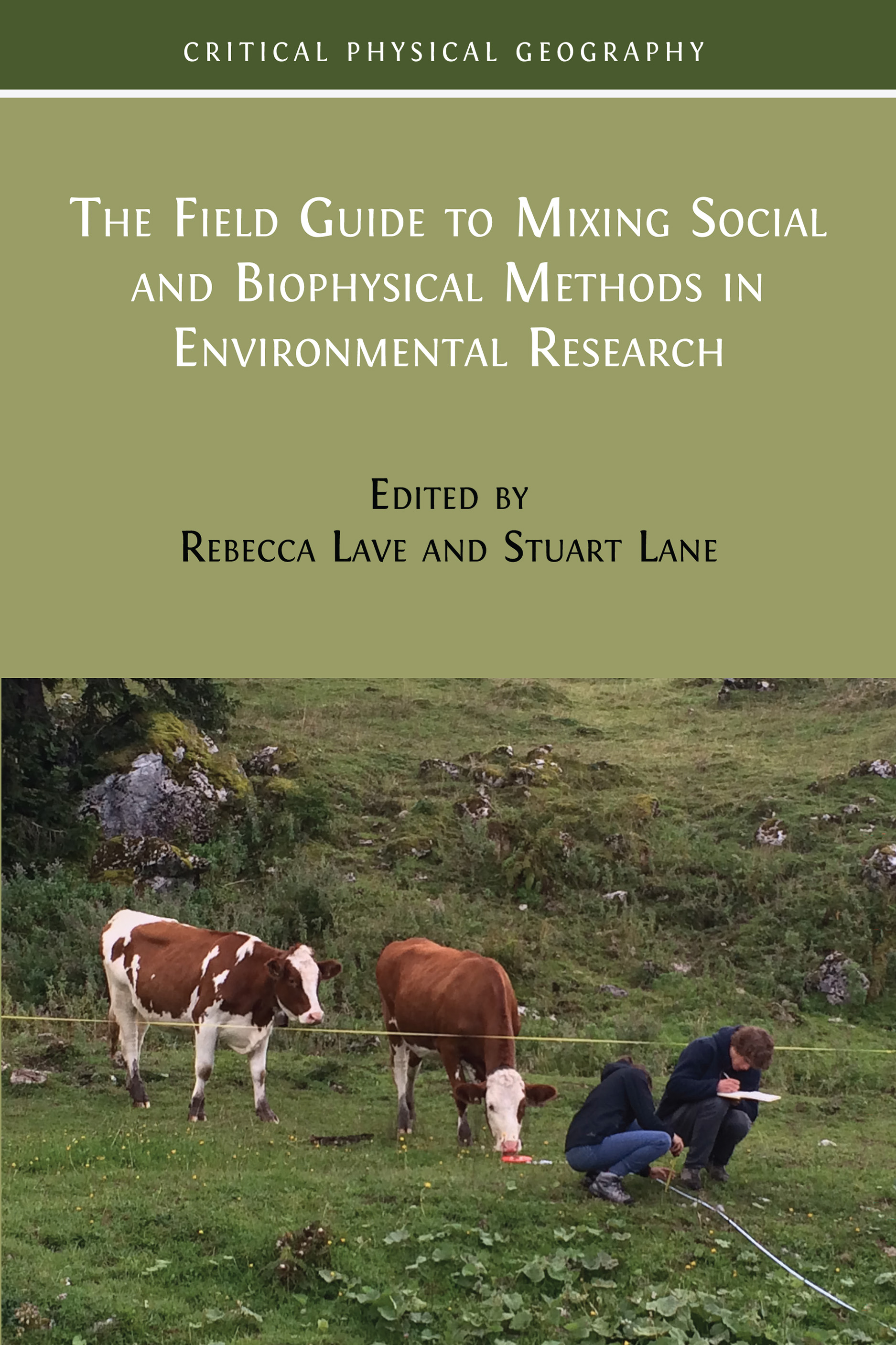
The Field Guide to Mixing Social and Biophysical Methods in Environmental Research
Edited by Rebecca Lave, Stuart Lane
Book information
- Publisher
- Open Book Publishers
- Publication
- Published 25 February 2025
- Place
- Cambridge, UK
- Series
- Critical Physical Geography: Interdisciplinary Approaches to Nature, Power and Politics
- Catalogue record
- View in the catalogue
Abstract
Despite ongoing debates about its origins, the Anthropocene—a new epoch characterized by significant human impact on the Earth's geology and ecosystems—is widely acknowledged. Our environment is increasingly a product of interacting biophysical and social forces, shaped by climate change, colonial legacies, gender norms, hydrological processes, and more. Understanding these intricate interactions requires a mixed-methods approach that combines qualitative and quantitative, biophysical and social research.
However, mixed-methods environmental research remains rare, hindered by academic boundaries, limited training, and the challenges of interdisciplinary collaboration. Time, funding, and the integration of diverse data further complicate this research, whilst the dynamics and ethics of interdisciplinary teams add another layer of complexity.
Despite these challenges, mixed-methods research offers a more robust and ultimately transformative understanding of environmental questions. This Field Guide aims to inspire and equip researchers to undertake such studies. Organized like a recipe book, it assists researchers in the preparation of their field work, as well as offering entry points to key methods and providing examples of successful mixed-methods projects.
This book will be of interest to scholars wishing to tackle environmental research in a more holistic manner, spanning ‘sister’ disciplines such as anthropology, statistics, political science, public health, archaeology, geography, history, ecology, and Earth science.
Chapters
Where its authors and editors are based
Countries of the institutions the book's authors, editors and chapter authors were affiliated to when it was published.
- AUTHORS / EDITORS
- CITATIONS Phase 2
- USAGE Phase 3
| Country | Authors / editors |
|---|---|
| United States | 28 |
| Switzerland | 7 |
| United Kingdom | 7 |
| New Zealand | 5 |
| Nepal | 4 |
| Germany | 3 |
| Gabon | 2 |
| The Netherlands | 2 |
All 12 countries
| Country | Authors / editors |
|---|---|
| United States | 28 |
| Switzerland | 7 |
| United Kingdom | 7 |
| New Zealand | 5 |
| Nepal | 4 |
| Germany | 3 |
| Gabon | 2 |
| The Netherlands | 2 |
| Canada | 1 |
| Finland | 1 |
| France | 1 |
| Sweden | 1 |
About this data
These figures cover 46 works. Each value comes from the most trusted source that has it; a correction made by OJC or OBC staff outranks every source.
| Source | Confidence | Works |
|---|---|---|
| Thoth | 90 / 100 | 46 |
| Works with a publication date | 100% |
|---|---|
| Works with a DOI | 100% |
| Works with a funder recorded | 0% |
| Authors with an affiliation | 95% |
| Affiliations matched to an institution (ROR) | 99% |
| Affiliations with a country | 100% |
Countries come from the institution each author was affiliated to when they published, as recorded in ROR. A country is never guessed, so authors without a matched institution are not counted on the maps.
Funders come from OpenAlex for articles and Thoth for books, where publishers recorded them. Most works record none, so a funder's figures show what is recorded, not everything it funded.
Chapters count as works: their authors and editors, and the countries of their institutions, are in every figure where Thoth records an affiliation for them.
Citations (Phase 2) and usage (Phase 3) are not collected yet.