Book view
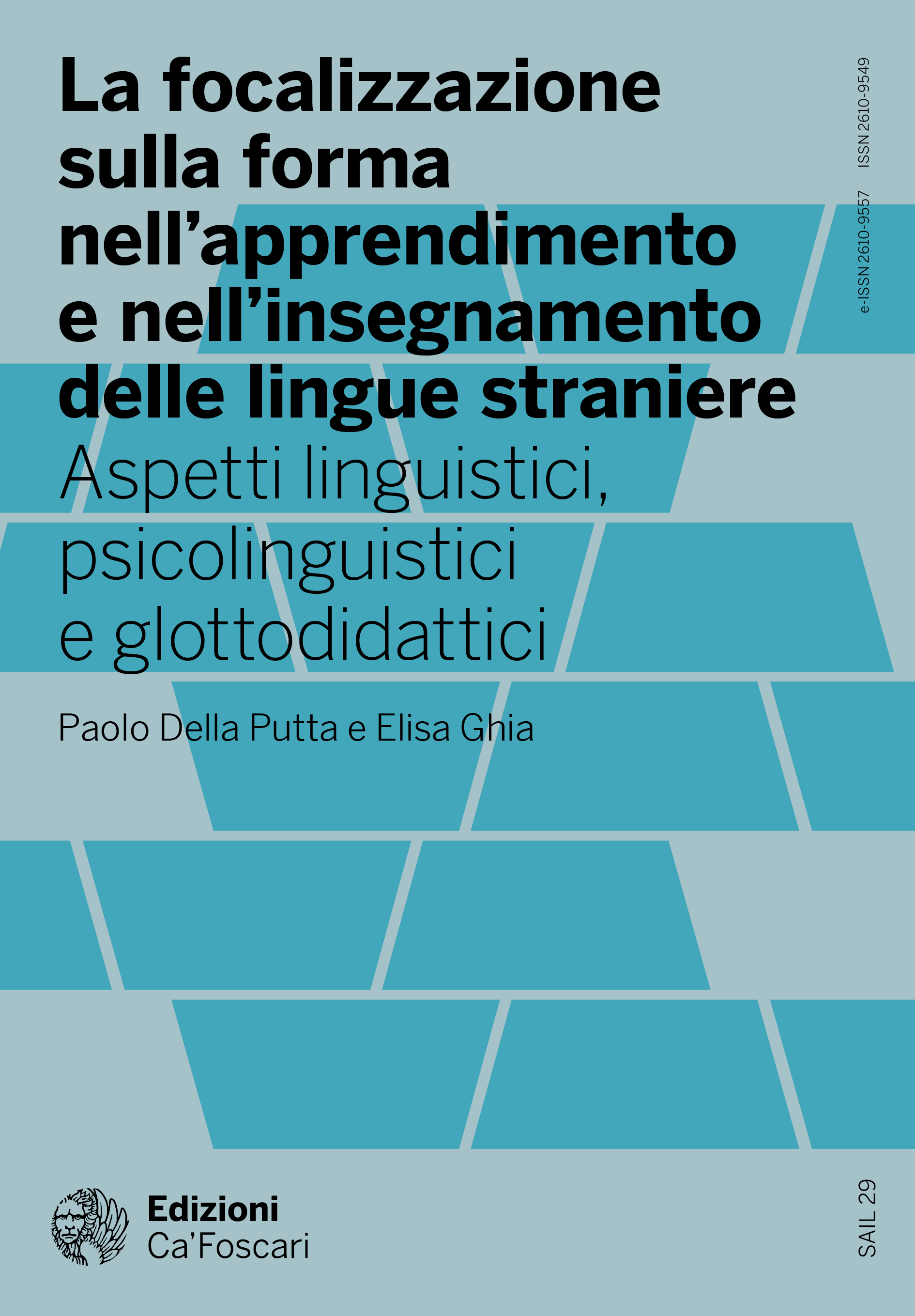
La focalizzazione sulla forma nell’apprendimento e nell’insegnamento delle lingue straniere
Aspetti linguistici, psicolinguistici e glottodidattici
Book information
- Publisher
- Edizioni Ca' Foscari
- Publication
- Published 18 February 2025
- Place
- Venice, Italy
- Series
- SAIL
- Catalogue record
- View in the catalogue
Abstract
The current volume explores the key construct of Focus on Form (FonF) and its practical applications to a variety of second language teaching and learning contexts. FonF is a type of cognitive process occurring during the reception or delivery of a linguistic message, in which the smooth flow of discourse is disrupted by a momentary attention to its form. In L2 learning settings, this can be prompted by the deliberate attention to specific language aspects driven by a language instructor or more competent user, or by comprehension problems experienced by learners during interaction. FonF has been shown to have a powerful impact on L2 development, and has been studied especially within interactionist and usage-based approaches to Second Language Acquisition. Given its cognitive nature, it is linked to the notions of attention and noticing, and has been widely studied in both classroom and naturalistic L2 learning settings also in relation to the related processes of Focus on Meaning (FonM) and Focus on Forms (FonFs). The book is divided into four chapters, which move from a theoretical definition of FonF to examples of its emergence and use in formal and less formal L2 English and L2 Italian learning settings. In these terms, the volume aims to stimulate both academic and pedagogical reflection among teachers, students and applied linguists. The first chapter provides a background to FonF by describing the characteristics of L2 input and the key cognitive constructs of selective attention, noticing and memory. Chapter 2 outlines a brief history of FonF within the cognitive-interactionist and usage-based perspectives, followed by its conceptualization in the foreign language teaching field. Chapter 3 describes the continuum from FonM to FonF up to the explicit practice of FonFs, each one having different applications and pedagogical potential. Such potential is clearly illustrated in Chapter 4, which shows concrete examples in L2 English and L2 Italian teaching and learning practices, useful for both learners and teacher reflection.
Where its authors and editors are based
Countries of the institutions the book's authors, editors and chapter authors were affiliated to when it was published.
- AUTHORS / EDITORS
- CITATIONS Phase 2
- USAGE Phase 3
| Country | Authors / editors |
|---|---|
| Italy | 2 |
About this data
These figures cover 1 work. Each value comes from the most trusted source that has it; a correction made by OJC or OBC staff outranks every source.
| Source | Confidence | Works |
|---|---|---|
| Thoth | 90 / 100 | 1 |
| Works with a publication date | 100% |
|---|---|
| Works with a DOI | 100% |
| Works with a funder recorded | 0% |
| Authors with an affiliation | 100% |
| Affiliations matched to an institution (ROR) | 100% |
| Affiliations with a country | 100% |
Countries come from the institution each author was affiliated to when they published, as recorded in ROR. A country is never guessed, so authors without a matched institution are not counted on the maps.
Funders come from OpenAlex for articles and Thoth for books, where publishers recorded them. Most works record none, so a funder's figures show what is recorded, not everything it funded.
Chapters count as works: their authors and editors, and the countries of their institutions, are in every figure where Thoth records an affiliation for them.
Citations (Phase 2) and usage (Phase 3) are not collected yet.