Book view
Tacitus, Annals, 15.20-23, 33-45
Latin Text, Study Aids with Vocabulary, and Commentary
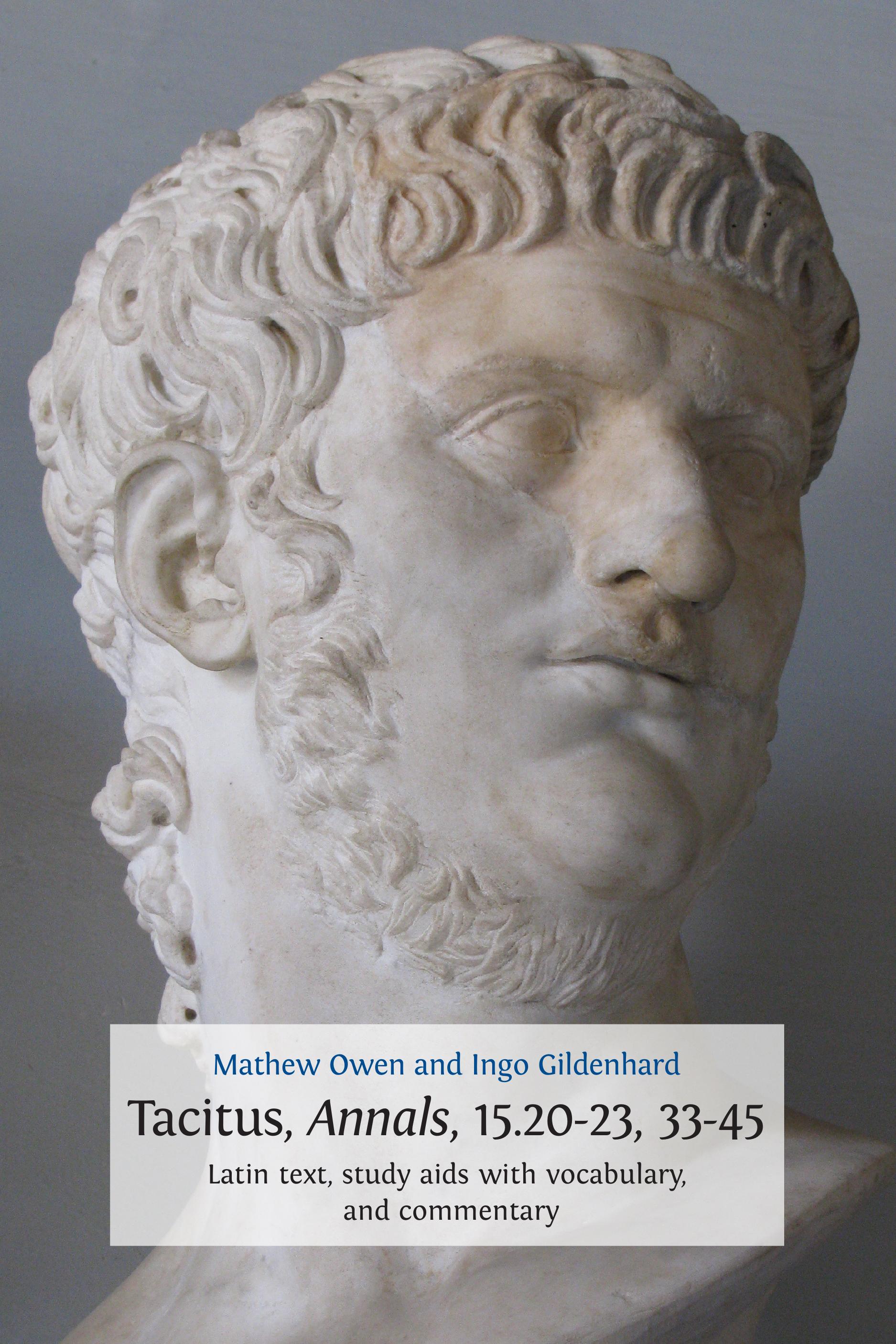
Book information
- Publisher
- Open Book Publishers
- Publication
- Published 20 September 2013
- Place
- Cambridge, UK
- Series
- Classics Textbooks
- Catalogue record
- View in the catalogue
Abstract
The emperor Nero is etched into the Western imagination as one of ancient Rome’s most infamous villains, and Tacitus’ Annals have played a central role in shaping the mainstream historiographical understanding of this flamboyant autocrat. This section of the text plunges us straight into the moral cesspool that Rome had apparently become in the later years of Nero’s reign, chronicling the emperor’s fledgling stage career including his plans for a grand tour of Greece; his participation in a city-wide orgy climaxing in his publicly consummated ‘marriage’ to his toy boy Pythagoras; the great fire of AD 64, during which large parts of central Rome went up in flames; and the rising of Nero’s ‘grotesque’ new palace, the so-called ‘Golden House’, from the ashes of the city. This building project stoked the rumours that the emperor himself was behind the conflagration, and Tacitus goes on to present us with Nero’s gruesome efforts to quell these mutterings by scapegoating and executing members of an unpopular new cult then starting to spread through the Roman empire: Christianity. All this contrasts starkly with four chapters focusing on one of Nero’s most principled opponents, the Stoic senator Thrasea Paetus, an audacious figure of moral fibre, who courageously refuses to bend to the forces of imperial corruption and hypocrisy. This course book offers a portion of the original Latin text, study aids with vocabulary, and a commentary. Designed to stretch and stimulate readers, Owen’s and Gildenhard’s incisive commentary will be of particular interest to students of Latin at both A2 and undergraduate level. It extends beyond detailed linguistic analysis and historical background to encourage critical engagement with Tacitus’ prose and discussion of the most recent scholarly thought.
Chapters
| Chapter | Author | Institution at publication |
|---|---|---|
| Introduction | Mathew Owen, Ingo Gildenhard | University of Cambridge |
| Commentary | Mathew Owen, Ingo Gildenhard | University of Cambridge |
| Latin text with study questions and vocabulary aid | Mathew Owen, Ingo Gildenhard | University of Cambridge |
Where its authors and editors are based
Countries of the institutions the book's authors, editors and chapter authors were affiliated to when it was published.
- AUTHORS / EDITORS
- CITATIONS Phase 2
- USAGE Phase 3
| Country | Authors / editors |
|---|---|
| United Kingdom | 1 |
About this data
These figures cover 4 works. Each value comes from the most trusted source that has it; a correction made by OJC or OBC staff outranks every source.
| Source | Confidence | Works |
|---|---|---|
| Thoth | 90 / 100 | 4 |
| Works with a publication date | 100% |
|---|---|
| Works with a DOI | 100% |
| Works with a funder recorded | 0% |
| Authors with an affiliation | 50% |
| Affiliations matched to an institution (ROR) | 100% |
| Affiliations with a country | 100% |
Countries come from the institution each author was affiliated to when they published, as recorded in ROR. A country is never guessed, so authors without a matched institution are not counted on the maps.
Funders come from OpenAlex for articles and Thoth for books, where publishers recorded them. Most works record none, so a funder's figures show what is recorded, not everything it funded.
Chapters count as works: their authors and editors, and the countries of their institutions, are in every figure where Thoth records an affiliation for them.
Citations (Phase 2) and usage (Phase 3) are not collected yet.