Book information
- Publisher
- Open Book Publishers
- Publication
- Published 28 October 2025
- Place
- Cambridge, UK
- Series
- Open Book Classics
- Catalogue record
- View in the catalogue
Abstract
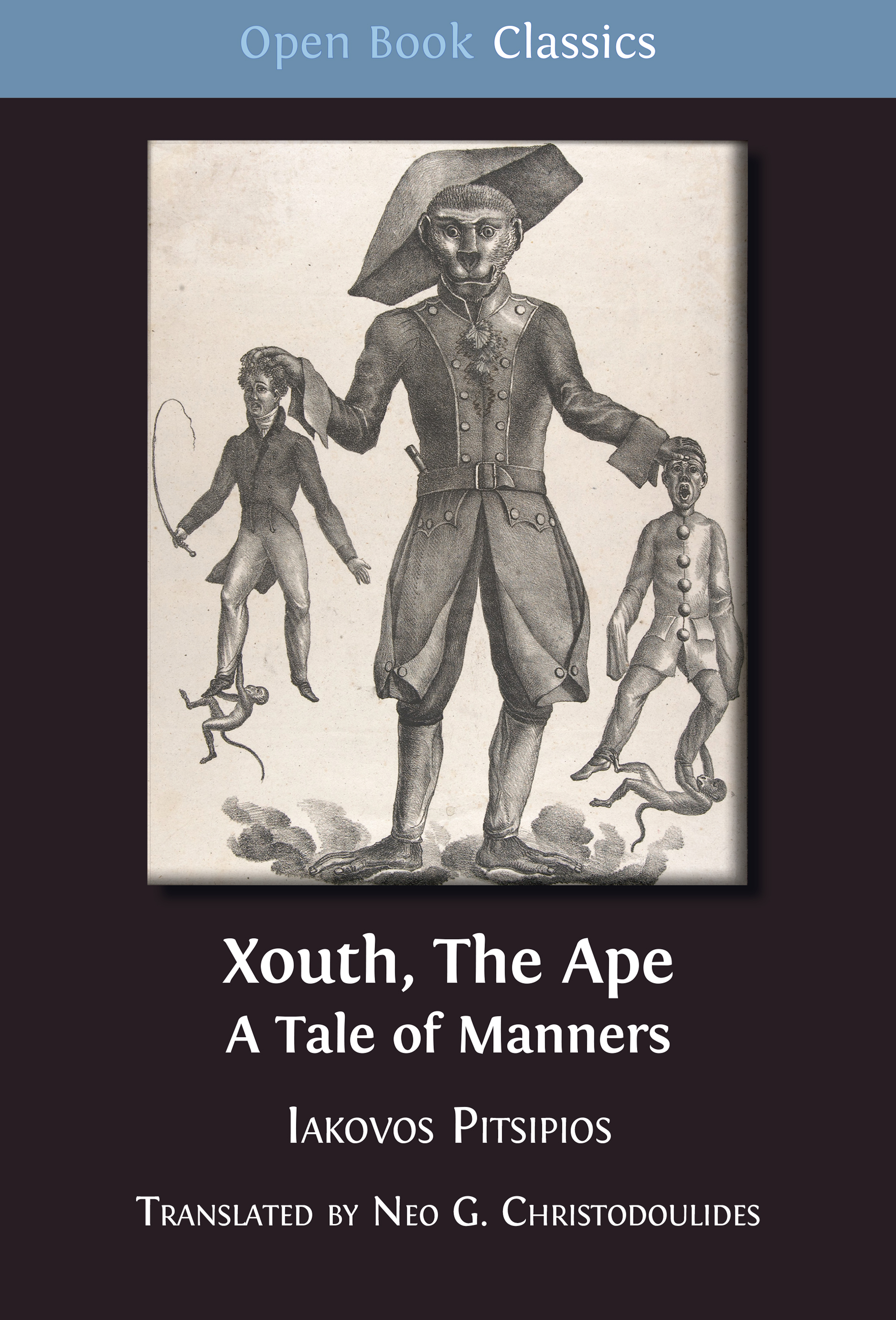
'Xouth, the Ape', published in 1848 by Iakovos Pitsipios is a pioneering and satirical Greek novel that deftly blends humour, cultural critique, and biting social commentary. The novel is set in the aftermath of the Greek War of Independence. The story follows a young Greek man, desperate to present himself as a European aristocrat, who finds himself entangled with Xouth—an ape who is, in fact, a German travel writer transformed as punishment for his vanity and prejudices.
Through the interactions between the protagonist and the ape-valet, Pitsipios skewers the pretensions of Greece’s newly minted elites, exposing the often comical efforts to mimic Western manners and ideals. The novel lampoons the wave of Western travel writers who ‘discovered’ Greece, poking fun at their colonial attitudes and superficial observations. The figure of Xouth serves as both a mirror and a caricature, reflecting the absurdities of identity, authenticity, and cultural imitation in a society striving to define itself between East and West.
Translated in English for the first time, with an expansive Introduction by Neo G. Christodoulides, the novel explores themes of national identity, the pitfalls of mimicry, and the complexities of cultural exchange. Rich with allusions to both Greek and European literary traditions, Pitsipios draws sharp parallels between his characters’ quests for legitimacy and the real historical debates around language, class, and belonging in 19th-century Greece. The novel’s polyglossic style—a blend of archaic, official, and colloquial Greek—further emphasises the layered and fractured nature of Greek identity at the time.
Despite its initial obscurity, the novel’s relevance endures: its sharp satire and insightful social analysis make it not just a humorous adventure, but a revealing document of post-revolutionary Greece and its ongoing negotiations with modernity, Western influence, and self-perception. 'Xouth, the Ape' is a hidden gem that deserves renewed attention from readers, scholars, and anyone fascinated by the crossroads of cultures.
Chapters
Where its authors and editors are based
Countries of the institutions the book's authors, editors and chapter authors were affiliated to when it was published.
- AUTHORS / EDITORS
- CITATIONS Phase 2
- USAGE Phase 3
| Country | Authors / editors |
|---|---|
| United Kingdom | 1 |
About this data
These figures cover 19 works. Each value comes from the most trusted source that has it; a correction made by OJC or OBC staff outranks every source.
| Source | Confidence | Works |
|---|---|---|
| Thoth | 90 / 100 | 19 |
| Works with a publication date | 100% |
|---|---|
| Works with a DOI | 100% |
| Works with a funder recorded | 0% |
| Authors with an affiliation | 50% |
| Affiliations matched to an institution (ROR) | 100% |
| Affiliations with a country | 100% |
Countries come from the institution each author was affiliated to when they published, as recorded in ROR. A country is never guessed, so authors without a matched institution are not counted on the maps.
Funders come from OpenAlex for articles and Thoth for books, where publishers recorded them. Most works record none, so a funder's figures show what is recorded, not everything it funded.
Chapters count as works: their authors and editors, and the countries of their institutions, are in every figure where Thoth records an affiliation for them.
Citations (Phase 2) and usage (Phase 3) are not collected yet.