Book view
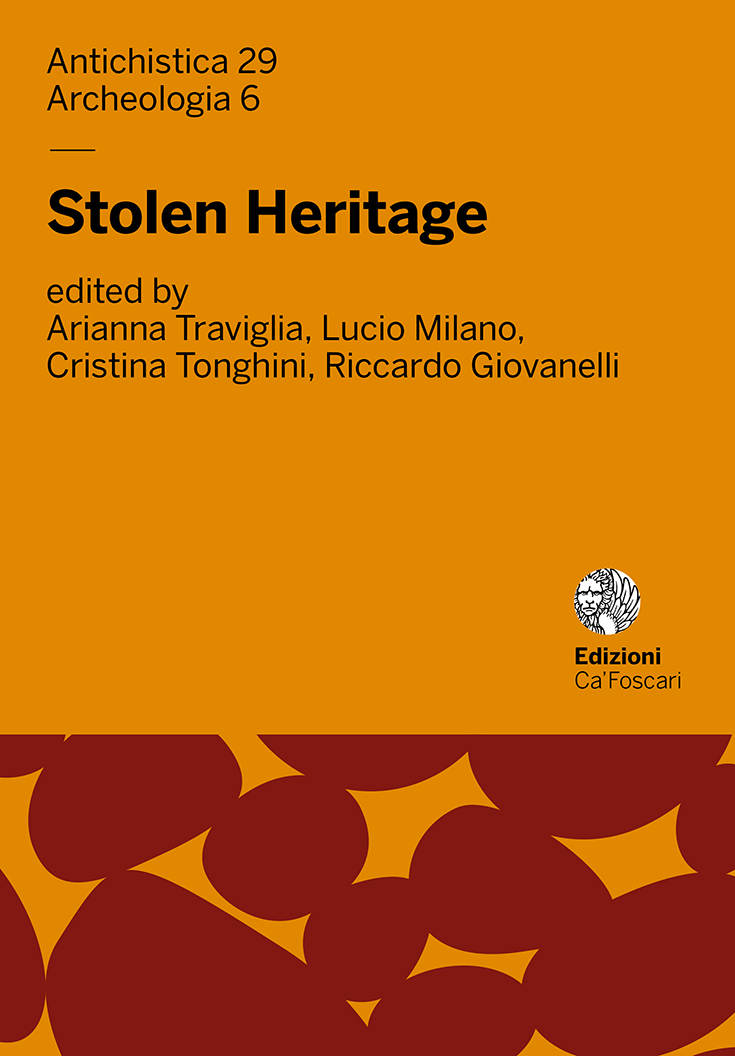
Stolen Heritage
Multidisciplinary Perspectives on Illicit Trafficking of Cultural Heritage in the EU and the MENA Region
Edited by Arianna Traviglia, Lucio Milano, Cristina Tonghini, Riccardo Giovanelli
Book information
- Publisher
- Edizioni Ca' Foscari
- Publication
- Published 31 March 2021
- Place
- Venice, Italy
- Series
- Antiquity Studies
- Catalogue record
- View in the catalogue
Abstract
It is a well-known fact that organised crime has developed into an international network including very diverse actors – ranging from the simple ‘grave diggers’ to powerful and wealthy white-collar professionals – that adopt illegal practices like money laundering, fraud and forgery. This criminal system, ultimately, damages and disintegrates our cultural identity and, in some cases, fosters political corruption, terrorism or civil unrest through the transnational and illicit trafficking of cultural property. The forms of ‘ownership’ of Cultural Heritage are often indistinct, and – depending on the national legislation of reference – the proprietorship and trade of historical and artistic assets of value may be legitimate or not. Casual collectors and criminals have always taken advantage from these ambiguities and managed to place on the market items obtained by destruction and looting of museums, monuments and archaeological areas. Thus, over the years, even the most renowned museum institutions might have - more or less consciously – displayed, hosted or lent cultural objects of illicit origin. Ransacking, thefts, clandestine exports and disputable transactions are crimes that primarily affect countries that are rich in artistic and archaeological assets, but such activities do not involve just some countries. This is an international border-crossing phenomenon that starts in given countries and expands to many others. Some are briefly passed through while a handful of powerful and rich ones are the actual destination marketplaces. Drawing from the experience of the conference Stolen Heritage (Venice, December 2019), held in the framework of the H2020 NETCHER (NETwork and digital platform for Cultural Heritage Enhancing and Rebuilding) project, this edited volume focuses on illicit trafficking in cultural property addressing the issue from a multidisciplinary perspective and featuring papers authored by international experts and professionals actively involved in Cultural Heritage protection. The articles included expand on such diverse topics as the European legislation regulating import, export, trade and restitution of cultural objects; ‘conflict antiquities’ and cultural heritage at risk in the Near and Middle East; looting activities and illicit excavations in Italy; the use of technologies to counter looting practices and the publication of unprovenanced items. This collection is meant as a valuable resource to disseminate new results of the research as well as to facilitate a better understanding of the international legislation related to the protection of Cultural Heritage.
Where its authors and editors are based
Countries of the institutions the book's authors, editors and chapter authors were affiliated to when it was published.
- AUTHORS / EDITORS
- CITATIONS Phase 2
- USAGE Phase 3
| Country | Authors / editors |
|---|---|
| Italy | 4 |
About this data
These figures cover 1 work. Each value comes from the most trusted source that has it; a correction made by OJC or OBC staff outranks every source.
| Source | Confidence | Works |
|---|---|---|
| Thoth | 90 / 100 | 1 |
| Works with a publication date | 100% |
|---|---|
| Works with a DOI | 100% |
| Works with a funder recorded | 0% |
| Authors with an affiliation | 100% |
| Affiliations matched to an institution (ROR) | 100% |
| Affiliations with a country | 100% |
Countries come from the institution each author was affiliated to when they published, as recorded in ROR. A country is never guessed, so authors without a matched institution are not counted on the maps.
Funders come from OpenAlex for articles and Thoth for books, where publishers recorded them. Most works record none, so a funder's figures show what is recorded, not everything it funded.
Chapters count as works: their authors and editors, and the countries of their institutions, are in every figure where Thoth records an affiliation for them.
Citations (Phase 2) and usage (Phase 3) are not collected yet.