Book view
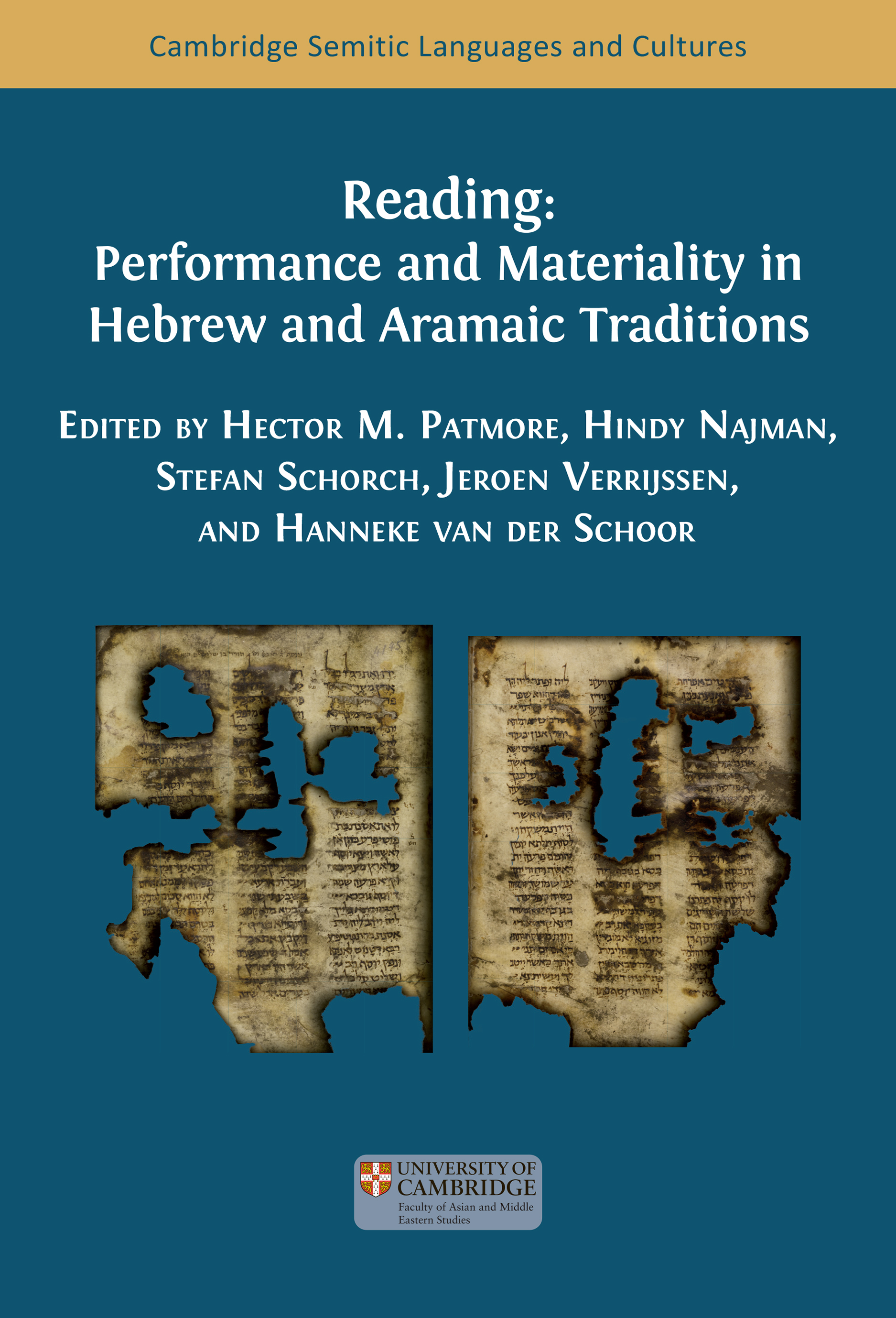
Reading
Performance and Materiality in Hebrew and Aramaic Traditions
Edited by Hector M. Patmore, Hindy Najman, Stefan Schorch, Jeroen Verrijssen, Hanneke van der Schoor
Book information
- Publisher
- Open Book Publishers
- Publication
- Published 21 July 2025
- Place
- Cambridge, UK
- Series
- Semitic Languages and Cultures
- Catalogue record
- View in the catalogue
Abstract
This volume contains the proceedings the 'Reading: Performance and Materiality in Hebrew and Aramaic Traditions' colloquium, hosted at the University of Oxford in 2023, and jointly sponsored by the Oriel Centre for the Study of the Bible and the European Research Council project, 'TEXTEVOLVE.'
The aim of the colloquium was to investigate Jewish approaches to the reading of texts, with a focus on reading practices that were applied to Hebrew and Aramaic texts in antiquity and the early Middle Ages. It explored, in particular, how these were shaped by material and non-textual aspects (oral traditions, performative context, philological values, etc). Among the questions it addressed were: How did non-textual components determine reading? To what extent did materiality shape or limit readings? How did reading practices shape the texts themselves? What values guided how texts were modified and variant texts evaluated? What determined which form or version of a text was read and according to what conventions? The responses to these questions collected in this volume highlight the tensions between authority and creativity, preservation and innovation, understanding and misapprehension, knowledge and ignorance, which shaped Jewish practices of reading.
Chapters
Where its authors and editors are based
Countries of the institutions the book's authors, editors and chapter authors were affiliated to when it was published.
- AUTHORS / EDITORS
- CITATIONS Phase 2
- USAGE Phase 3
| Country | Authors / editors |
|---|---|
| France | 4 |
| Germany | 4 |
| United Kingdom | 4 |
| Belgium | 2 |
| Israel | 1 |
| United States | 1 |
About this data
These figures cover 16 works. Each value comes from the most trusted source that has it; a correction made by OJC or OBC staff outranks every source.
| Source | Confidence | Works |
|---|---|---|
| Thoth | 90 / 100 | 16 |
| Works with a publication date | 100% |
|---|---|
| Works with a DOI | 100% |
| Works with a funder recorded | 6% |
| Authors with an affiliation | 79% |
| Affiliations matched to an institution (ROR) | 100% |
| Affiliations with a country | 100% |
Countries come from the institution each author was affiliated to when they published, as recorded in ROR. A country is never guessed, so authors without a matched institution are not counted on the maps.
Funders come from OpenAlex for articles and Thoth for books, where publishers recorded them. Most works record none, so a funder's figures show what is recorded, not everything it funded.
Chapters count as works: their authors and editors, and the countries of their institutions, are in every figure where Thoth records an affiliation for them.
Citations (Phase 2) and usage (Phase 3) are not collected yet.