Book view
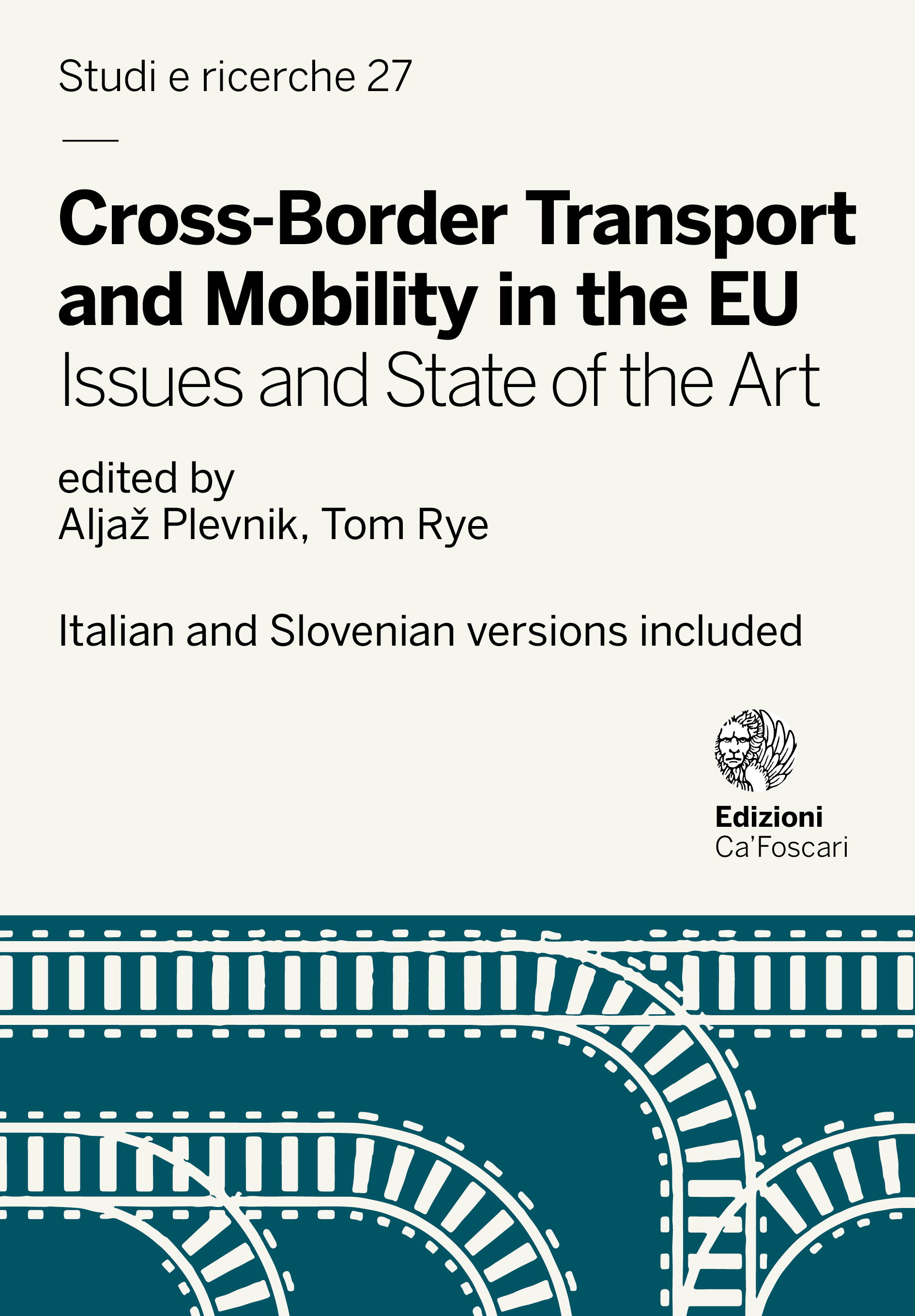
Cross-Border Transport and Mobility in the EU
Issues and State of the Art
Edited by Aljaž Plevnik, Tom Rye
Book information
- Publisher
- Edizioni Ca' Foscari
- Publication
- Published 12 October 2021
- Place
- Venice, Italy
- Series
- Studi e ricerche
- Catalogue record
- View in the catalogue
Abstract
The path towards a barrier-free single European market requires that particular attention is paid to cross-border transport. In spite of the intense commitment and actions taken by the European Union as well as by national governments and regions, much remains to be done in order to dissolve all the barriers to cross-border mobility of people. Issues are not only infrastructural but also related to administrative and planning coordination. Cross-border mobility planning and management is therefore a central issue in European cohesion and single market development policies. This theme has therefore been the subject of an international workshop organised in late 2020 as part of the CROSSMOBY project, funded by the Interreg Italy-Slovenia V-A Programme 2014-2020. This book brings together some of the contributions from that conference. The aim of this book is to provide a systematic analysis of what has already been done and what are the next priorities. This book aims to take a first step in this direction, providing a series of contributions from both academic and practitioner on cross-border passenger transport and mobility. Such topic is here examined according to several different perspectives: from the framework of EU regulations and policies to the projects funded and implemented in the last EU programming period on cross-border transport and mobility topic (2014-2020); from the application of Sustainable Urban Mobility Plans (SUMP) to the recognition of the territorial context and the state of the art of strategic mobility planning in the municipalities of the Italy-Slovenia cross-border area.
Where its authors and editors are based
Countries of the institutions the book's authors, editors and chapter authors were affiliated to when it was published.
- AUTHORS / EDITORS
- CITATIONS Phase 2
- USAGE Phase 3
About this data
These figures cover 1 work. Each value comes from the most trusted source that has it; a correction made by OJC or OBC staff outranks every source.
| Source | Confidence | Works |
|---|---|---|
| Thoth | 90 / 100 | 1 |
| Works with a publication date | 100% |
|---|---|
| Works with a DOI | 100% |
| Works with a funder recorded | 0% |
| Authors with an affiliation | 100% |
| Affiliations matched to an institution (ROR) | 100% |
| Affiliations with a country | 100% |
Countries come from the institution each author was affiliated to when they published, as recorded in ROR. A country is never guessed, so authors without a matched institution are not counted on the maps.
Funders come from OpenAlex for articles and Thoth for books, where publishers recorded them. Most works record none, so a funder's figures show what is recorded, not everything it funded.
Chapters count as works: their authors and editors, and the countries of their institutions, are in every figure where Thoth records an affiliation for them.
Citations (Phase 2) and usage (Phase 3) are not collected yet.