Book view
African Markets and the Utu-buntu Business Model
A Perspective in Economic Informality in Nairobi
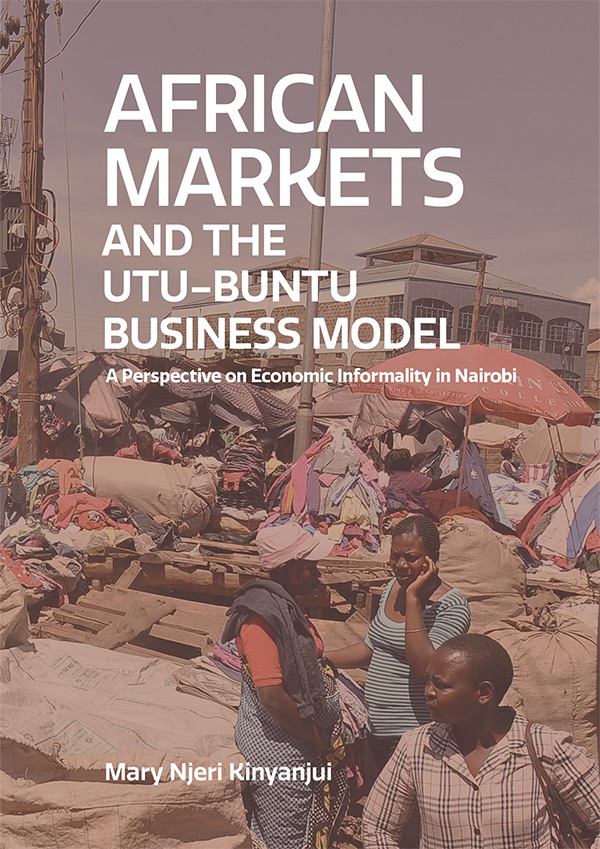
Book information
- Publisher
- African Minds
- Publication
- Published 1 March 2019
- Place
- Cape Town
- Catalogue record
- View in the catalogue
Abstract
Using the utu-ubuntu model to understand the activities of traders and artisans in Nairobi’s markets, this book explores how, despite being consistently excluded and disadvantaged, they shape urban spaces in and around the city, and contribute to its development as a whole. With immense resilience, and without discarding their own socio-cultural or economic values, informal traders and artisans have created a territorial complex that can be described as the African metropolis.
African Markets and the Utu-buntu Business Model sheds light on the ethics and values that underpin the work of traders and artisans in Nairobi, as well as their resilience and positive impact on urbanisation. This book makes an important contribution to the discourse on urban economics and planning in African cities.
Where its authors and editors are based
Countries of the institutions the book's authors, editors and chapter authors were affiliated to when it was published.
- AUTHORS / EDITORS
- CITATIONS Phase 2
- USAGE Phase 3
No affiliations with a known country in these years yet.
About this data
These figures cover 1 work. Each value comes from the most trusted source that has it; a correction made by OJC or OBC staff outranks every source.
| Source | Confidence | Works |
|---|---|---|
| Thoth | 90 / 100 | 1 |
| Works with a publication date | 100% |
|---|---|
| Works with a DOI | 100% |
| Works with a funder recorded | 0% |
| Authors with an affiliation | 0% |
Countries come from the institution each author was affiliated to when they published, as recorded in ROR. A country is never guessed, so authors without a matched institution are not counted on the maps.
Funders come from OpenAlex for articles and Thoth for books, where publishers recorded them. Most works record none, so a funder's figures show what is recorded, not everything it funded.
Chapters count as works: their authors and editors, and the countries of their institutions, are in every figure where Thoth records an affiliation for them.
Citations (Phase 2) and usage (Phase 3) are not collected yet.