Book view
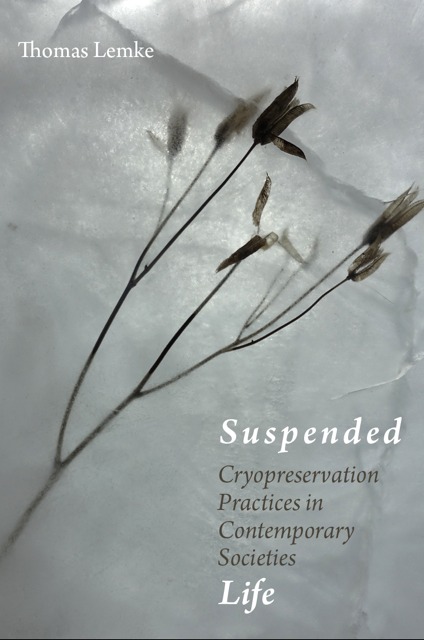
Suspended Life: Cryopreservation Practices in Contemporary Societies
Book information
- Publisher
- Mattering Press
- Publication
- Forthcoming 1 February 2027
- Catalogue record
- View in the catalogue
Abstract
Cryopreservation practices – the freezing of biological samples such as cells, tissues or organs at very low temperatures to preserve their viability for future use – have become crucial features of contemporary societies. Suspended Life investigates how collecting, storing and utilising human and non-human biological material through freezing and thawing protocols transforms understandings of life and death, health and illness, and notions of (in)fertility, sustainability and conservation.By introducing a new conceptual vocabulary, the book addresses the radical and ongoing transformation of temporal pathways in contemporary societies brought about by cryopreservation. It is based on the thesis that cryopreservation creates a liminal state beyond or between life and death: ‘suspended life’, which extends the present by suppressing metabolic processes, delaying change and promising reversibility. Adopting the concept of suspended life will help address two key issues in empirical studies of cryopreservation: a structuralist perspective that contrasts potential and actual life, and an essentialist view that treats life as an organism’s capacity rather than an emergent property.Suspended Life conceptualises cryopreservation practices as technologies of anticipation, shifting the analytical focus from potentialities and promises to practices of future-making. These practices range from addressing the existential threat of biodiversity loss by storing organic material from (nearly) extinct animals to the everyday concern of preparing for future infertility by freezing human eggs. The book advances the ongoing debate about the social dimensions of cryopreservation practices by resisting hierarchical concepts of life and emphasising relational ontologies. It situates this investigation within the broader field of ‘critical temperature studies’ (Nicole Starosielski), which exposes the power effects of thermal practices, revealing their racist, genderist, classist and colonial dimensions, and within the wider context of the politics of suspension, characterised by anticipatory rationalities and mechanisms of deferral and abeyance across many social fields.Suspended Life shows how cryopreservation practices confront us with the realm of the unfinished, the deferred, and the provisional, and how they are linked to a cultural imaginary that blends religious motifs with elements of science fiction, connecting apocalyptic fears with resurrection fantasies.
Where its authors and editors are based
Countries of the institutions the book's authors, editors and chapter authors were affiliated to when it was published.
- AUTHORS / EDITORS
- CITATIONS Phase 2
- USAGE Phase 3
No affiliations with a known country in these years yet.
About this data
These figures cover 1 work. Each value comes from the most trusted source that has it; a correction made by OJC or OBC staff outranks every source.
| Source | Confidence | Works |
|---|---|---|
| Thoth | 90 / 100 | 1 |
| Works with a publication date | 100% |
|---|---|
| Works with a DOI | 100% |
| Works with a funder recorded | 0% |
Countries come from the institution each author was affiliated to when they published, as recorded in ROR. A country is never guessed, so authors without a matched institution are not counted on the maps.
Funders come from OpenAlex for articles and Thoth for books, where publishers recorded them. Most works record none, so a funder's figures show what is recorded, not everything it funded.
Chapters count as works: their authors and editors, and the countries of their institutions, are in every figure where Thoth records an affiliation for them.
Citations (Phase 2) and usage (Phase 3) are not collected yet.