Book view
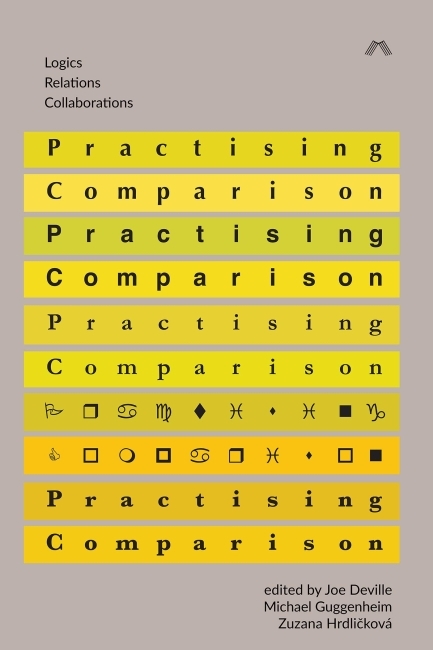
Practising Comparison
Logics, Relations, Collaborations
Edited by Joe Deville, Michael Guggenheim, Zuzana Hrdličková
Book information
- Publisher
- Mattering Press
- Publication
- Published 25 July 2016
- Place
- Manchester, UK
- Catalogue record
- View in the catalogue
Abstract
This book compares things, objects, concepts, and ideas. It is also about the practical acts of doing comparison. Comparison is not something that exists in the world, but a particular kind of activity.
Agents of various kinds compare by placing things next to one another, by using software programs and other tools, and by simply looking in certain ways. Comparing like this is an everyday practice. But in the social sciences, comparing often becomes more burdensome, more complex, and more questions are asked of it.
How, then, do social scientists compare? What role do funders, their tools, and databases play in social scientific comparisons? Which sorts of objects do they choose to compare and how do they decide which comparisons are meaningful? Doing comparison in the social sciences, it emerges, is a practice weighed down by a history in which comparison was seen as problematic. As it plays out in the present, this history encounters a range of other agents also involved in doing comparison who may challenge the comparisons of social scientists themselves.
This book introduces these questions through a varied range of reports, auto-ethnographies, and theoretical interventions that compare and analyse these different and often intersecting comparisons. Its goal is to begin a move away from the critique of comparison and towards a better comparative practice, guided not by abstract principles, but a deeper understanding of the challenges of practising comparison.
Chapters
| Chapter | Author | Institution at publication |
|---|---|---|
| Introduction | Joe Deville, Michael Guggenheim, Zuzana Hrdličková | Lancaster University; Goldsmiths University of London |
| Comparative Research | Monika Krause | Goldsmiths University of London |
| Comparative Tinkering with Care Moves | Peter Lutz | Uppsala University |
| Comparing Comparisons | Sarah de Rijcke, Iris Wallenburg, Paul Wouters, Roland Bal | Leiden University; Erasmus University Rotterdam |
| Cross Comparison | Alice Santiago Faria | Universidade Nova de Lisboa |
| Frame Against the Grain | Tereza Stöckelová | Czech Academy of Sciences; Charles University |
| Lateral Comparisons | Christopher Gad, Casper Bruun Jensen | IT University of Copenhagen; The University of Osaka |
| Pulling Oneself Out of the Traps of Comparison | Madeleine Akrich, Vololona Rabeharisoa | École Nationale Supérieure des Mines de Paris |
| Same, Same but Different | Joe Deville, Michael Guggenheim, Zuzana Hrdličková | Lancaster University; Goldsmiths University of London |
| Steve Jobs, Terrorists, Gentlemen, and Punks | Morgan Meyer | AgroParisTech |
| Afterword | Jennifer Robinson | University College London |
Where its authors and editors are based
Countries of the institutions the book's authors, editors and chapter authors were affiliated to when it was published.
- AUTHORS / EDITORS
- CITATIONS Phase 2
- USAGE Phase 3
| Country | Authors / editors |
|---|---|
| The Netherlands | 4 |
| United Kingdom | 4 |
| France | 3 |
| Czechia | 1 |
| Denmark | 1 |
| Japan | 1 |
| Portugal | 1 |
| Sweden | 1 |
About this data
These figures cover 12 works. Each value comes from the most trusted source that has it; a correction made by OJC or OBC staff outranks every source.
| Source | Confidence | Works |
|---|---|---|
| Thoth | 90 / 100 | 12 |
| Works with a publication date | 100% |
|---|---|
| Works with a DOI | 8% |
| Works with a funder recorded | 0% |
| Authors with an affiliation | 87% |
| Affiliations matched to an institution (ROR) | 100% |
| Affiliations with a country | 100% |
Countries come from the institution each author was affiliated to when they published, as recorded in ROR. A country is never guessed, so authors without a matched institution are not counted on the maps.
Funders come from OpenAlex for articles and Thoth for books, where publishers recorded them. Most works record none, so a funder's figures show what is recorded, not everything it funded.
Chapters count as works: their authors and editors, and the countries of their institutions, are in every figure where Thoth records an affiliation for them.
Citations (Phase 2) and usage (Phase 3) are not collected yet.