Book information
- Publisher
- Mattering Press
- Publication
- Published 6 October 2021
- Place
- Manchester, UK
- Catalogue record
- View in the catalogue
Abstract
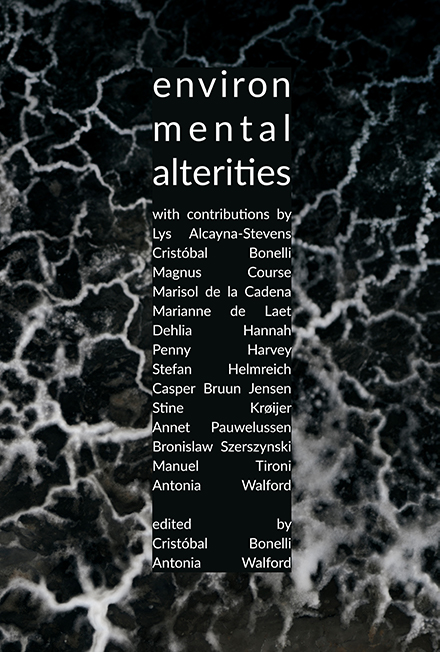
In the context of accelerating environmental crises and exhausted intellectual paradigms, this book asks what comes after ‘after nature’. Instead of demanding new models and approaches, it invites its readers to look to the endpoints and failures of what is already known, in order to generate alternative forms of ethical engagement with worlds both on this planet, and beyond it. Drawing together scholarship from across science and technology studies, philosophy, and anthropology and bringing it into conversation with rich ethnographic and empirical material, the book asks how we might potentialise the contradictions and oppositions of critical social scientific thinking in order to develop a mode of paradoxical engagement that is in constant movement between knowledge and its edges, practices and their limits, and which allows us to relate to that which is excessive to relations and relationality.
The chapters in the book range across very different empirical settings and communities of people, from fishermen in the Scottish seas, the sea folk of Indonesian archipelagos, indigenous peoples in forests in Lowland Ecuador, primatologists in the jungle of DR Congo, the personal and domestic space of living with dogs and the cosmological scale of planetary interactions. Each chapter explores different modes of environmental relationality and alterity by grappling with the spaces in-between – the contradictions, uncertainties, limits, excesses and liminalities which make up people’s everyday relations with their environments. The chapters are accompanied by in-depth conversations between scholars who frankly discuss the proposals of the book and the arguments of each chapter, with a view to inviting further reflection and discussion amongst the book’s readers. As the chapters and conversations in this book show, admitting that we still do not know what the environment is, even in times of crisis, can be a form of hopeful, humble environmental politics.
Chapters
| Chapter | Author | Institution at publication |
|---|---|---|
| Introduction | Cristóbal Bonelli, Antonia Walford | University of Amsterdam; University College London |
| Easy gesturing or inventing politics? | Marisol de la Cadena, Casper Bruun Jensen | University of California, Davis |
| Environmental infrastructural alterities and communicative possibilities | Penny Harvey, Stefan Helmreich | University of Manchester; Massachusetts Institute of Technology |
| Planetary alterity, solar cosmopolitics and the Parliament of Planets | Bronislaw Szerszynski | Lancaster University |
| Relating to resistances, curating antagonisms | Dehlia Hannah, Manuel Tironi | Royal Danish Academy – Architecture, Design, Conservation; Pontificia Universidad Católica de Chile |
| The non-relational forest | Stine Krøijer | University of Copenhagen |
| The woman who shed her skin | Magnus Course | University of Edinburgh |
| Thinking in forests | Lys Alcayna-Stevens | Harvard University; London School of Hygiene & Tropical Medicine |
| To live and learn | Marianne de Laet | Harvey Mudd College |
| Visits from octopus and crocodile kin | Annet Pauwelussen | Wageningen University & Research; University of Washington |
Where its authors and editors are based
Countries of the institutions the book's authors, editors and chapter authors were affiliated to when it was published.
- AUTHORS / EDITORS
- CITATIONS Phase 2
- USAGE Phase 3
| Country | Authors / editors |
|---|---|
| United Kingdom | 5 |
| United States | 5 |
| Denmark | 2 |
| The Netherlands | 2 |
| Chile | 1 |
About this data
These figures cover 11 works. Each value comes from the most trusted source that has it; a correction made by OJC or OBC staff outranks every source.
| Source | Confidence | Works |
|---|---|---|
| Thoth | 90 / 100 | 11 |
| Works with a publication date | 100% |
|---|---|
| Works with a DOI | 9% |
| Works with a funder recorded | 0% |
| Authors with an affiliation | 81% |
| Affiliations matched to an institution (ROR) | 100% |
| Affiliations with a country | 100% |
Countries come from the institution each author was affiliated to when they published, as recorded in ROR. A country is never guessed, so authors without a matched institution are not counted on the maps.
Funders come from OpenAlex for articles and Thoth for books, where publishers recorded them. Most works record none, so a funder's figures show what is recorded, not everything it funded.
Chapters count as works: their authors and editors, and the countries of their institutions, are in every figure where Thoth records an affiliation for them.
Citations (Phase 2) and usage (Phase 3) are not collected yet.