Book information
- Publisher
- Mattering Press
- Publication
- Published 1 January 2017
- Catalogue record
- View in the catalogue
Abstract
A doctor injects turpentine into the leg of a dying patient; the patient lives and years later a granddaughter uses this story of survival to write a story of her own. A refugee is questioned in court for falsifying paternity; a cultural expert intervenes to develop a legal case for kinship that exceeds DNA. A caring father lives a powerful truth, though a filmmaker must misrepresent Ecuadorian prostitutes in order to share it. In all three cases, “the case” shapes possibilities for action. In all three cases, “the case” is different than it was the case before.
The Ethnographic Case challenges a widespread academic inclination to treat concepts as immutable mobiles. The contributions to this volume develop “ethnographic casing” as a technique of attending to heterogeneities in systems of thought. Medical cases. Legal cases. Briefcases. Detective cases. Some cases featured are violent, others compassionate; some set stereotypes in motion, others break them down. Connected more by difference than similarity, the “cases” in this volume make a case for the virtue of relational science. This is a science that is not beholden to the masters’ narratives, but which embraces the double-work of caring for detail, while caring for the practices through which one learns to care. In 26 gripping and provocative installations, the volume showcases research from numerous influential feminist and decolonial scholars. Where anthropology has long sought to identify patterns in culture, this volume makes space for inquiry focused on particularities and advocates for an intellectual politics where that which doesn’t fit is still allowed to matter.
Chapters
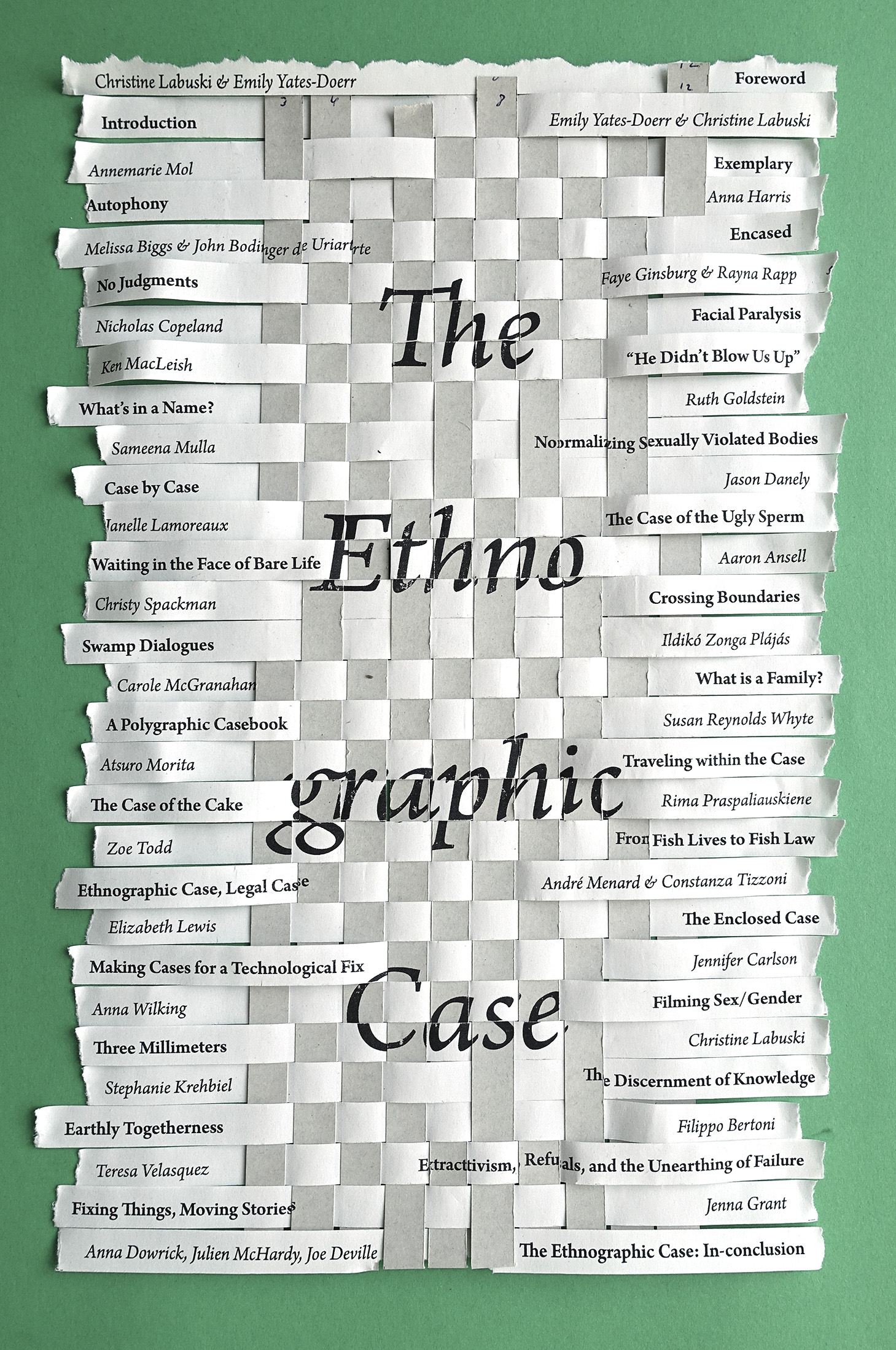
| Chapter | Author | Institution at publication |
|---|---|---|
| A Polygraphic Casebook | Susan Reynolds Whyte | University of Copenhagen |
| Autophony: Listening to Your Eyes Move | Anna Harris | Maastricht University |
| Case by Case | Jason Danely | Oxford Brookes University |
| Crossing Boundaries: Making Sense with the Sense-able | Christy Spackman | Harvey Mudd College |
| Earthly Togetherness: Making a Case for Living with Worms | Filippo Bertoni | Aarhus University |
| Encased: Plotting Attentions Through Distraction | Melissa Biggs, John Bodinger de Uriarte | The University of Texas at Austin; Susquehanna University |
| Ethnographic Case, Legal Case: From the Spirit of the Law to the Law of the Spirit | André Menard, Constanza Tizzoni | Universidad de Chile |
| Exemplary: The Case of the Farmer and the Turpentine | Annemarie Mol | University of Amsterdam |
| Extractivism, Refusals, and the Unearthing of Failure | Teresa Velásquez | California State University, San Bernardino |
| Facial Paralysis: Somaticizing Frustration in Guatemala | Nicholas Copeland | Virginia Tech |
| Filming Sex/Gender: The Ethics of (Mis)representation | Anna Wilking | |
| Fixing Things, Moving Stories | Jenna Grant | University of Washington |
| From Fish Lives to Fish Law: Learning to See Indigenous Legal Orders in Canada | Zoe Todd | Carleton University; University of Aberdeen |
| Making Cases for a Technological Fix: Germany’s Energy Transition and the Green Good Life | Jennifer Carlson | Rice University |
| No Judgments: Fieldwork on the Spectrum | Faye Ginsburg, Rayna Rapp | New York University |
| Normalizing Sexually Violated Bodies: Sexual Assault Adjudication, Medical Evidence, and the Legal Case | Sameena Mulla | Marquette University |
| Swamp Dialogues: Filming Ethnography | Ildikó Zonga Plájás | University of Amsterdam |
| The Book-CASE | Emily Yates-Doerr, Christine Labuski | University of Amsterdam; Virginia Tech |
| The Case of the Cake: Dilemmas of Giving and Taking | Rima Praspaliauskiene | Mills College |
| The Case of the Ugly Sperm | Janelle Lamoreaux | University of Cambridge |
| The Discernment of Knowledge: Sexualized Violence in the Mennonite Church | Stephanie Krehbiel | |
| The Enclosed Case | Elizabeth Lewis | The University of Texas at Austin |
| Three Millimeters | Christine Labuski | Virginia Tech |
| Traveling within the Case | Atsuro Morita | The University of Osaka |
| Waiting in the Face of Bare Life | Aaron Ansell | Virginia Tech |
| What is a Family? Refugee DNA and the Possible Truths of Kinship | Carole McGranahan | University of Colorado Boulder |
| What’s in a Name? | Ruth Goldstein | University of California, Berkeley |
| “He Didn’t Blow Us Up”: Routine Violence and Non-event as Case | Ken MacLeish | Vanderbilt University |
| Conclusion | Emily Yates-Doerr | University of Amsterdam |
Where its authors and editors are based
Countries of the institutions the book's authors, editors and chapter authors were affiliated to when it was published.
- AUTHORS / EDITORS
- CITATIONS Phase 2
- USAGE Phase 3
| Country | Authors / editors |
|---|---|
| United States | 17 |
| The Netherlands | 4 |
| United Kingdom | 3 |
| Chile | 2 |
| Denmark | 2 |
| Canada | 1 |
| Japan | 1 |
About this data
These figures cover 30 works. Each value comes from the most trusted source that has it; a correction made by OJC or OBC staff outranks every source.
| Source | Confidence | Works |
|---|---|---|
| Thoth | 90 / 100 | 30 |
| Works with a publication date | 100% |
|---|---|
| Works with a DOI | 3% |
| Works with a funder recorded | 0% |
| Authors with an affiliation | 94% |
| Affiliations matched to an institution (ROR) | 100% |
| Affiliations with a country | 100% |
Countries come from the institution each author was affiliated to when they published, as recorded in ROR. A country is never guessed, so authors without a matched institution are not counted on the maps.
Funders come from OpenAlex for articles and Thoth for books, where publishers recorded them. Most works record none, so a funder's figures show what is recorded, not everything it funded.
Chapters count as works: their authors and editors, and the countries of their institutions, are in every figure where Thoth records an affiliation for them.
Citations (Phase 2) and usage (Phase 3) are not collected yet.