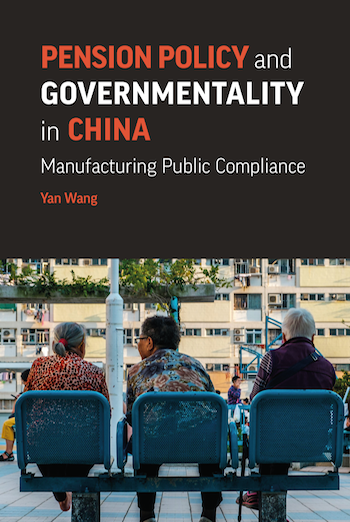
Book information
- Publisher
- LSE Press
- Publication
- Published 27 October 2022
- Place
- London
- Catalogue record
- View in the catalogue
Abstract
Rapid economic growth is often a disruptive social process threatening the social relations and ideologies of incumbent regimes. Yet far from acting defensively, the Chinese Communist Party has lead a major social and economic transformation over forty years, without yet encountering fundamental challenges subverting its rule. A key question for political sociology is thus - how have the logics of China’s governmentality been able to help maintain compliance from the governed while acting so radically to advance the state’s growth priorities?
This book explores the issue by analysing the detailed trajectories, rationale, and effects of China’s pension reforms. It uses strong methods, including institutional analysis of resource allocation in the multiple pension schemes and programmes, and quantitative text analysis of the knowledge construction in official discourse along with the reforms. Causal identification estimates the effects of key policy instruments on public opinion about pension responsibility and political trust. Moving beyond the pension issues, the analysis discusses with qualitative evidence why falsified compliance might exist in China’s society and the mechanisms that may lie behind it. Where active counter-conduct (such as resistance) is confined, individuals may choose cognitive rebellion and falsify their public compliance.
The Chinese state’s strategy to generate public compliance is hybrid, organic, and dynamic. The state rules society by its customised governance design and constant adjustments. Public compliance is not only acquired through ‘buying off’ the public with governmental performance and transfer benefits, but is also manufactured through achieving cultural changes and new ideological foundations for general legitimation.
Chapters
| Chapter | Author | Institution at publication |
|---|---|---|
| Introduction | Yan Wang | London School of Economics and Political Science |
| Falsification of ‘manufactured compliance’ and wider legitimation and governmentality issues | Yan Wang | London School of Economics and Political Science |
| Manufacturing compliance with ‘rule by design’ | Yan Wang | London School of Economics and Political Science |
| Maximising support for pension reform using policy experimentation, and the potential to backfire | Yan Wang | London School of Economics and Political Science |
| Pension issues, state governmentality, and falsified compliance in a comparative perspective | Yan Wang | |
| Who deserves benefits and why – constructing fairness, pension expectations, and subjectivity | Yan Wang | London School of Economics and Political Science |
| Who gets what and how: governance based on subpopulations | Yan Wang | London School of Economics and Political Science |
Where its authors and editors are based
Countries of the institutions the book's authors, editors and chapter authors were affiliated to when it was published.
- AUTHORS / EDITORS
- CITATIONS Phase 2
- USAGE Phase 3
| Country | Authors / editors |
|---|---|
| United Kingdom | 1 |
About this data
These figures cover 8 works. Each value comes from the most trusted source that has it; a correction made by OJC or OBC staff outranks every source.
| Source | Confidence | Works |
|---|---|---|
| Thoth | 90 / 100 | 8 |
| Works with a publication date | 100% |
|---|---|
| Works with a DOI | 100% |
| Works with a funder recorded | 0% |
| Authors with an affiliation | 88% |
| Affiliations matched to an institution (ROR) | 100% |
| Affiliations with a country | 100% |
Countries come from the institution each author was affiliated to when they published, as recorded in ROR. A country is never guessed, so authors without a matched institution are not counted on the maps.
Funders come from OpenAlex for articles and Thoth for books, where publishers recorded them. Most works record none, so a funder's figures show what is recorded, not everything it funded.
Chapters count as works: their authors and editors, and the countries of their institutions, are in every figure where Thoth records an affiliation for them.
Citations (Phase 2) and usage (Phase 3) are not collected yet.