Book view
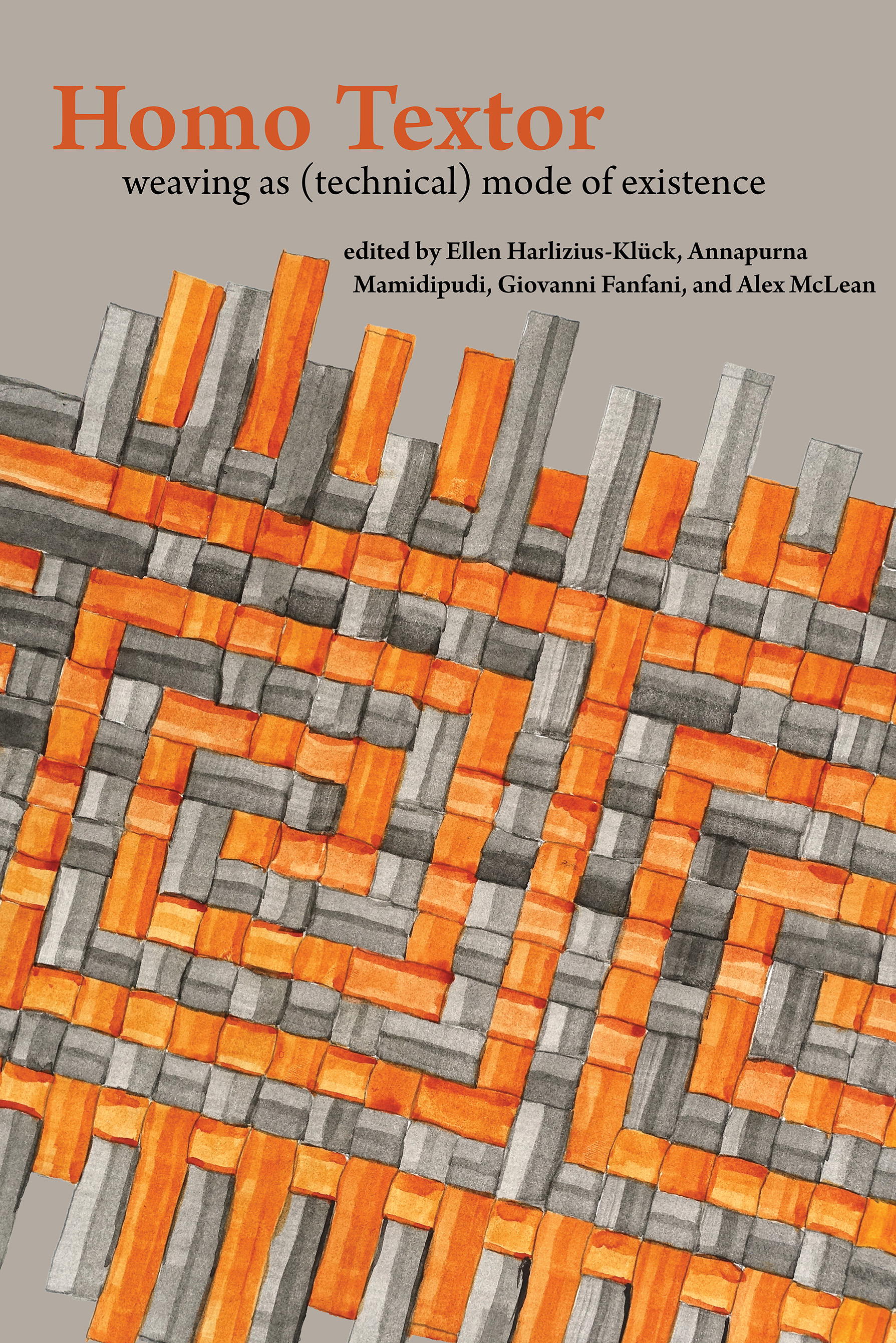
Homo Textor
Weaving As (Technical) Mode of Existence
Edited by Ellen Harlizius-Klück, Annapurna Mamidipudi, Giovanni Fanfani, Alex McLean
Book information
- Publisher
- Mattering Press
- Publication
- Published 29 June 2026
- Catalogue record
- View in the catalogue
Abstract
Homo Textor aims to exemplify how weaving as a (technical) mode of existence provides concepts that help to rethink Homo faber and the way the Moderns (as described by Latour) talk about technology. Contradicting a hylomorphic schema where an actor gives form to matter, the characteristic weaving mode is histomorphism, a generative process where intelligible forms grow out of the loom-weaver-threads system. As the contributions in this book show, histomorphism is not a technical mode restricted to the craft of weaving, but a concept providing a complex type of order that humans/actors trace across social, formal, cosmological, digital, and philosophical dimensionsThis book extends the possibilities opened up by the ‘Inquiry into Modes of Existence’ project of Bruno Latour, and engages Ingold’s notion that making should be seen as a modality of weaving. It provides case studies, performances, technical tools, speculative analyses, ethnographic studies, and philosophical meditations that reveal something about weaving that otherwise remains invisible when presented according to common disciplinary boundaries.The contributions form clusters and connect with each other around (Part I) challenges of referencing terminology, technology, and form, (Part II) explorations of patterns as knowledge of order, and (Part III) stories about missing and seizing textile opportunities. The first part addresses established paradigms of production and making, such as the superimposition of form to matter (hylemorphism), the opposition of (extrinsic) structure and (intrinsic) substance, and the search for exact correspondences between terms and objects to which weaving poses a radical challenge. The papers in part II look at what weavers do and know and how this knowledge travels to other types of objects and beings as well as their relation to each other, the world in which they live, and how it is ordered. Part III brings together chapters demonstrating that considering seriously not only the textile object as outcome of a textile production process, but also the production process itself with its social relations and movements can take us to new perspectives not only in art, but also in coding and the development of new technologies.
Chapters
| Chapter | Author | Institution at publication |
|---|---|---|
| Algorithmic Patterns on the Live Loom | Alex McLean | Then Try This |
| Braiding and Dancing | Victoria Mitchell | Norwich University of the Arts |
| Comparative Reflections on Andean Weaving as Science | Denise Y. Arnold | Birkbeck, University of London; Instituto de Lengua y Cultura Aymara |
| Embodying Patterns of Textile Machinery | Caroline Radcliffe | University of Birmingham |
| Epistemic, Social, and Material Ordering through Weaving Threads | Annapurna Mamidipudi | Technische Universität Berlin |
| Introducing Homo textor | Ellen Harlizius-Klück, Annapurna Mamidipudi, Giovanni Fanfani, Alex McLean | Deutsches Museum; Technische Universität Berlin; Then Try This |
| Lost in Lexicography | Giovanni Fanfani | Deutsches Museum |
| Merge, Weave, House, Trap | Julian Rohrhuber | Robert Schumann University of Music and Media |
| Modular Patterns | Kalliope Sarri | |
| Poikilia, Geometry and Living Patterns in the Greek Archaic and Classical Mind | Adeline Grand-Clément | Université Toulouse - Jean Jaurès |
| String | Ebru Kurbak | University of Applied Arts Vienna |
| The Technical Mode of Existence of Weaving | Ellen Harlizius-Klück | Deutsches Museum |
| The Textile Expression Gap | Lars Hallnäs | University of Borås |
| Untangling knowledge work by maypole weaving with a Penelopean robot swarm | David Griffiths | Then Try This |
| Woven Witness | Anthony Tuck, Cole Reilly, Cinzia Presti, Joseph Capozzi | University of Massachusetts Amherst; University of Cincinnati; Georgia Institute of Technology |
Where its authors and editors are based
Countries of the institutions the book's authors, editors and chapter authors were affiliated to when it was published.
- AUTHORS / EDITORS
- CITATIONS Phase 2
- USAGE Phase 3
| Country | Authors / editors |
|---|---|
| United Kingdom | 5 |
| Germany | 4 |
| United States | 4 |
| Austria | 1 |
| Bolivia | 1 |
| France | 1 |
| Sweden | 1 |
About this data
These figures cover 16 works. Each value comes from the most trusted source that has it; a correction made by OJC or OBC staff outranks every source.
| Source | Confidence | Works |
|---|---|---|
| Thoth | 90 / 100 | 16 |
| Works with a publication date | 100% |
|---|---|
| Works with a DOI | 6% |
| Works with a funder recorded | 0% |
| Authors with an affiliation | 80% |
| Affiliations matched to an institution (ROR) | 100% |
| Affiliations with a country | 100% |
Countries come from the institution each author was affiliated to when they published, as recorded in ROR. A country is never guessed, so authors without a matched institution are not counted on the maps.
Funders come from OpenAlex for articles and Thoth for books, where publishers recorded them. Most works record none, so a funder's figures show what is recorded, not everything it funded.
Chapters count as works: their authors and editors, and the countries of their institutions, are in every figure where Thoth records an affiliation for them.
Citations (Phase 2) and usage (Phase 3) are not collected yet.