Book view
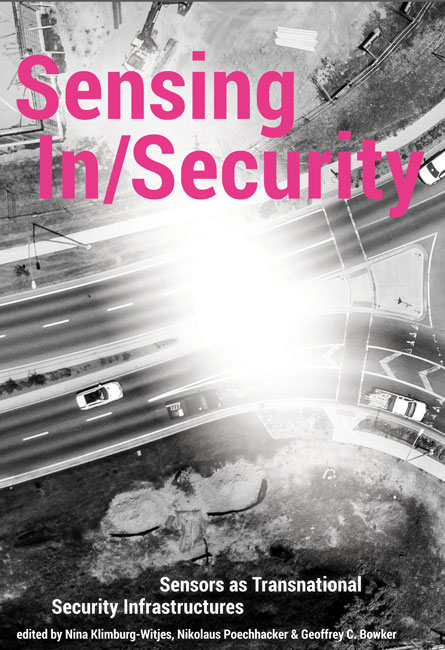
Sensing In/Security
Sensors as Transnational Security Infrastructures
Edited by Nina Klimburg-Witjes, Nikolaus Poechhacker, Geoffrey C. Bowker; by Lucy Suchman
Book information
- Publisher
- Mattering Press
- Publication
- Published 24 August 2021
- Place
- Manchester, UK
- Catalogue record
- View in the catalogue
Abstract
Sensing In/Security: Sensors as Transnational Security Infrastructures investigates how sensors and sensing practices enact regimes of security and insecurity. It extends long-standing concerns with infrastructuring to emergent modes of surveillance and control by exploring how digitally networked sensors shape securitisation practices. Contributions in this volume examine how sensing devices gain political and epistemic relevance in various forms of in/security, from border control, regulation, and epidemiological tracking, to aerial surveillance and hacking. Instead of focusing on specific sensory devices and their consequences, this volume explores the complex and sometimes invisible political, cultural and ethical processes of infrastructuring in/security.
Chapters
| Chapter | Author | Institution at publication |
|---|---|---|
| Drones as political machines | Ciara Bracken-Roche | National University of Ireland, Maynooth |
| Expanding technosecurity culture | Jutta Weber | Paderborn University |
| Hacking satellites | Jan-Hendrik Passoth, Geoffrey C. Bowker, Nina Klimburg-Witjes, Godert-Jan van Manen | European University Viadrina; University of California, Irvine; University of Vienna |
| Human sensing infrastructures and global public health security in India’s Million Death Study | Erik Aarden | University of Klagenfurt |
| Microclimates of (in)security in Santiago | Martin Tironi, Matías Valderrama | Pontificia Universidad Católica de Chile |
| Sensing data centres | A.R.E. Taylor, Julia Velkova | University of Cambridge; Linköping University |
| Sensing European alterity | Annalisa Pelizza, Wouter Van Rossem | University of Bologna; University of Twente |
| Sensing in/securities | Nina Klimburg-Witjes, Nikolaus Poechhacker, Geoffrey C. Bowker | University of Vienna; University of Graz; University of California, Irvine |
| Sensing Salmonella | Francis Lee | Chalmers University of Technology |
| Smart cities, smart borders | Ilia Antenucci | Western Sydney University |
| Visual Vignette I | Evan Light, Fenwick McKelvey, Rachel Douglas-Jones | York University; Concordia University; IT University of Copenhagen |
| Visual Vignette II | Chris Wood | |
| Visual Vignette III | Katja Mayer, El Iblis Shah | Centre for Social Innovation; University of Vienna |
| Visual Vignettes | Mascha Gugganig, Rachel Douglas-Jones | Technical University of Munich; IT University of Copenhagen |
Where its authors and editors are based
Countries of the institutions the book's authors, editors and chapter authors were affiliated to when it was published.
- AUTHORS / EDITORS
- CITATIONS Phase 2
- USAGE Phase 3
| Country | Authors / editors |
|---|---|
| Austria | 4 |
| Germany | 3 |
| Canada | 2 |
| Chile | 2 |
| Sweden | 2 |
| The Netherlands | 2 |
| United Kingdom | 2 |
| Australia | 1 |
All 12 countries
| Country | Authors / editors |
|---|---|
| Austria | 4 |
| Germany | 3 |
| Canada | 2 |
| Chile | 2 |
| Sweden | 2 |
| The Netherlands | 2 |
| United Kingdom | 2 |
| Australia | 1 |
| Denmark | 1 |
| Ireland | 1 |
| Italy | 1 |
| United States | 1 |
About this data
These figures cover 15 works. Each value comes from the most trusted source that has it; a correction made by OJC or OBC staff outranks every source.
| Source | Confidence | Works |
|---|---|---|
| Thoth | 90 / 100 | 15 |
| Works with a publication date | 100% |
|---|---|
| Works with a DOI | 7% |
| Works with a funder recorded | 0% |
| Authors with an affiliation | 90% |
| Affiliations matched to an institution (ROR) | 100% |
| Affiliations with a country | 100% |
Countries come from the institution each author was affiliated to when they published, as recorded in ROR. A country is never guessed, so authors without a matched institution are not counted on the maps.
Funders come from OpenAlex for articles and Thoth for books, where publishers recorded them. Most works record none, so a funder's figures show what is recorded, not everything it funded.
Chapters count as works: their authors and editors, and the countries of their institutions, are in every figure where Thoth records an affiliation for them.
Citations (Phase 2) and usage (Phase 3) are not collected yet.