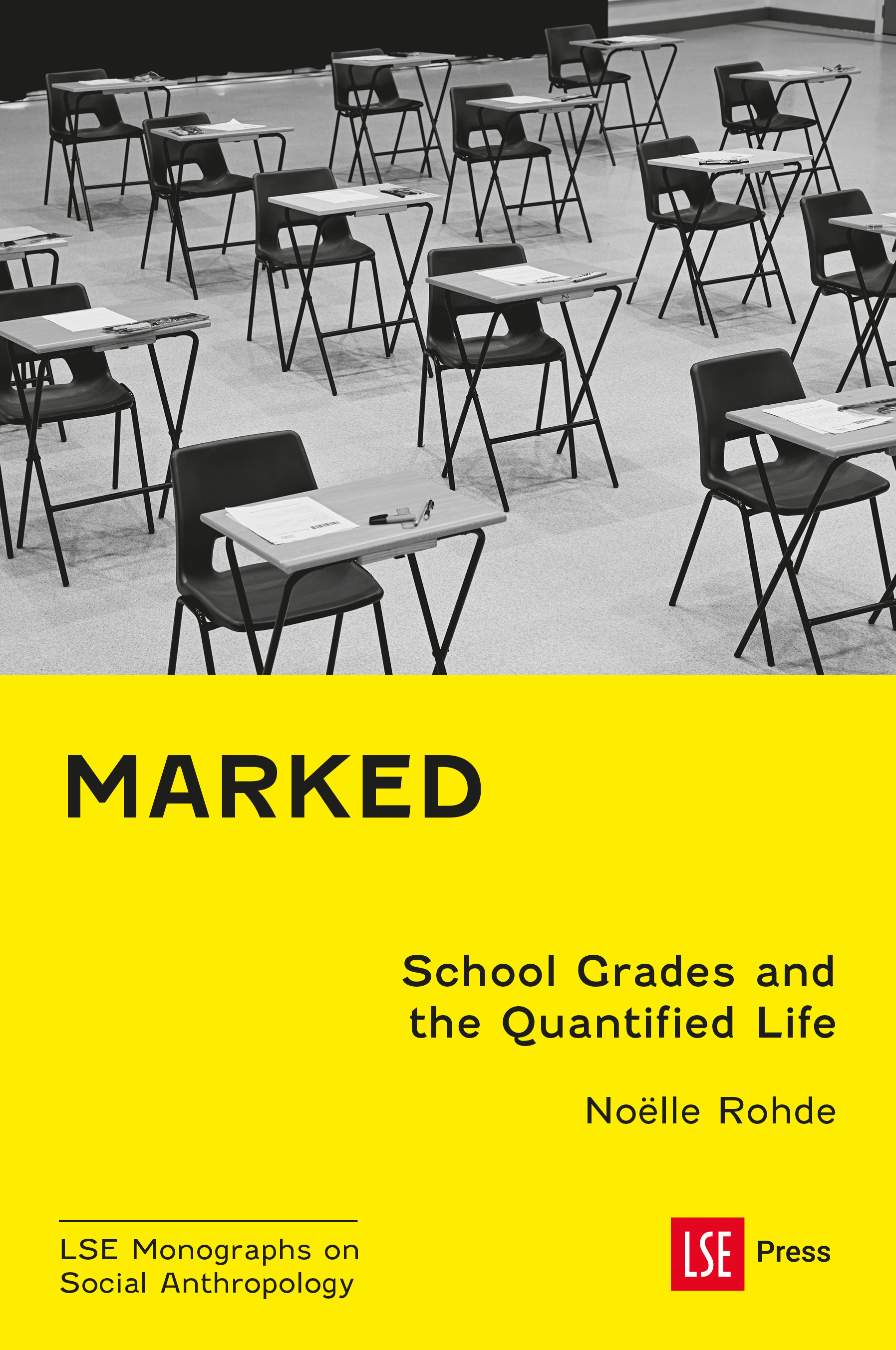
Book information
- Publisher
- LSE Press
- Publication
- Published 4 June 2026
- Place
- London
- Series
- LSE Monographs on Social Anthropology
- Catalogue record
- View in the catalogue
Abstract
There are few things left on earth that people have not attempted to measure. From temperature to time, from finances to football, numbers are a crucial mediator of how we perceive and understand the world we live in. Increasingly, however, it is humans themselves who are the subject of quantification. Our fitness and success, even our personality traits and attractiveness, are now the stuff of scales and scores. But what does it do to us to be on the receiving end of such measurement?
One of the world’s most successful global metrics is the school grade. Long predating the digital age, educational marks can be traced back at least to sixteenth-century European schools and have since conquered the world, becoming the indicator of academic achievement.
To understand what it means to be quantified, Noëlle Rohde undertook in-depth fieldwork in a German comprehensive school where students receive more than one hundred grades per year. By staying close to the pupils as they are continually examined and assessed, her ethnography illustrates how marks mould students’ self-images, how they enforce meritocratic thinking and serve as a potent disciplinary tool. Marked: School Grades and the Quantified Life not only offers a nuanced account of the effects of grades on students, but also tells a cautionary tale of the increasing quantification of human life.
Chapters
| Chapter | Author | Institution at publication |
|---|---|---|
| The global triumph of grades | Noëlle Rohde | |
| Schooling and grading – the German way | Noëlle Rohde | |
| Educational realities in a disadvantaged comprehensive school | Noëlle Rohde | |
| ‘What did you get?’ Lateral and hierarchical visibility through grades | Noëlle Rohde | |
| ‘It’s understandable if it destroys you, right? ’Students’ graded identities | Noëlle Rohde | |
| ‘To assign people their place in society’ – Marks and meritocracy | Noëlle Rohde | |
| ‘Mostly in the heart’ – Discipline and the corporeality of being grade | Noëlle Rohde | |
| ‘She can make you into a tramp’ – Testimonial injustice against the bearers of numbers | Noëlle Rohde | |
| On the ethics of quantification | Noëlle Rohde |
Where its authors and editors are based
Countries of the institutions the book's authors, editors and chapter authors were affiliated to when it was published.
- AUTHORS / EDITORS
- CITATIONS Phase 2
- USAGE Phase 3
No affiliations with a known country in these years yet.
About this data
These figures cover 10 works. Each value comes from the most trusted source that has it; a correction made by OJC or OBC staff outranks every source.
| Source | Confidence | Works |
|---|---|---|
| Thoth | 90 / 100 | 10 |
| Works with a publication date | 100% |
|---|---|
| Works with a DOI | 10% |
| Works with a funder recorded | 0% |
| Authors with an affiliation | 0% |
Countries come from the institution each author was affiliated to when they published, as recorded in ROR. A country is never guessed, so authors without a matched institution are not counted on the maps.
Funders come from OpenAlex for articles and Thoth for books, where publishers recorded them. Most works record none, so a funder's figures show what is recorded, not everything it funded.
Chapters count as works: their authors and editors, and the countries of their institutions, are in every figure where Thoth records an affiliation for them.
Citations (Phase 2) and usage (Phase 3) are not collected yet.