Book information
- Publisher
- Mattering Press
- Publication
- Published 18 May 2022
- Place
- Manchester, UK
- Catalogue record
- View in the catalogue
Abstract
Democratic Situations challenges researchers and students in Science & Technology Studies and related fields to treat democracy as an empirical phenomenon. This means leaving behind off-the-shelf theoretical notions of democracy that may have travelled into STS unexamined. The alternative strategy pursued in this volume is to pay as much analytical attention to the study of democratic politics as STS has previously offered to familiar topics of science and technology.
This timely collection of empirical stories and conceptual inventions leads the way by showing how the making and doing of democracy can be placed at the centre of relational research. The book turns the well-known sites of contemporary Euro-American participatory democracy, such as elections, bureaucracies, public debate and citizen participation, into fluctuating democratic situations where supposedly untouchable democratic ideals are shaped, contested and warped in practice. The fact that Euro-American participatory democracy is often upheld as an ideal for the rest of the world makes it all the more important to study how it is a situated, distributed, material, emergent, heterogenous, fragile and at times faltering figure and project.
Through situated analyses, the authors demonstrate that democracy cannot be reduced to theoretical ideals and schemes of conflict, institutions, or deliberation. Instead, the volume offers an urgently needed empirically driven renewal of our understanding of democratic politics in a time when conventional ideas increasingly fail to capture current events such as Brexit, Trump and Covid19.
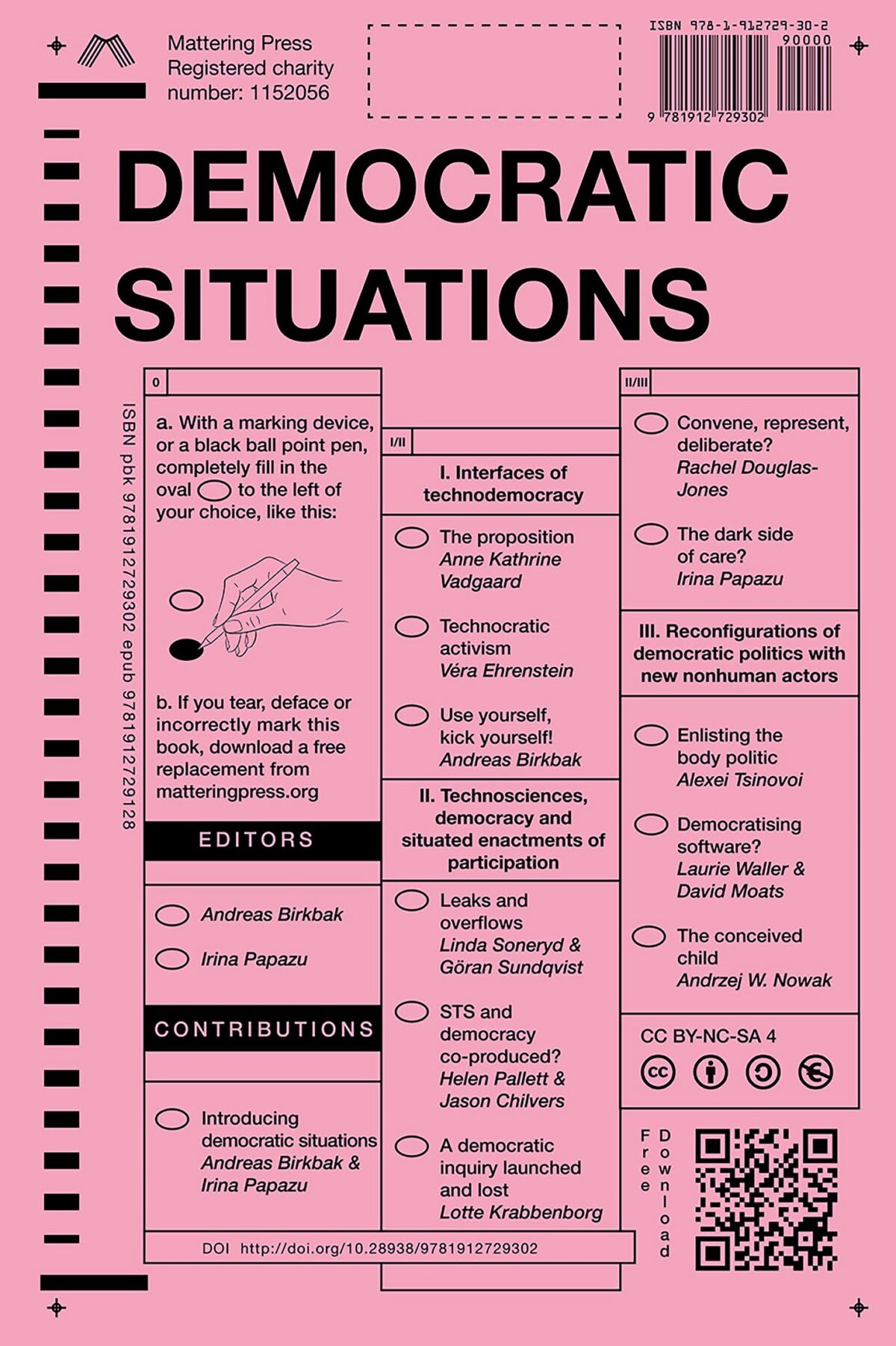
The twelve chapters are organised into three sections. The first part, entitled Interfaces of technodemocracy, focuses on how democratic politics is co-shaped by its interfaces with more or less rigid institutions and bureaucracies. The second section, Technosciences, democracy and situated enactments of participation, emphasises the relationships between science and public participation. The third part called Reconfigurations of democratic politics with new nonhuman actors focuses on the role of material objects, especially new digital technologies, in democratic politics.
Chapters
| Chapter | Author | Institution at publication |
|---|---|---|
| A democratic inquiry launched and lost | Lotte Krabbenborg | Radboud University Nijmegen |
| Convene, represent, deliberate? | Rachel Douglas-Jones | IT University of Copenhagen |
| Democratising software? | Laurie Waller, David Moats | University of East Anglia; Linköping University |
| Enlisting the body politic | Alexei Tsinovoi | Lund University |
| Introducing democratic situations | Andreas Birkbak, Irina Papazu | Aalborg University; IT University of Copenhagen |
| Leaks and Overflows | Linda Soneryd, Göran Sundqvist | University of Gothenburg |
| STS and democracy co-produced? | Helen Pallett, Jason Chilvers | University of East Anglia |
| Technocratic activism | Véra Ehrenstein | Centre National pour la Recherche Scientifique et Technique (CNRST) |
| The conceived child | Andrzej W. Nowak | Adam Mickiewicz University in Poznań |
| The dark side of care? | Irina Papazu | IT University of Copenhagen |
| The proposition | Anne Kathrine Vadgaard | |
| Use yourself, kick yourself! | Andreas Birkbak | Aalborg University |
Where its authors and editors are based
Countries of the institutions the book's authors, editors and chapter authors were affiliated to when it was published.
- AUTHORS / EDITORS
- CITATIONS Phase 2
- USAGE Phase 3
| Country | Authors / editors |
|---|---|
| Sweden | 4 |
| Denmark | 3 |
| United Kingdom | 3 |
| Morocco | 1 |
| Poland | 1 |
| The Netherlands | 1 |
About this data
These figures cover 13 works. Each value comes from the most trusted source that has it; a correction made by OJC or OBC staff outranks every source.
| Source | Confidence | Works |
|---|---|---|
| Thoth | 90 / 100 | 13 |
| Works with a publication date | 100% |
|---|---|
| Works with a DOI | 8% |
| Works with a funder recorded | 0% |
| Authors with an affiliation | 94% |
| Affiliations matched to an institution (ROR) | 100% |
| Affiliations with a country | 100% |
Countries come from the institution each author was affiliated to when they published, as recorded in ROR. A country is never guessed, so authors without a matched institution are not counted on the maps.
Funders come from OpenAlex for articles and Thoth for books, where publishers recorded them. Most works record none, so a funder's figures show what is recorded, not everything it funded.
Chapters count as works: their authors and editors, and the countries of their institutions, are in every figure where Thoth records an affiliation for them.
Citations (Phase 2) and usage (Phase 3) are not collected yet.