Book view
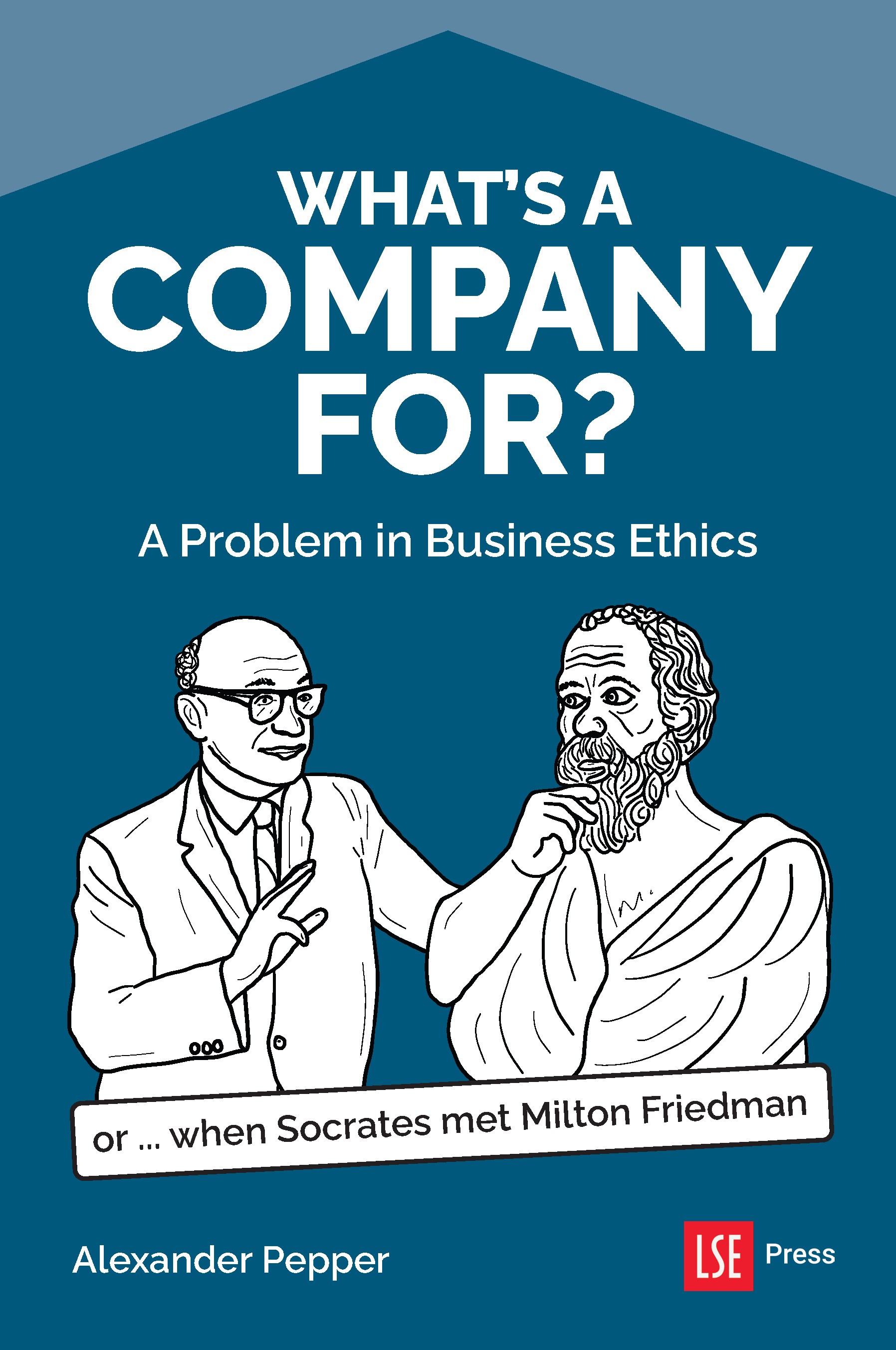
What’s a Company For?
A Problem in Business Ethics (or...when Socrates met Milton Friedman)
Book information
- Publisher
- LSE Press
- Publication
- Published 30 June 2026
- Place
- London
- Catalogue record
- View in the catalogue
Abstract
Is the job of a company director simply to make as much money as possible as quickly as possible for shareholders? Do businesses have obligations to employees, other stakeholders, and society as a whole? And, most pressingly of all, do they have any responsibility for the environment, for social inequality, and to sustain fair competition in a world dominated by mega-corporations?
In this book, Professor Alexander (‘Sandy’) Pepper considers the controversial subject of corporate purpose. Drawing on ideas from philosophy, economics, law, and management studies, he critically examines competing answers to the question ‘What’s a Company For?’. To help answer this, Pepper imagines the conversations that might take place if 20th-century economist Milton Friedman, who famously argued for the primacy of shareholders’ interests, engaged in dialogue with Socrates. The Athenian philosopher proves a playful and provocative interlocutor for questions of how a company operates ethically when faced with 21st-century questions of responsibility towards people, society, and the planet.
Ultimately, through academic argument, and creative philosophical dialogues, Pepper makes the case for responsible business. Building on Alasdair MacIntyre’s virtue ethics, he argues that a company’s purpose encompasses not just profit, but prosperity for all those who contribute to its work, particularly employees. It also has moral obligations to society in general.
This book is a concise, witty and engaging exploration of these knotty debates, and an essential read for students, researchers and even company directors looking to understand the bigger picture.
Chapters
| Chapter | Author | Institution at publication |
|---|---|---|
| Introduction | ||
| Shareholder primacy | ||
| Stakeholder theory | ||
| On ‘mastery’ – reconciling shareholder primacyand stakeholder theory | ||
| On ‘virtue’ – business ethics after ‘mastery’ | ||
| What’s a company for? A call for responsiblebusiness |
Where its authors and editors are based
Countries of the institutions the book's authors, editors and chapter authors were affiliated to when it was published.
- AUTHORS / EDITORS
- CITATIONS Phase 2
- USAGE Phase 3
No affiliations with a known country in these years yet.
About this data
These figures cover 7 works. Each value comes from the most trusted source that has it; a correction made by OJC or OBC staff outranks every source.
| Source | Confidence | Works |
|---|---|---|
| Thoth | 90 / 100 | 7 |
| Works with a publication date | 100% |
|---|---|
| Works with a DOI | 14% |
| Works with a funder recorded | 0% |
| Authors with an affiliation | 0% |
Countries come from the institution each author was affiliated to when they published, as recorded in ROR. A country is never guessed, so authors without a matched institution are not counted on the maps.
Funders come from OpenAlex for articles and Thoth for books, where publishers recorded them. Most works record none, so a funder's figures show what is recorded, not everything it funded.
Chapters count as works: their authors and editors, and the countries of their institutions, are in every figure where Thoth records an affiliation for them.
Citations (Phase 2) and usage (Phase 3) are not collected yet.