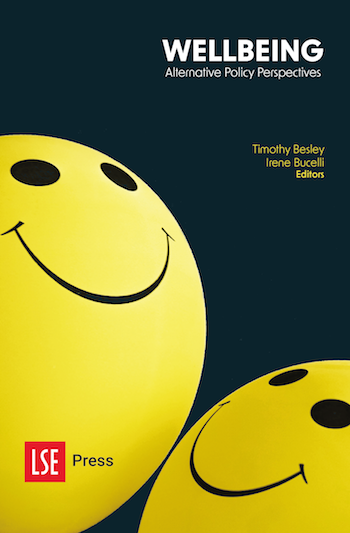
Book information
- Publisher
- LSE Press
- Publication
- Published 30 August 2022
- Place
- UK: London
- Catalogue record
- View in the catalogue
Abstract
Governments in liberal democracies pursue social welfare, but in many different ways. The wellbeing approach instead asks: Why not focus directly on increasing measured human happiness? Why not try to improve people’s overall quality of life, as it is subjectively seen by citizens themselves?
The radical implications of this stance include shifting attention to previously neglected areas (such as mental health and ‘social infrastructure’ services) and developing defensible measures of overall wellbeing or quality of life indicators. Can one ‘master’ concept of wellbeing work to create more holism in policy-making? Or should we stick with multiple metrics? These debates have been live in relation to an alternative ‘capacities’ approaches, and they are well-developed in health policymaking. Most recently, the connections between wellbeing and political participation have come into sharper focus.
Wellbeing remains a contested concept, one that can be interpreted and used differently, with consequences for how it is incorporated into policy decisions. By bringing together scholars from economics, psychology and behavioural science, philosophy and political science, the authors explore how different disciplinary approaches can contribute to the study of wellbeing and how this can shape policy priorities.
Where its authors and editors are based
Countries of the institutions the book's authors, editors and chapter authors were affiliated to when it was published.
- AUTHORS / EDITORS
- CITATIONS Phase 2
- USAGE Phase 3
| Country | Authors / editors |
|---|---|
| United Kingdom | 1 |
About this data
These figures cover 1 work. Each value comes from the most trusted source that has it; a correction made by OJC or OBC staff outranks every source.
| Source | Confidence | Works |
|---|---|---|
| Thoth | 90 / 100 | 1 |
| Works with a publication date | 100% |
|---|---|
| Works with a DOI | 100% |
| Works with a funder recorded | 0% |
| Authors with an affiliation | 50% |
| Affiliations matched to an institution (ROR) | 0% |
| Affiliations with a country | 100% |
Countries come from the institution each author was affiliated to when they published, as recorded in ROR. A country is never guessed, so authors without a matched institution are not counted on the maps.
Funders come from OpenAlex for articles and Thoth for books, where publishers recorded them. Most works record none, so a funder's figures show what is recorded, not everything it funded.
Chapters count as works: their authors and editors, and the countries of their institutions, are in every figure where Thoth records an affiliation for them.
Citations (Phase 2) and usage (Phase 3) are not collected yet.