Book information
- Publisher
- LSE Press
- Publication
- Published 7 May 2026
- Place
- London
- Series
- RGS-IBG book series
- Catalogue record
- View in the catalogue
Abstract
Climate action is at an impasse. Its political opponents are stronger than ever, its advocates powerless. Almost every major government and corporation expresses their commitment to tackling climate change, yet decades of discussion, governance, and action have failed to stop carbon emissions advancing to record annual levels. How has so little been achieved for so long on such an urgent issue?
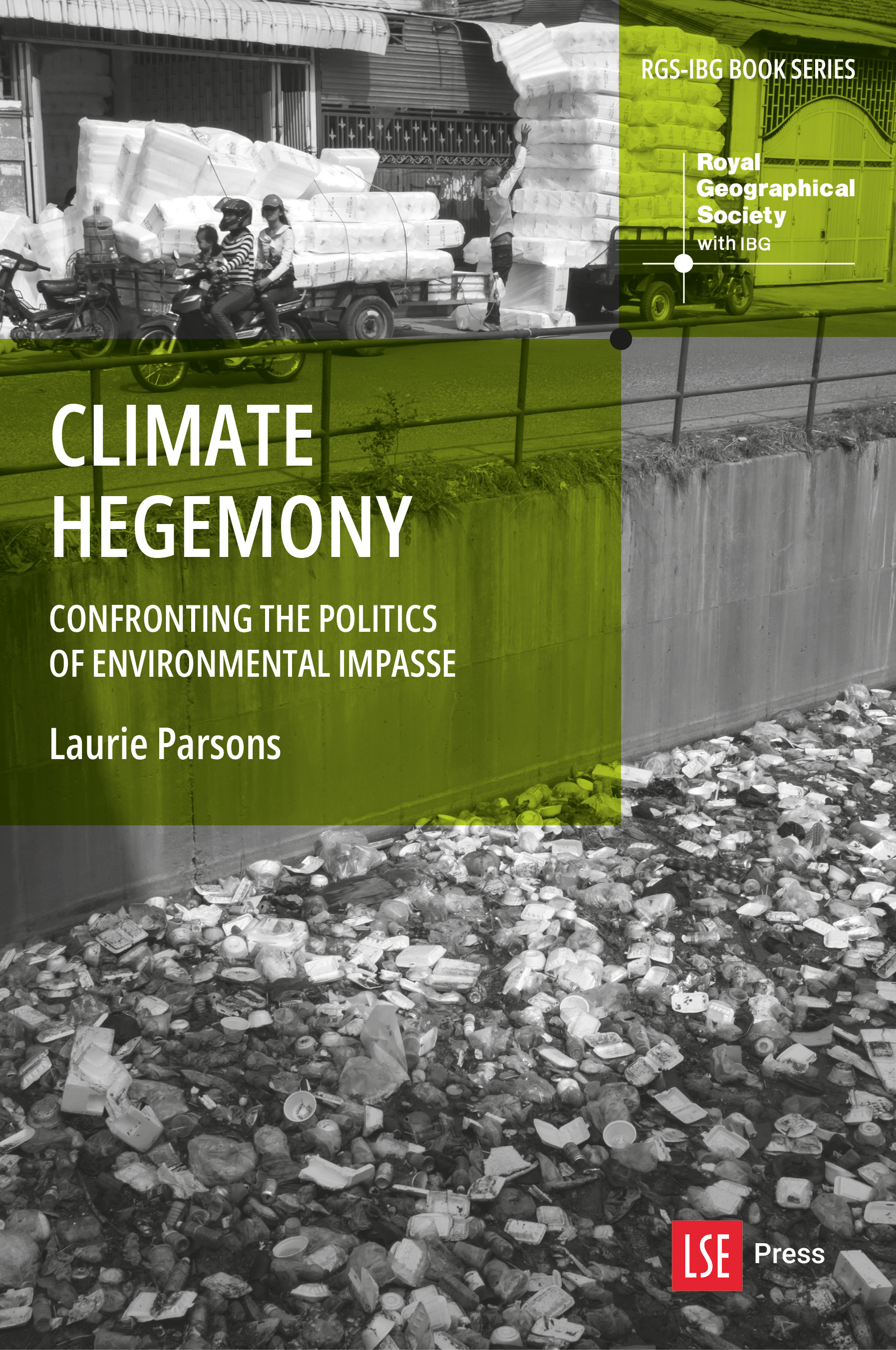
In Climate Hegemony: Confronting the Politics of Environmental Impasse, Laurie Parsons shows how the architecture of environmental thinking has been locked into ineffective pathways. We don’t need to be coerced into inaction on climate, because our understanding is constrained by metaphors, rhetoric and assumptions so embedded we have long since ceased to see them.
To confront this, Climate Hegemony brings us a human’s-eye view of the climate crisis, building up from lived experience to reveal the interests and politics that underpin the impasse. Drawing on almost two decades’ research at the frontline of global development in Cambodia, Parsons reveals the chasm between how climate change appears in a newspaper, or a policy bulletin, and how it appears to those immersed in the places it affects. From this perspective, the limitations of current environmental thinking become clear, but so too do a great many alternatives.
In this powerfully argued work, Parsons set out how, if we were to rethink the perspective from which we understand climate change, we can build knowledge from and for marginalised communities, from the ground upwards, challenging the impasse and creating new pathways to address and adapt to the social impacts of climate breakdown.
Chapters
| Chapter | Author | Institution at publication |
|---|---|---|
| Categorical domination: segregating disasters from the global economy | ||
| Climate control | ||
| Climate control: over to you | ||
| Confronting our dragons: new perspectives on environmental change | ||
| I, climate migrant: science, security and stigma in the analysis of environmental mobility | ||
| Irrigation, rhetoric and scale | ||
| Narratives and rhetoric in contemporary climate policy | ||
| The tyranny of environmental metaphors | ||
| The wicked problem of climate change on the Tonle Sap Lake | ||
| Thumbnail knowledges: the geography of the un- and half- known | ||
| What do you know: the politics of environmental ignorance |
Where its authors and editors are based
Countries of the institutions the book's authors, editors and chapter authors were affiliated to when it was published.
- AUTHORS / EDITORS
- CITATIONS Phase 2
- USAGE Phase 3
No affiliations with a known country in these years yet.
About this data
These figures cover 12 works. Each value comes from the most trusted source that has it; a correction made by OJC or OBC staff outranks every source.
| Source | Confidence | Works |
|---|---|---|
| Thoth | 90 / 100 | 12 |
| Works with a publication date | 100% |
|---|---|
| Works with a DOI | 8% |
| Works with a funder recorded | 0% |
| Authors with an affiliation | 0% |
Countries come from the institution each author was affiliated to when they published, as recorded in ROR. A country is never guessed, so authors without a matched institution are not counted on the maps.
Funders come from OpenAlex for articles and Thoth for books, where publishers recorded them. Most works record none, so a funder's figures show what is recorded, not everything it funded.
Chapters count as works: their authors and editors, and the countries of their institutions, are in every figure where Thoth records an affiliation for them.
Citations (Phase 2) and usage (Phase 3) are not collected yet.