Book information
- Publisher
- Mattering Press
- Publication
- Published 25 July 2016
- Place
- Manchester, UK
- Catalogue record
- View in the catalogue
Abstract
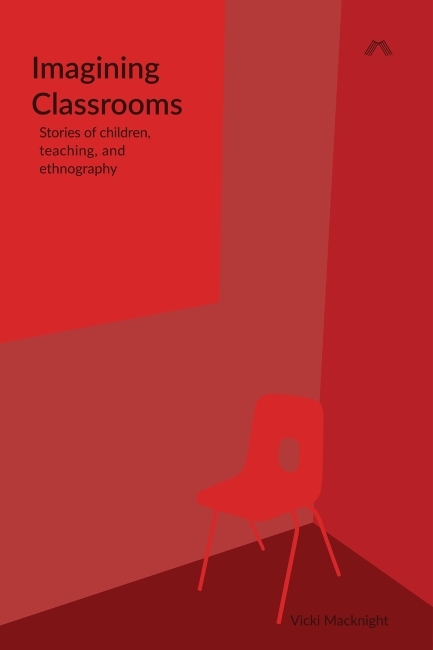
In this book we go to five Australian classrooms, bustling with nine- and ten-year-old children. In each classroom, imaginations are being done, not just in minds, but with bodies too, using materials and words, laughter and ideas. Each classroom is part of a different type of school: a Waldorf/Steiner school, an exclusive private school, a middle-class government school, a diverse catholic school, and a school for intellectually disabled ‘special’ children. And at these five schools, we see imagination being done — to represent, to transform, to empathise, to work with others, and to think.
The book’s characters are children and teachers, with teachers working through the school day to give children the skills they will need to think, to think with and about others, and to be creative. What we notice are habits of imagining being instilled and these range from getting children to close their eyes and imagine accurate representations, through to getting them to imagine how others feel, to getting children to make new connections between thoughts and feelings. We wonder about the implications of these habits for good knowing and good doing.
At the same time, the book shines a critical lens onto the imaginative practices of ethnographers and participant-observers, to help us think about how we define, how we class, and how we analyse our data. Ethnographers, too, have habits of imagining, representing, empathising, and connecting, and noticing these habits can help us do them better. How are academic practices both material and imaginative? How might we make sure our work is both as accurate and as ethical as possible? Macknight argues that imagination is not just something hidden in minds — it is something we do. This, then, is a book about how to do imagination better for thinking, for making, and for living together.
Chapters
| Chapter | Author | Institution at publication |
|---|---|---|
| Introduction | Vicki Macknight | University of Otago |
| Preface · On Losing Foundations | Vicki Macknight | University of Otago |
| Defining Imagination in Practice | Vicki Macknight | University of Otago |
| Having a Friend | Vicki Macknight | |
| Imagination and Theory Building | Vicki Macknight | University of Otago |
| Imagining Classrooms | Vicki Macknight | University of Otago |
| Pictures in the Mind | Vicki Macknight | University of Otago |
| Telling a Good Yarn | Vicki Macknight | University of Otago |
| Thinking of Otherness | Vicki Macknight | University of Otago |
| Afterword | Vicki Macknight | University of Otago |
| Conclusion | Vicki Macknight | University of Otago |
Where its authors and editors are based
Countries of the institutions the book's authors, editors and chapter authors were affiliated to when it was published.
- AUTHORS / EDITORS
- CITATIONS Phase 2
- USAGE Phase 3
| Country | Authors / editors |
|---|---|
| New Zealand | 1 |
About this data
These figures cover 12 works. Each value comes from the most trusted source that has it; a correction made by OJC or OBC staff outranks every source.
| Source | Confidence | Works |
|---|---|---|
| Thoth | 90 / 100 | 12 |
| Works with a publication date | 100% |
|---|---|
| Works with a DOI | 8% |
| Works with a funder recorded | 0% |
| Authors with an affiliation | 92% |
| Affiliations matched to an institution (ROR) | 100% |
| Affiliations with a country | 100% |
Countries come from the institution each author was affiliated to when they published, as recorded in ROR. A country is never guessed, so authors without a matched institution are not counted on the maps.
Funders come from OpenAlex for articles and Thoth for books, where publishers recorded them. Most works record none, so a funder's figures show what is recorded, not everything it funded.
Chapters count as works: their authors and editors, and the countries of their institutions, are in every figure where Thoth records an affiliation for them.
Citations (Phase 2) and usage (Phase 3) are not collected yet.