Book information
- Publisher
- LSE Press
- Publication
- Published 23 October 2023
- Place
- UK: London
- Catalogue record
- View in the catalogue
Abstract
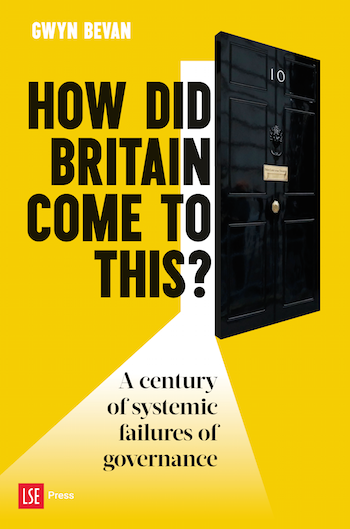
If every system is perfectly designed to get the results it gets, what is wrong with the design of the systems that govern Britain? And how have they resulted in failures in housing, privatisation, outsourcing, education and healthcare? In How Did Britain Come to This? Gwyn Bevan examines a century of varieties of systemic failures in the British state. The book begins and ends by showing how systems of governance explain scandals in NHS hospitals, and the failures and successes of the UK and Germany in responding to Covid-19 before and after vaccines became available.
The book compares geographical fault lines and inequalities in Britain with those that have developed in other European countries and argues that the causes of Britain’s entrenched inequalities are consequences of shifts in systems of governance over the past century. Clement Attlee’s postwar government aimed to remedy the failings of the prewar minimal state, while Margaret Thatcher’s governments in the 1980s in turn sought to remedy the failings of Attlee’s planned state by developing the marketised state, which morphed into the financialised state we see today.
This analysis highlights the urgent need for a new political settlement of an enabling state that tackles current systemic weaknesses from market failures and over-centralisation. This book offers an accessible, analytic account of government failures of the past century, and is essential reading for anyone who wants to make an informed contribution to what an innovative, capable state might look like in a post-pandemic world.
Chapters
Where its authors and editors are based
Countries of the institutions the book's authors, editors and chapter authors were affiliated to when it was published.
- AUTHORS / EDITORS
- CITATIONS Phase 2
- USAGE Phase 3
| Country | Authors / editors |
|---|---|
| United Kingdom | 1 |
About this data
These figures cover 11 works. Each value comes from the most trusted source that has it; a correction made by OJC or OBC staff outranks every source.
| Source | Confidence | Works |
|---|---|---|
| Thoth | 90 / 100 | 11 |
| Works with a publication date | 100% |
|---|---|
| Works with a DOI | 100% |
| Works with a funder recorded | 0% |
| Authors with an affiliation | 9% |
| Affiliations matched to an institution (ROR) | 0% |
| Affiliations with a country | 100% |
Countries come from the institution each author was affiliated to when they published, as recorded in ROR. A country is never guessed, so authors without a matched institution are not counted on the maps.
Funders come from OpenAlex for articles and Thoth for books, where publishers recorded them. Most works record none, so a funder's figures show what is recorded, not everything it funded.
Chapters count as works: their authors and editors, and the countries of their institutions, are in every figure where Thoth records an affiliation for them.
Citations (Phase 2) and usage (Phase 3) are not collected yet.