Book view
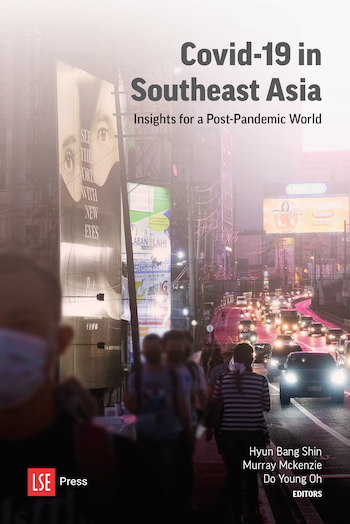
COVID-19 in Southeast Asia
Insights for a post-pandemic world
Edited by Murray Mckenzie, Hyun Bang Shin, Do Young Oh
Book information
- Publisher
- LSE Press
- Publication
- Published 6 January 2022
- Place
- UK: London
- Catalogue record
- View in the catalogue
Abstract
COVID-19 has presented huge challenges to governments, businesses, civil societies, and people from all walks of life, but its impact has been highly variegated, affecting society in multiple negative ways, with uneven geographical and socioeconomic patterns. The crisis revealed existing contradictions and inequalities in society, compelling us to question what it means to return to “normal” and what insights can be gleaned from Southeast Asia for thinking about a post-pandemic world.
In this regard, this edited volume collects the informed views of an ensemble of social scientists – area studies, development studies, and legal scholars; anthropologists, architects, economists, geographers, planners, sociologists, and urbanists; representing academic institutions, activist and charitable organisations, policy and research institutes, and areas of professional practice – who recognise the necessity of critical commentary and engaged scholarship.
These contributions represent a wide-ranging set of views, collectively producing a compilation of reflections on the following three themes in particular: (1) Urbanisation, digital infrastructures, economies, and the environment; (2) Migrants, (im)mobilities, and borders; and (3) Collective action, communities, and mutual action.
Overall, this edited volume first aims to speak from a situated position in relevant debates to challenge knowledge about the pandemic that has assigned selective and inequitable visibility to issues, people, or places, or which through its inferential or interpretive capacity has worked to set social expectations or assign validity to certain interventions with a bearing on the pandemic’s course and the future it has foretold. Second, it aims to advance or renew understandings of social challenges, risks, or inequities that were already in place, and which, without further or better action, are to be features of our “post-pandemic world” as well.
This volume also contributes to the ongoing efforts to de-centre and decolonise knowledge production. It endeavours to help secure a place within these debates for a region that was among the first outside of East Asia to be forced to contend with COVID-19 in a substantial way and which has evinced a marked and instructive diversity and dynamism in its fortunes.
Chapters
Where its authors and editors are based
Countries of the institutions the book's authors, editors and chapter authors were affiliated to when it was published.
- AUTHORS / EDITORS
- CITATIONS Phase 2
- USAGE Phase 3
| Country | Authors / editors |
|---|---|
| United Kingdom | 12 |
| Malaysia | 5 |
| Hong Kong | 2 |
| Indonesia | 2 |
| Philippines | 2 |
| Singapore | 2 |
| Cambodia | 1 |
| China | 1 |
All 10 countries
| Country | Authors / editors |
|---|---|
| United Kingdom | 12 |
| Malaysia | 5 |
| Hong Kong | 2 |
| Indonesia | 2 |
| Philippines | 2 |
| Singapore | 2 |
| Cambodia | 1 |
| China | 1 |
| South Korea | 1 |
| United States | 1 |
About this data
These figures cover 31 works. Each value comes from the most trusted source that has it; a correction made by OJC or OBC staff outranks every source.
| Source | Confidence | Works |
|---|---|---|
| Thoth | 90 / 100 | 31 |
| Works with a publication date | 100% |
|---|---|
| Works with a DOI | 100% |
| Works with a funder recorded | 0% |
| Authors with an affiliation | 71% |
| Affiliations matched to an institution (ROR) | 97% |
| Affiliations with a country | 100% |
Countries come from the institution each author was affiliated to when they published, as recorded in ROR. A country is never guessed, so authors without a matched institution are not counted on the maps.
Funders come from OpenAlex for articles and Thoth for books, where publishers recorded them. Most works record none, so a funder's figures show what is recorded, not everything it funded.
Chapters count as works: their authors and editors, and the countries of their institutions, are in every figure where Thoth records an affiliation for them.
Citations (Phase 2) and usage (Phase 3) are not collected yet.