Book view
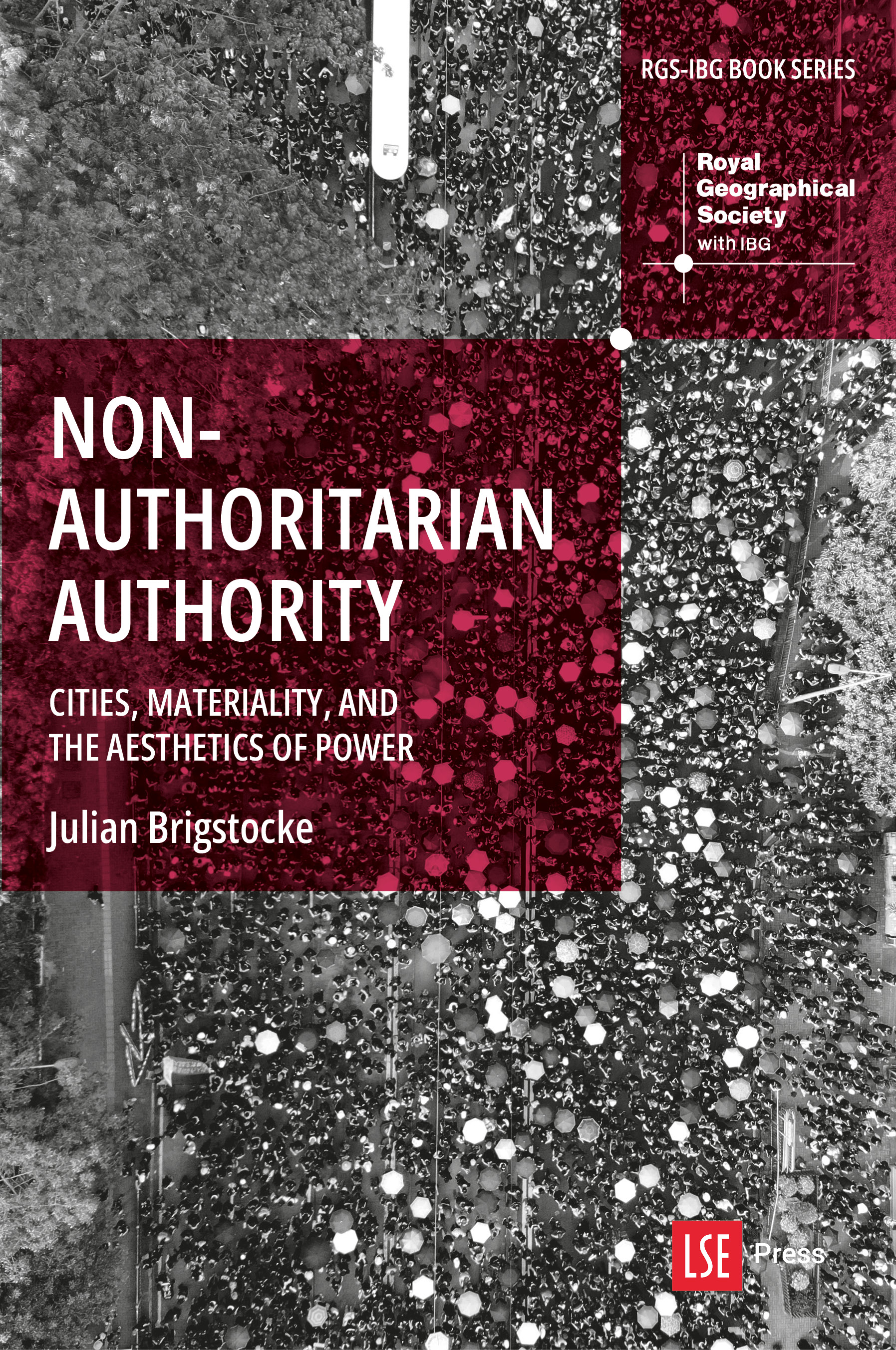
Nonauthoritarian Authority
Cities, Materiality, and the Aesthetics of Power
Book information
- Publisher
- LSE Press
- Publication
- Published 26 March 2026
- Place
- London
- Series
- RGS-IBG book series
- Catalogue record
- View in the catalogue
Abstract
Authority is not a word with many positive connotations. It suggests power-hungry dictators, trigger-happy police, stifling bureaucracies, and monumental urban landscapes. In Nonauthoritarian Authority Julian Brigstocke argues that in these shattered times, anti-authoritarianism is not enough: a radical, speculative reinvention of authority is needed. He introduces the idea of non-authoritarian authority: a form of power that pluralises marginalised and hidden voices, recognises diverse agencies, and amplifies heterogeneous demands.
Engaging with key philosophical debates around materiality, experience, feeling, agency, and landscape, Nonauthoritarian Authority stages a series of experiments with thinking, reading, researching, and writing non-authoritarian authority. Dramatising a speculative search for barely sensed, dispersed authorities, Brigstocke’s experiments in thinking explore the intrinsically spatial nature of authority, through empirical studies of violent urban borders in Rio de Janeiro, colonial material infrastructures in Hong Kong, monumental architecture in Paris, and everyday spaces of encounter in the UK.
Offering an intricate and playful reflection on the relationship between authority, urban forms, and writing, each exercise in thinking links form and genre to a distinctive way of imagining authority. Each chapter simultaneously critiques a form of authoritarian authority and searches for a new, nonauthoritarian authority within the rubble of the old.
Chapters
| Chapter | Author | Institution at publication |
|---|---|---|
| Atmospheric authority and emotional borderwork in the favelas of Rio de Janeiro | ||
| Attuning to emergent, everyday, ordinary authorities | ||
| Authority and modernity | ||
| Authority, authorship, form, and genre: a horoscope for the neurotic and paranoid | ||
| Authority, modernity, and the factory of emotions | ||
| Four speculative figures of authority: attention, care, birth, attunement | ||
| Granular authority, bureaucracy, and the aesthetics of sand in colonial Hong Kong | ||
| Landscapes of thinking, or, where am I when I think? | ||
| Lectio divina – reading Arendt’s ‘What is authority?’ | ||
| Spaces and aesthetics of authority | ||
| Speculative provocations for a nonauthoritarian authority |
Where its authors and editors are based
Countries of the institutions the book's authors, editors and chapter authors were affiliated to when it was published.
- AUTHORS / EDITORS
- CITATIONS Phase 2
- USAGE Phase 3
No affiliations with a known country in these years yet.
About this data
These figures cover 12 works. Each value comes from the most trusted source that has it; a correction made by OJC or OBC staff outranks every source.
| Source | Confidence | Works |
|---|---|---|
| Thoth | 90 / 100 | 12 |
| Works with a publication date | 100% |
|---|---|
| Works with a DOI | 8% |
| Works with a funder recorded | 8% |
| Authors with an affiliation | 0% |
Countries come from the institution each author was affiliated to when they published, as recorded in ROR. A country is never guessed, so authors without a matched institution are not counted on the maps.
Funders come from OpenAlex for articles and Thoth for books, where publishers recorded them. Most works record none, so a funder's figures show what is recorded, not everything it funded.
Chapters count as works: their authors and editors, and the countries of their institutions, are in every figure where Thoth records an affiliation for them.
Citations (Phase 2) and usage (Phase 3) are not collected yet.