Book view
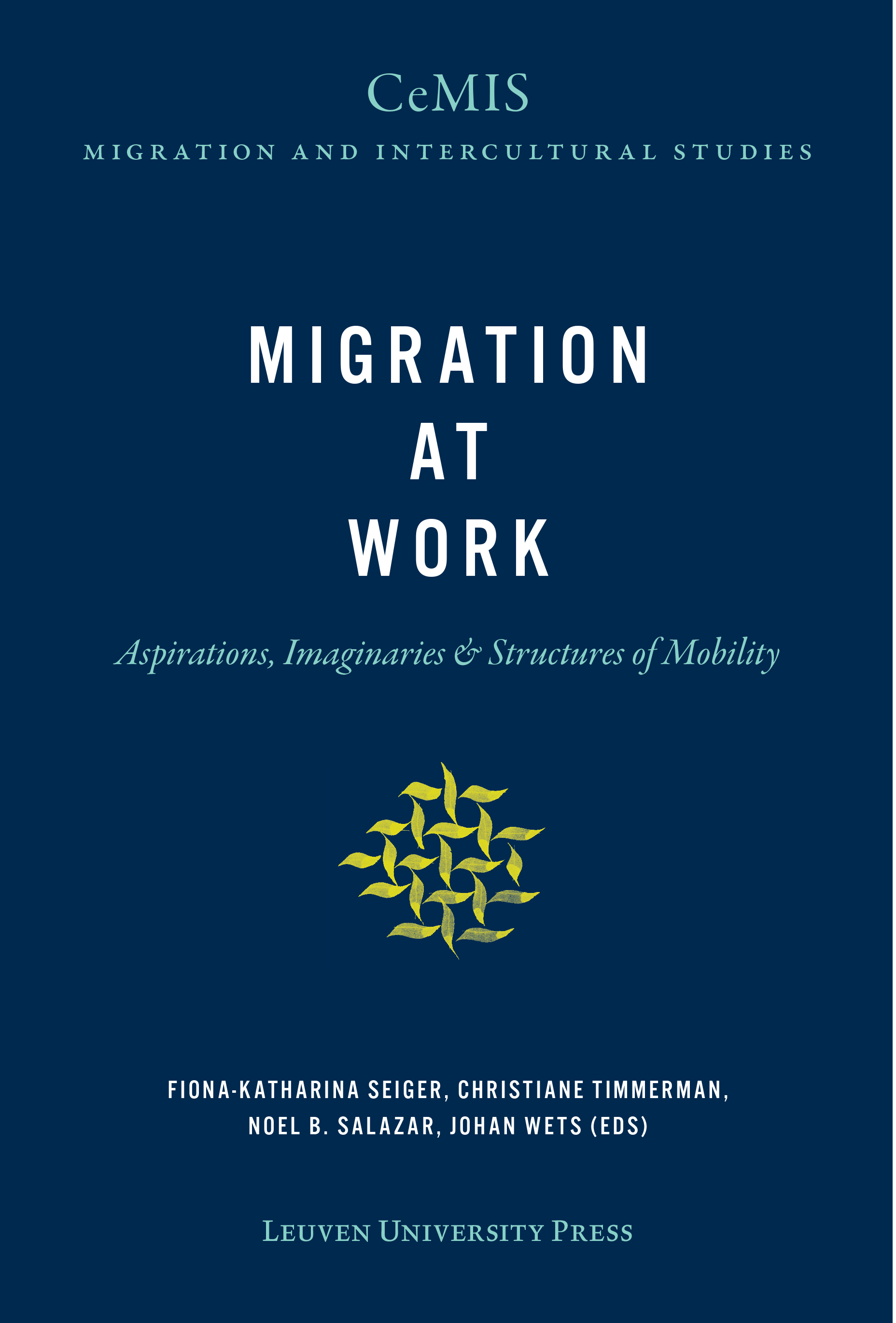
Migration at Work
Aspirations, Imaginaries & Structures of Mobility
Edited by Fiona-Katharina Seiger, Christiane Timmerman, Noel B. Salazar, Johan Wets
Book information
- Publisher
- Leuven University Press
- Publication
- Published 24 September 2020
- Place
- Leuven, BE
- Series
- CeMIS Migration and Intercultural Studies
- Catalogue record
- View in the catalogue
Abstract
Migration and Labour Mobility
The willingness to migrate in search of employment is in itself insufficient to compel anyone to move. The dynamics of labour mobility are heavily influenced by the opportunities perceived and the imaginaries held by both employers and regulating authorities in relation to migrant labour. This volume offers a multidisciplinary approach to the study of the structures and imaginaries underlying various forms of mobility. Based on research conducted in different geographical contexts, including the European Union, Turkey, and South Africa, and tackling the experiences and aspirations of migrants from various parts of the globe, the chapters comprised in this volume analyse labour-related mobilities from two distinct yet intertwined vantage points: the role of structures and regimes of mobility on the one hand, and aspirations as well as migrant imaginaries on the other. Migration at Work thus aims to draw cross-contextual parallels by addressing the role played by opportunities in mobilising people, how structures enable, sustain, and change different forms of mobility, and how imaginaries fuel labour migration and vice versa. In doing so, this volume also aims to tackle the interrelationships between imaginaries driving migration and shaping “regimes of mobility”, as well as how the former play out in different contexts, shaping internal and cross-border migration.
Based on empirical research in various fields, this collection provides valuable scholarship and evidence on current processes of migration and mobility.
Contributors: Iratxe Aristegui (University of Deusto), Deniz Berfin Ayaydin (CEMESO), Maria Luisa Di Martino (University of Deusto), Iraklis Dimitriadis (University of Milan), Russell King (University of Sussex / Malmö University), Aija Lulle (University of Louborough), Concepción Maiztegui-Oñate (University of Deusto), Faith Mkwananzi (University of the Free State), Christine Moderbacher (Max Planck Institute for Social Anthropology), Alice Ncube (University of the Free State), Noel B. Salazar (KU Leuven), Fiona-Katharina Seiger (Erasmus University Rotterdam), Joana de Sousa Ribeiro (University of Coimbra), Mirjam Wajsberg (Radboud University), Johan Wets (KU Leuven)
Ebook available in Open Access.
This publication is GPRC-labeled (Guaranteed Peer-Reviewed Content).
Where its authors and editors are based
Countries of the institutions the book's authors, editors and chapter authors were affiliated to when it was published.
- AUTHORS / EDITORS
- CITATIONS Phase 2
- USAGE Phase 3
No affiliations with a known country in these years yet.
About this data
These figures cover 1 work. Each value comes from the most trusted source that has it; a correction made by OJC or OBC staff outranks every source.
| Source | Confidence | Works |
|---|---|---|
| Thoth | 90 / 100 | 1 |
| Works with a publication date | 100% |
|---|---|
| Works with a DOI | 100% |
| Works with a funder recorded | 100% |
| Authors with an affiliation | 0% |
Countries come from the institution each author was affiliated to when they published, as recorded in ROR. A country is never guessed, so authors without a matched institution are not counted on the maps.
Funders come from OpenAlex for articles and Thoth for books, where publishers recorded them. Not every work records one, so a funder's figures show what is recorded, not everything it funded.
Chapters count as works: their authors and editors, and the countries of their institutions, are in every figure where Thoth records an affiliation for them.
Citations (Phase 2) and usage (Phase 3) are not collected yet.