Book view
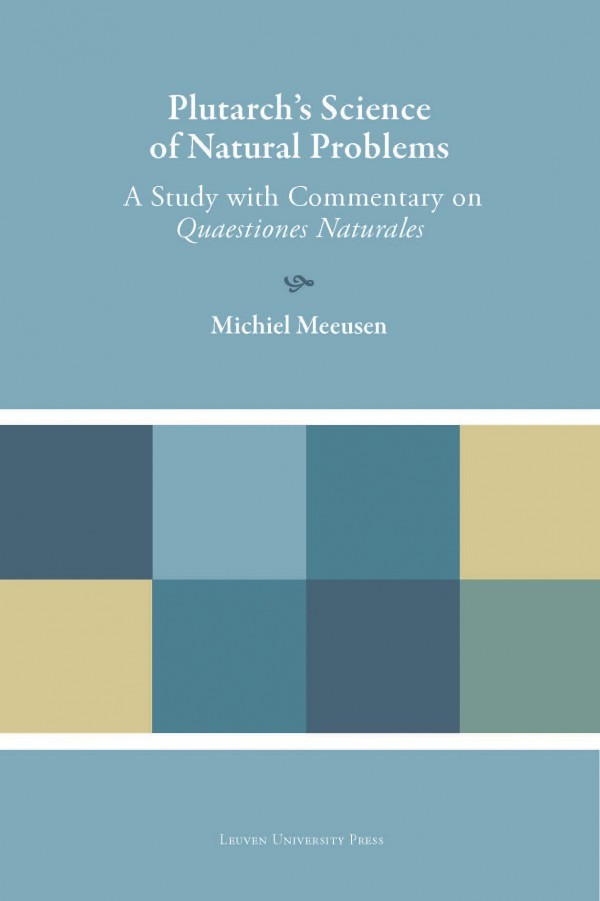
Plutarch's Science of Natural Problems
A Study with Commentary on Quaestiones Naturales
Book information
- Publisher
- Leuven University Press
- Publication
- Published 10 February 2017
- Place
- Leuven, BE
- Series
- Plutarchea Hypomnemata
- Catalogue record
- View in the catalogue
Abstract
The role of natural science in the Roman Imperial Era In his Quaestiones naturales, Plutarch unmistakeably demonstrates a huge interest in the world of natural phenomena. The work of this famous intellectual and philosopher from Chaeronea consists of forty-one natural problems that address a wide variety of questions, sometimes rather peculiar ones, and answers pertaining to ancient Greek physics, including problems related to the fields of zoology, botany, meteorology and their respective subdisciplines. By providing a thorough study of and commentary on this generally neglected text, written by one of the most influential and prolific writers from Antiquity, this book contributes to our better understanding of Plutarch’s natural scientific programme and, the condition and role of ancient natural science in the Roman Imperial Era in general.
This publication is GPRC-labeled (Guaranteed Peer-Reviewed Content).
Where its authors and editors are based
Countries of the institutions the book's authors, editors and chapter authors were affiliated to when it was published.
- AUTHORS / EDITORS
- CITATIONS Phase 2
- USAGE Phase 3
No affiliations with a known country in these years yet.
About this data
These figures cover 1 work. Each value comes from the most trusted source that has it; a correction made by OJC or OBC staff outranks every source.
| Source | Confidence | Works |
|---|---|---|
| Thoth | 90 / 100 | 1 |
| Works with a publication date | 100% |
|---|---|
| Works with a DOI | 100% |
| Works with a funder recorded | 0% |
| Authors with an affiliation | 0% |
Countries come from the institution each author was affiliated to when they published, as recorded in ROR. A country is never guessed, so authors without a matched institution are not counted on the maps.
Funders come from OpenAlex for articles and Thoth for books, where publishers recorded them. Most works record none, so a funder's figures show what is recorded, not everything it funded.
Chapters count as works: their authors and editors, and the countries of their institutions, are in every figure where Thoth records an affiliation for them.
Citations (Phase 2) and usage (Phase 3) are not collected yet.