Book view
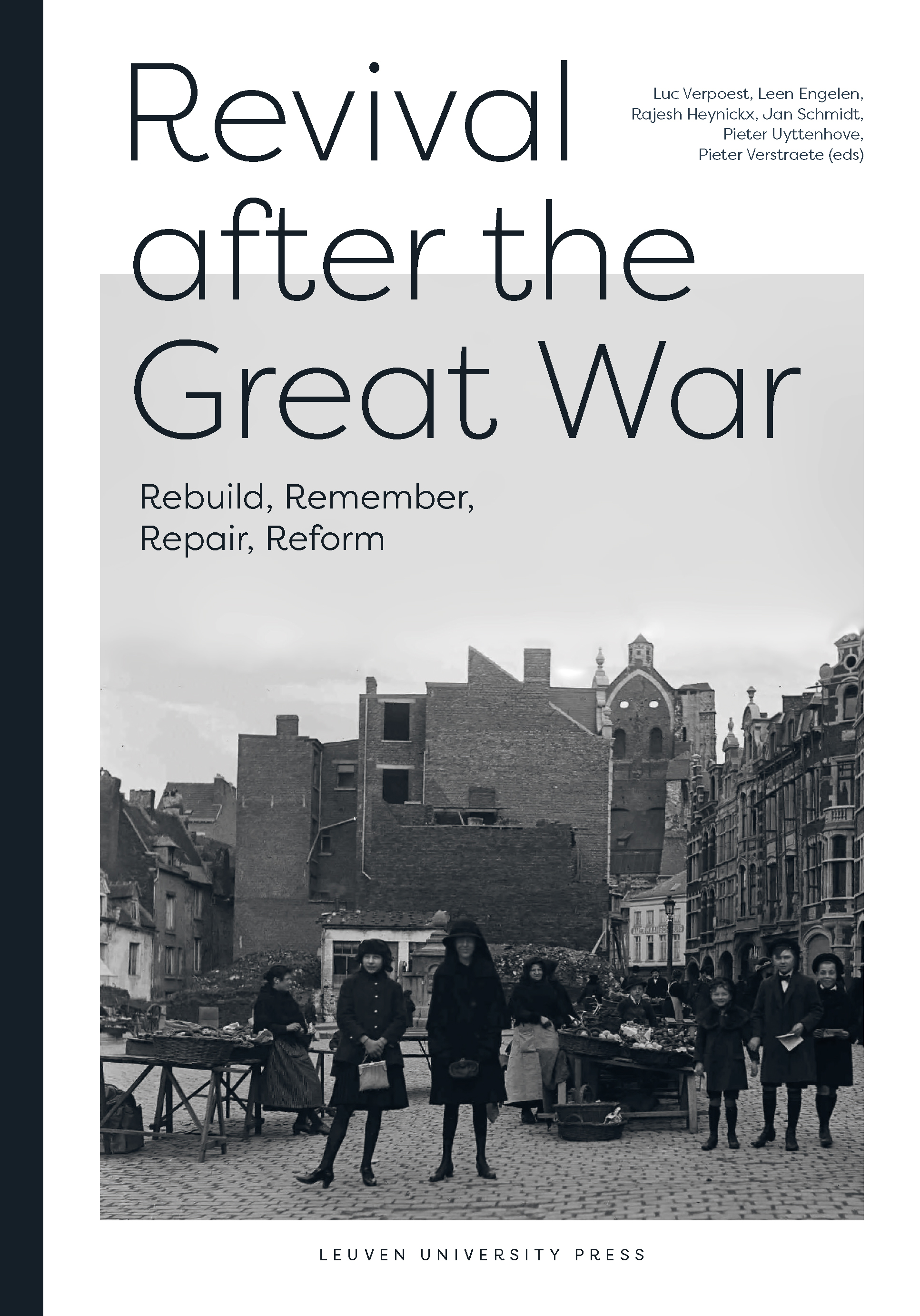
Revival After the Great War
Rebuild, Remember, Repair, Reform
Edited by Luc Verpoest, Leen Engelen, Rajesh Heynickx, Jan Schmidt, Pieter Uyttenhove, Pieter Verstraete
Book information
- Publisher
- Leuven University Press
- Publication
- Published 20 November 2020
- Place
- Leuven, BE
- Catalogue record
- View in the catalogue
Abstract
The challenges of post-war recoveryfrom social and political reform to architectural design
In the months and years immediately following the First World War, the many (European) countries that had formed its battleground were confronted with daunting challenges. These challenges varied according to the countries' earlier role and degree of involvement in the war but were without exception enormous. The contributors to this book analyse how this was not only a matter of rebuilding ravaged cities and destroyed infrastructure, but also of repairing people’s damaged bodies and upended daily lives, and rethinking and reforming societal, economic and political structures. These processes took place against the backdrop of mass mourning and remembrance, political violence and economic crisis. At the same time, the post-war tabula rasaoffered many opportunities for innovation in various areas of society, from social and political reform to architectural design. The wide scope of post-war recovery and revival is reflected in the different sections of this book: rebuild, remember, repair, and reform. It offers insights into post-war revival in Western European countries such as Belgium, France, the United Kingdom, Germany, Portugal, Spain, and Italy, as well as into how their efforts were perceived outside of Europe, for instance in Argentina and the United States.
Contributors: Helen Brooks (University of Kent), Dries Claeys (KU Leuven), Marisa De Picker (KU Leuven), Leen Engelen (LUCA/KU Leuven), Rajesh Heynickx (KU Leuven), John Horne (Trinity College Dublin), Maarten Liefooghe (Ghent University), Ana Paula Pires (Universidade Nova de Lisboa), Richard Plunz (Columbia University), Tammy Proctor (Utah State University), Pierre Purseigle (University of Warwick), Carolina Garcia Sanz (Universidad de Sevilla), Jan Schmidt (KU Leuven), Yves Segers (KU Leuven), Marjan Sterckx (Ghent University), Maria Inés Tato (Universidad de Buenos Aires), Pieter Uyttenhove (Ghent University), Joris Vandendriessche (KU Leuven), Luc Verpoest (KU Leuven), Pieter Verstraete (KU Leuven), Volker Welter (University of California), Kaat Wils (KU Leuven)
Ebook available in Open Access. This publication is GPRC-labeled (Guaranteed Peer-Reviewed Content).
Where its authors and editors are based
Countries of the institutions the book's authors, editors and chapter authors were affiliated to when it was published.
- AUTHORS / EDITORS
- CITATIONS Phase 2
- USAGE Phase 3
No affiliations with a known country in these years yet.
About this data
These figures cover 1 work. Each value comes from the most trusted source that has it; a correction made by OJC or OBC staff outranks every source.
| Source | Confidence | Works |
|---|---|---|
| Thoth | 90 / 100 | 1 |
| Works with a publication date | 100% |
|---|---|
| Works with a DOI | 100% |
| Works with a funder recorded | 100% |
| Authors with an affiliation | 0% |
Countries come from the institution each author was affiliated to when they published, as recorded in ROR. A country is never guessed, so authors without a matched institution are not counted on the maps.
Funders come from OpenAlex for articles and Thoth for books, where publishers recorded them. Not every work records one, so a funder's figures show what is recorded, not everything it funded.
Chapters count as works: their authors and editors, and the countries of their institutions, are in every figure where Thoth records an affiliation for them.
Citations (Phase 2) and usage (Phase 3) are not collected yet.