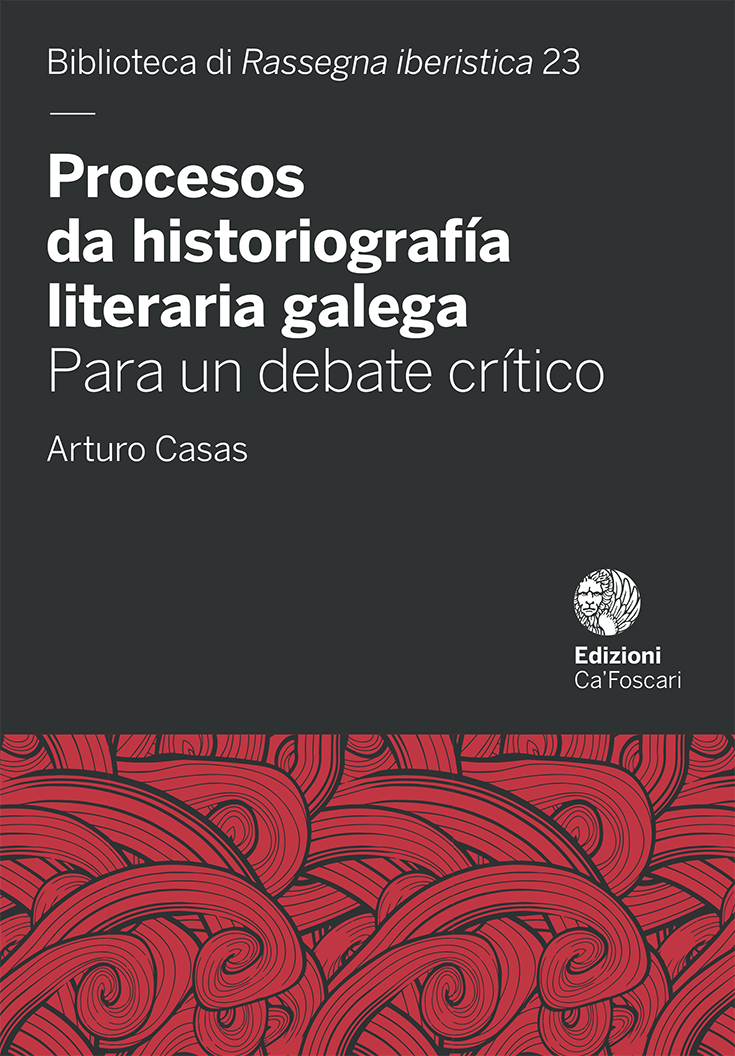
Book information
- Publisher
- Edizioni Ca' Foscari
- Publication
- Published 24 November 2021
- Place
- Venice, Italy
- Series
- Library of <i>Rassegna iberistica</i>
- Catalogue record
- View in the catalogue
Abstract
Galician literary historiography shows links and ruptures that refer to the cultural history of Galicia itself and to the sequence of historical events that have delineated the social, economic and political development of the country since the nineteenth century. These coordinates comprise a series of processes, including the elaboration and propagation of ideologies aimed at achieving a way out of political subalternity and oriented towards the horizon of national emancipation. Those events and these processes also marked the connection of Galicia with modernity and the dynamics of historical change. As a result of the above, this book analyses critically the institutionalization processes of the history of Galician literature – with special emphasis on historiographic models such as that of Said Armesto, Carvalho Calero, Méndez Ferrín and others – and indicates the need to undertake a productive methodological innovation of the discipline in heuristic, organic and discursive terms. It further argues that this update should pay attention to substantive theoretical debates, not exclusively of specific cultural coordinates, such as Galician ones or any others that could be considered. Among these, the cooperation between history and sociology, the intellection of literary facts as historical facts, the review of the link between literary history and nation, the public uses of literary history, and the inquiry of discursive choices that promote a less self-indulgent and predictable historiography. This essentially involved a challenge, that of permanent dialogue with some of the most powerful critical reinterpretations of the Galician historiographic tradition and with alternative models constituted from feminist thought, postcolonial theories, the sociology of the literary field or the systemic theories of culture, as well as with the contributions made from a post-national understanding of the literary phenomenon.
Where its authors and editors are based
Countries of the institutions the book's authors, editors and chapter authors were affiliated to when it was published.
- AUTHORS / EDITORS
- CITATIONS Phase 2
- USAGE Phase 3
| Country | Authors / editors |
|---|---|
| Spain | 1 |
About this data
These figures cover 1 work. Each value comes from the most trusted source that has it; a correction made by OJC or OBC staff outranks every source.
| Source | Confidence | Works |
|---|---|---|
| Thoth | 90 / 100 | 1 |
| Works with a publication date | 100% |
|---|---|
| Works with a DOI | 100% |
| Works with a funder recorded | 0% |
| Authors with an affiliation | 100% |
| Affiliations matched to an institution (ROR) | 100% |
| Affiliations with a country | 100% |
Countries come from the institution each author was affiliated to when they published, as recorded in ROR. A country is never guessed, so authors without a matched institution are not counted on the maps.
Funders come from OpenAlex for articles and Thoth for books, where publishers recorded them. Most works record none, so a funder's figures show what is recorded, not everything it funded.
Chapters count as works: their authors and editors, and the countries of their institutions, are in every figure where Thoth records an affiliation for them.
Citations (Phase 2) and usage (Phase 3) are not collected yet.