Book view
The design of educational environments for the learning of foreign languages
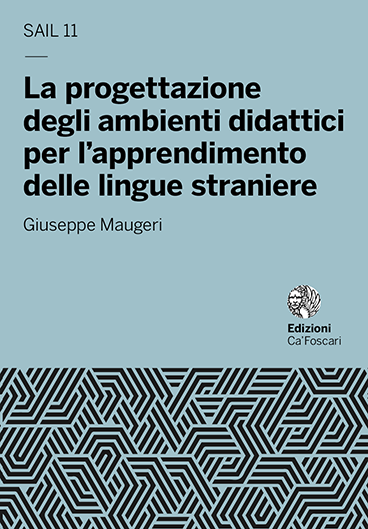
Book information
- Publisher
- Edizioni Ca' Foscari
- Publication
- Published 18 September 2017
- Place
- Venice, Italy
- Series
- SAIL
- Catalogue record
- View in the catalogue
Abstract
Can educational environment be designed to enhance the students’ learning strategies? Can educational space influence the linguistic experience of the students and, in particular, their motivation and linguistic performance? Starting from a research perspective of language teaching, we will give an answer to these questions and thus offer a conceptual and operational framework to create a significant educational environment for learners. Therefore it becomes important to analyze the physical context using specific tools in order to identify which aspects and practices may affect the use of space and, consequently, to act for an environmental requalification. In this way environment is based on people’s characteristics and needs; it is a strategy to improve both the process of communication among the organization-teacher-learners and the students’ communication skills.
Where its authors and editors are based
Countries of the institutions the book's authors, editors and chapter authors were affiliated to when it was published.
- AUTHORS / EDITORS
- CITATIONS Phase 2
- USAGE Phase 3
| Country | Authors / editors |
|---|---|
| Italy | 1 |
About this data
These figures cover 1 work. Each value comes from the most trusted source that has it; a correction made by OJC or OBC staff outranks every source.
| Source | Confidence | Works |
|---|---|---|
| Thoth | 90 / 100 | 1 |
| Works with a publication date | 100% |
|---|---|
| Works with a DOI | 100% |
| Works with a funder recorded | 0% |
| Authors with an affiliation | 100% |
| Affiliations matched to an institution (ROR) | 100% |
| Affiliations with a country | 100% |
Countries come from the institution each author was affiliated to when they published, as recorded in ROR. A country is never guessed, so authors without a matched institution are not counted on the maps.
Funders come from OpenAlex for articles and Thoth for books, where publishers recorded them. Most works record none, so a funder's figures show what is recorded, not everything it funded.
Chapters count as works: their authors and editors, and the countries of their institutions, are in every figure where Thoth records an affiliation for them.
Citations (Phase 2) and usage (Phase 3) are not collected yet.