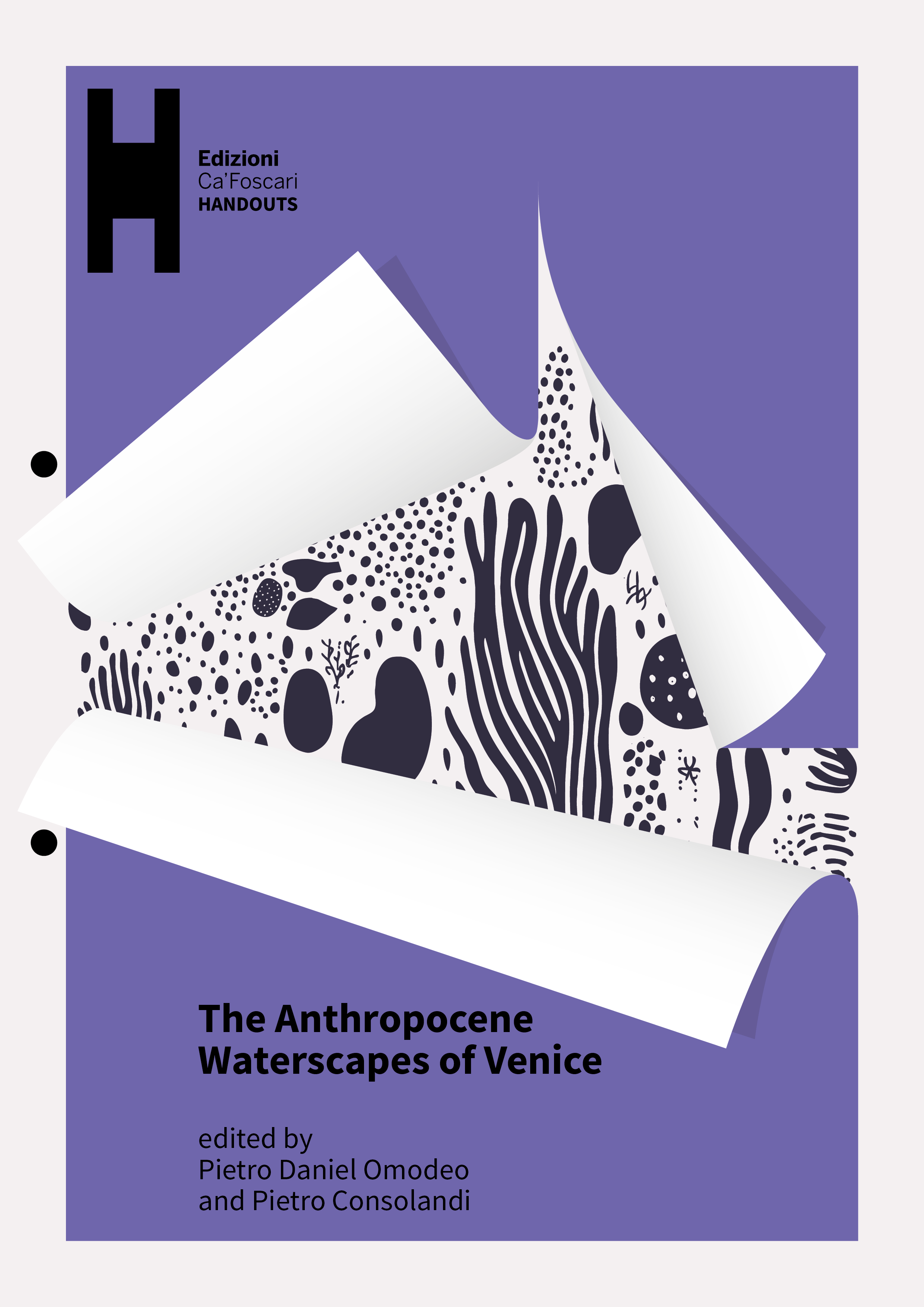
Book information
- Publisher
- Edizioni Ca' Foscari
- Publication
- Published 10 June 2025
- Place
- Venice, Italy
- Series
- Edizioni Ca’ Foscari Handouts
- Catalogue record
- View in the catalogue
Abstract
This handbook is an interdisciplinary introduction to the Anthropocene, the epoch in which the combined impact of humans and their technologies on the Earth system is comparable to that of natural forces. To more concretely consider the historical, political, and epistemological conditions behind the Anthropocene, the handbook takes the water city of Venice, along with its cultural–natural ecology, as the paradigm of the ongoing geoanthropological transformation of the planet. In connection with the educational program of the Department of Philosophy and Cultural Heritage at the Ca’ Foscari University of Venice, the contributions herein reflect environmental humanities research, with an emphasis on hydrosociology, supported by the UNITWIN/UNESCO Chair on Water Heritage and Sustainable Development and the NICHE Centre for Environmental Humanities. The handbook contains a series of lessons, in which scholars with different backgrounds and disciplinary training examine the historical development of the human–nature relationship from multiple comparative perspectives. Unit One (four lessons) offers an overview of Anthropocene Venice, ranging from a discussion of riverine and aquatic mythologies to the history of water science and management, from antiquity to the industrial age. Unit Two (three lessons) deals with the general question of the Anthropocene, the genealogies of the concept, and its articulation as a problem of oversight and knowledge economy, including artistic vistas (e.g., bird’s-eye view, vedute, and aerial photography). Unit Three (three lessons) is a comparative discussion of water cities – Venice, Tenochtitlán, and Bangkok – against the background of hydrophilia, the lasting connection between humans and aquatic environments in history. Unit Four (four lessons) explores the cultural politics of the Anthropocene, with a special emphasis on the following issues: the social underpinnings of science and technology, the mission of eco-artistic movements, resistance to the extractivism of material resources and cultural commons, and the struggles for the rights of nature against ecocide.
Where its authors and editors are based
Countries of the institutions the book's authors, editors and chapter authors were affiliated to when it was published.
- AUTHORS / EDITORS
- CITATIONS Phase 2
- USAGE Phase 3
| Country | Authors / editors |
|---|---|
| Italy | 1 |
| United Kingdom | 1 |
About this data
These figures cover 1 work. Each value comes from the most trusted source that has it; a correction made by OJC or OBC staff outranks every source.
| Source | Confidence | Works |
|---|---|---|
| Thoth | 90 / 100 | 1 |
| Works with a publication date | 100% |
|---|---|
| Works with a DOI | 100% |
| Works with a funder recorded | 0% |
| Authors with an affiliation | 100% |
| Affiliations matched to an institution (ROR) | 100% |
| Affiliations with a country | 100% |
Countries come from the institution each author was affiliated to when they published, as recorded in ROR. A country is never guessed, so authors without a matched institution are not counted on the maps.
Funders come from OpenAlex for articles and Thoth for books, where publishers recorded them. Most works record none, so a funder's figures show what is recorded, not everything it funded.
Chapters count as works: their authors and editors, and the countries of their institutions, are in every figure where Thoth records an affiliation for them.
Citations (Phase 2) and usage (Phase 3) are not collected yet.