Book view
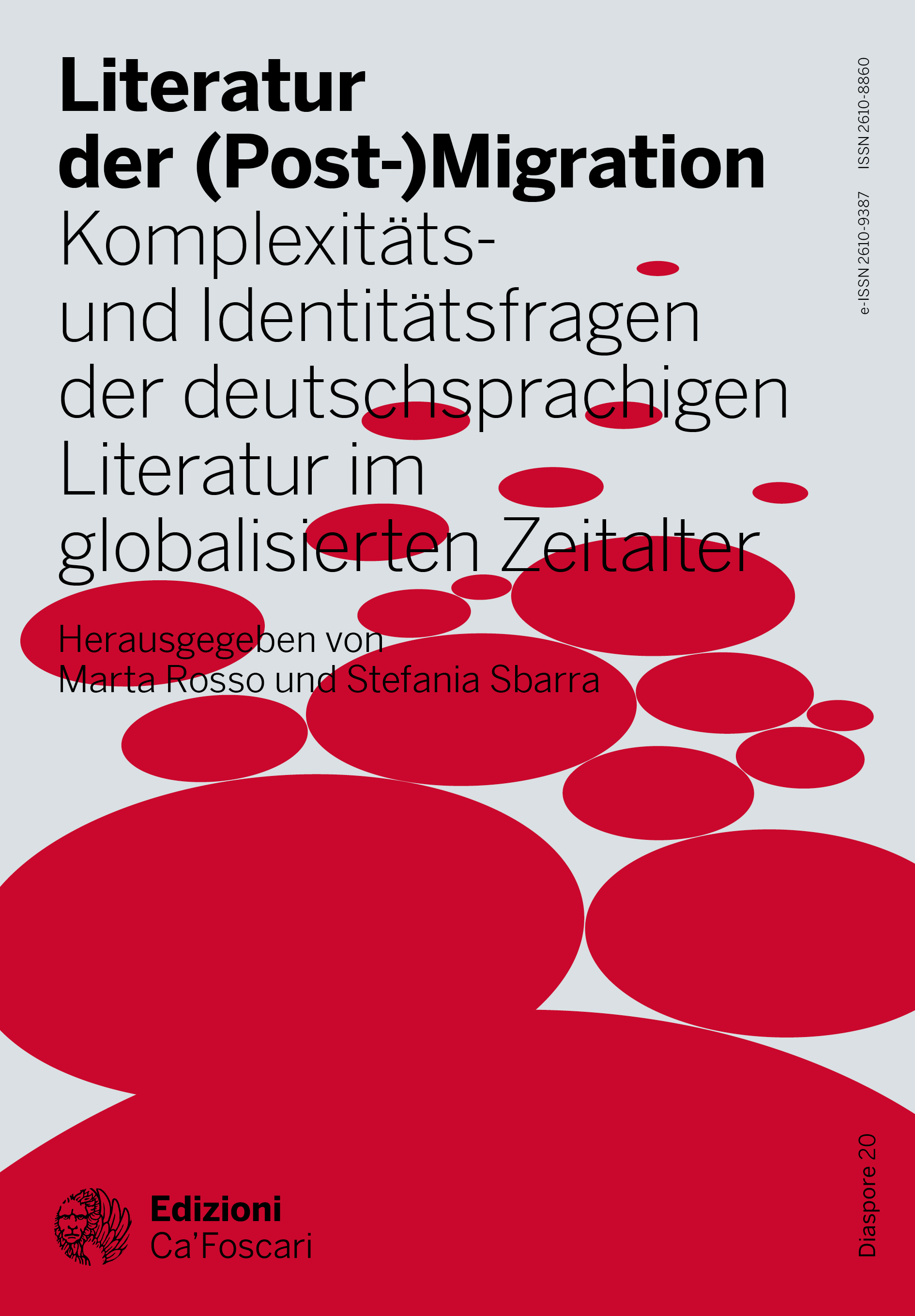
Literature of (Post-)Migration
Questions of Complexity and Identity in German-Language Literature in a Globalised Age
Edited by Marta Rosso, Stefania Sbarra
Book information
- Publisher
- Edizioni Ca' Foscari
- Publication
- Published 16 June 2023
- Place
- Venice, Italy
- Series
- Diaspore
- Catalogue record
- View in the catalogue
Abstract
This volume brings together contributions from the international conference "Literatur zwischen Migration und Globalisierung. Formen der Komplexität in der deutschsprachigen Gegenwartsliteratur", which took place in May 2022 at Ca’ Foscari University of Venice. It aims to reflect on the literature of migration of the last thirty years and to situate it in the increasingly complex world of our globalised present, crossed by the movements of people and cultures. The reflections of the individual essays take, as point of departure, the common observation that the literature of (post)migration is characterised by careful linguistic research and radical aesthetic experimentation, capable of interrogating our intercultural reality and of restoring a likewise complex image of the world and of society. The contributors that have converged in the present volume focus on examining the issues of complexity and identity, which, in the texts they discuss, are inextricably linked to the narration of spaces, borders, and movements. In the works of Uljana Wolf, Olga Grjasnowa, Emine Sevgi Özdamar, Michael Stavarič, Terézia Mora, Emilia Smechowski, Feridun Zaimoglu, and Sasha Marianna Salzmann, the literary language variously becomes a means to explore new possibilities of meaning, to recover what has been erased, to reconstruct the biographical stratifications inscribed in the bodies, to feel at home in a foreign world, to criticise the historical memory of society, to register bilingualisms, conflicts, and ‘in-betweenness’, and hence to narrate the new forms of identity, of hybrid identity, of postidentity, and of gender identity that are formed as a result of first, second, or third generation migrations and in correspondence with precise geographical and human spaces.
Where its authors and editors are based
Countries of the institutions the book's authors, editors and chapter authors were affiliated to when it was published.
- AUTHORS / EDITORS
- CITATIONS Phase 2
- USAGE Phase 3
| Country | Authors / editors |
|---|---|
| Italy | 2 |
About this data
These figures cover 1 work. Each value comes from the most trusted source that has it; a correction made by OJC or OBC staff outranks every source.
| Source | Confidence | Works |
|---|---|---|
| Thoth | 90 / 100 | 1 |
| Works with a publication date | 100% |
|---|---|
| Works with a DOI | 100% |
| Works with a funder recorded | 0% |
| Authors with an affiliation | 100% |
| Affiliations matched to an institution (ROR) | 100% |
| Affiliations with a country | 100% |
Countries come from the institution each author was affiliated to when they published, as recorded in ROR. A country is never guessed, so authors without a matched institution are not counted on the maps.
Funders come from OpenAlex for articles and Thoth for books, where publishers recorded them. Most works record none, so a funder's figures show what is recorded, not everything it funded.
Chapters count as works: their authors and editors, and the countries of their institutions, are in every figure where Thoth records an affiliation for them.
Citations (Phase 2) and usage (Phase 3) are not collected yet.