Book view
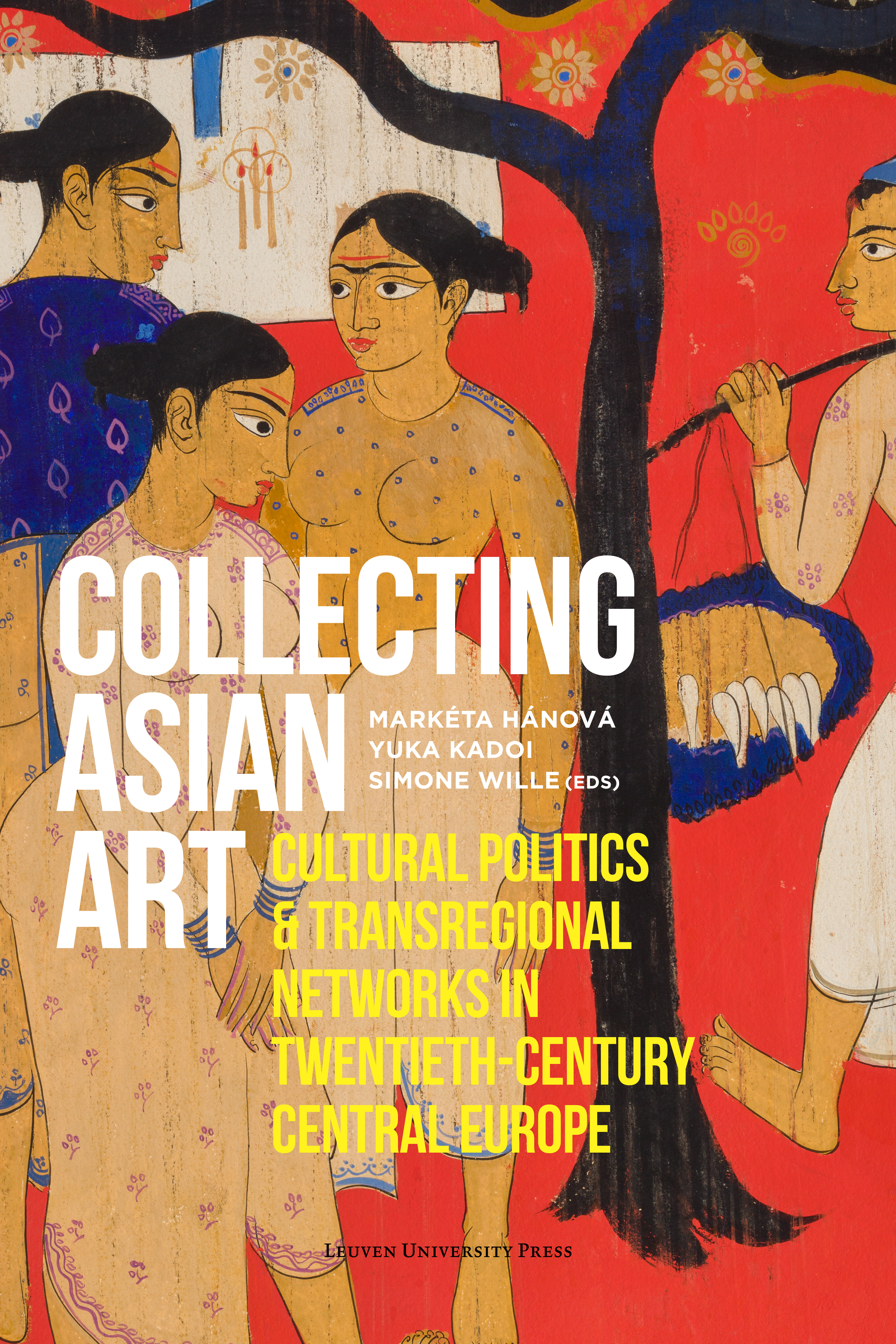
Collecting Asian Art
Cultural Politics and Transregional Networks in Twentieth-Century Central Europe
Edited by Markéta Hánová, Yuka Kadoi, Simone Wille
Book information
- Publisher
- Leuven University Press
- Publication
- Published 30 January 2024
- Place
- Leuven, BE
- Catalogue record
- View in the catalogue
Abstract
Museum collections of Asian art in Central Europe.
Rather than centering on the well-known collections in Western European and North American museums, Collecting Asian Art turns to museum collections of Asian art in Central Europe which emerged from the late 19th century onwards. Highlighting the dimensions of Central European connectedness, this volume explores how these collections evolved and changed under changing cultural and political conditions from the pre-World War I to the post-World War II periods. With a primary focus on collections of East Asian, South Asian, and West Asian art in Vienna, Prague, Berlin, Warsaw, Kraków, Budapest, and Ljubljana, it outlines the transregional connections and networks that gradually developed.
Collecting Asian Art locates Asian art across the twentieth-century in Central Europe via discourse and ideology, and discusses key collections and the way individual collectors built their networks. It thus explores transregional connections that developed through collecting activities and strategies in the prewar, interwar and postwar eras. Contributors also examine the personal connections between a group of Indologists from postwar Prague and modernist Indian artists from the early 1950s to the 1980s and also discuss the systematic archiving of East Asian art collections in Slovenia. A concluding conversation looks at colonisation and decolonisation from a broader perspective by approaching it through recent art historical discussions on the global dimensions of modernism. By defining the region through its external relationships and its entanglements with regions across Asia rather than as a self-contained unit, the contributions in this volume outline how these transregional connections and networks evolved and changed over time, thus highlighting their singularity in comparison to developments in Western Europe. Based on recent research, Collecting Asian Art reveals neglected sources while reinterpreting well-known ones.
Contributors: Zdenka Klimtová (National Gallery in Prague); Agnieszka Kluczewska-Wójcik (Polish Institute of World Art Studies); Partha Mitter (University of Sussex); Michaela Pejčochová (National Gallery in Prague); Uta Rahman Steinert (Staatliche Museen zu Berlin); Iván Szántó (Eötvös Loránd University); Nataša Vampelj Suhadolnik (University of Ljubljana); Johannes Wieninger (MAK – Museum of Applied Arts); Tomáš Winter (Czech Academy of Sciences).
Ebook available in Open Access.
This publication is GPRC-labeled (Guaranteed Peer-Reviewed Content).
Where its authors and editors are based
Countries of the institutions the book's authors, editors and chapter authors were affiliated to when it was published.
- AUTHORS / EDITORS
- CITATIONS Phase 2
- USAGE Phase 3
No affiliations with a known country in these years yet.
About this data
These figures cover 1 work. Each value comes from the most trusted source that has it; a correction made by OJC or OBC staff outranks every source.
| Source | Confidence | Works |
|---|---|---|
| Thoth | 90 / 100 | 1 |
| Works with a publication date | 100% |
|---|---|
| Works with a DOI | 100% |
| Works with a funder recorded | 100% |
| Authors with an affiliation | 0% |
Countries come from the institution each author was affiliated to when they published, as recorded in ROR. A country is never guessed, so authors without a matched institution are not counted on the maps.
Funders come from OpenAlex for articles and Thoth for books, where publishers recorded them. Not every work records one, so a funder's figures show what is recorded, not everything it funded.
Chapters count as works: their authors and editors, and the countries of their institutions, are in every figure where Thoth records an affiliation for them.
Citations (Phase 2) and usage (Phase 3) are not collected yet.