Book view
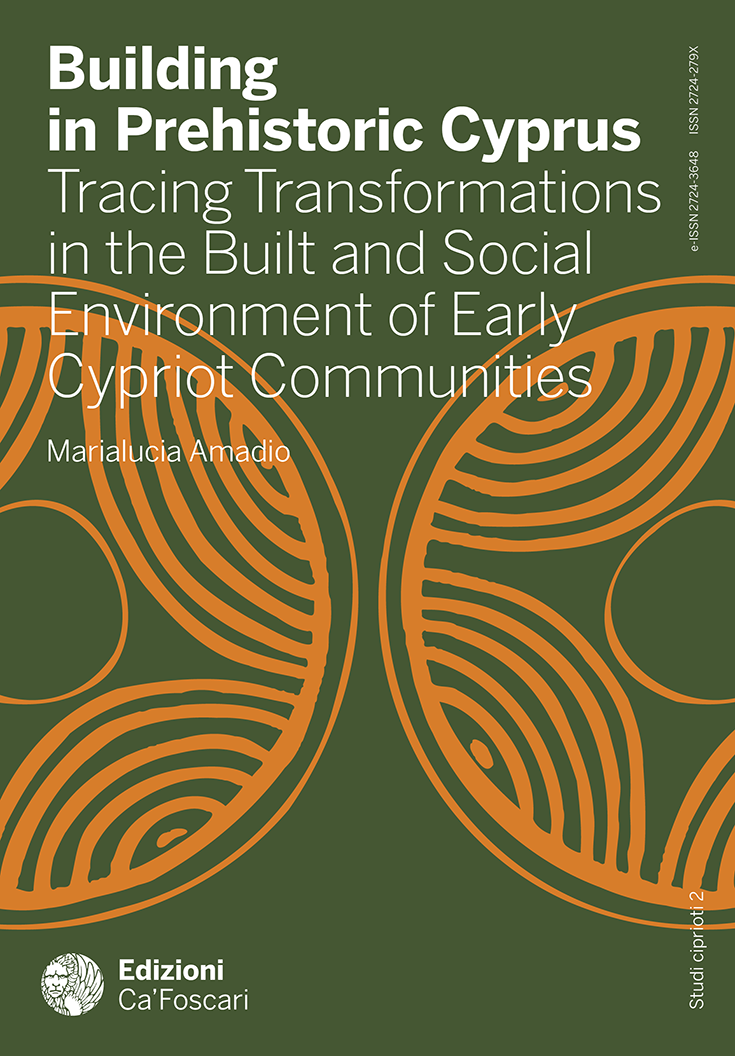
Building in Prehistoric Cyprus
Tracing Transformations in the Built and Social Environment of Early Cypriot Communities
Book information
- Publisher
- Edizioni Ca' Foscari
- Publication
- Published 3 October 2023
- Place
- Venice, Italy
- Series
- Studi ciprioti
- Catalogue record
- View in the catalogue
Abstract
The study of architecture, from the selection, procurement and processing of raw materials, to the construction and use of buildings as spaces of action and interaction, can provide major insights into the social organisation of ancient communities. Architecture, as a way of organising space and encoding meaning, plays an active role in structuring movement and socio-cultural identities and provides a range of potential avenues for exploring social motivations and rationales in particular contexts and environments, both at the individual and community levels. This book examines ‘architecture’ as key media for analysing socio-cultural narratives in prehistoric Cyprus and exploring the formation, reproduction and development of early Cypriot communities. In particular, the volume aims at moving beyond the classification of architectural forms and functions and exploring the social, ideological, economic and political transformations that characterised the Cypriot prehistory from the late Aceramic Neolithic until the advent of the Late Bronze Age (7000/6800-1750/1700 Cal BC) by using architectural evidence as the focal analytical data-set. The interest of this study is not only in how people constructed buildings but also in how buildings contributed to the construction and definition of new socio-cultural and economic identities during Cypriot prehistory. Through a detailed review of the existing architectural data-set available for prehistoric Cypriot settlements, the book aims to understand how the development of new concepts of architecture, and the increasing appearance of social, cultural and economic forms of complexity are mutually constituted.
Where its authors and editors are based
Countries of the institutions the book's authors, editors and chapter authors were affiliated to when it was published.
- AUTHORS / EDITORS
- CITATIONS Phase 2
- USAGE Phase 3
| Country | Authors / editors |
|---|---|
| Italy | 1 |
About this data
These figures cover 1 work. Each value comes from the most trusted source that has it; a correction made by OJC or OBC staff outranks every source.
| Source | Confidence | Works |
|---|---|---|
| Thoth | 90 / 100 | 1 |
| Works with a publication date | 100% |
|---|---|
| Works with a DOI | 100% |
| Works with a funder recorded | 0% |
| Authors with an affiliation | 100% |
| Affiliations matched to an institution (ROR) | 100% |
| Affiliations with a country | 100% |
Countries come from the institution each author was affiliated to when they published, as recorded in ROR. A country is never guessed, so authors without a matched institution are not counted on the maps.
Funders come from OpenAlex for articles and Thoth for books, where publishers recorded them. Most works record none, so a funder's figures show what is recorded, not everything it funded.
Chapters count as works: their authors and editors, and the countries of their institutions, are in every figure where Thoth records an affiliation for them.
Citations (Phase 2) and usage (Phase 3) are not collected yet.