Book view
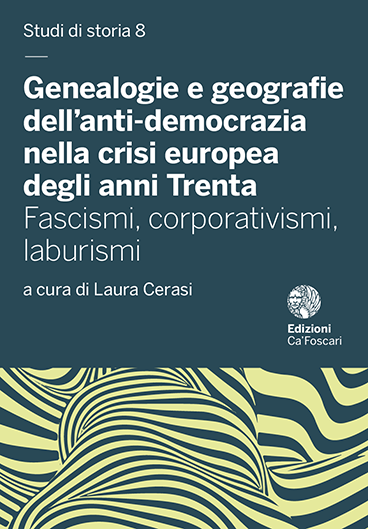
Genealogies and Geographies of Anti-Democracy in the European Crisis of the 1930s
Fascisms, Corporativisms, Laburisms
Edited by Laura Cerasi
Book information
- Publisher
- Edizioni Ca' Foscari
- Publication
- Published 31 May 2019
- Place
- Venice, Italy
- Series
- Studi di storia
- Catalogue record
- View in the catalogue
Abstract
The European responses to the inter-war years crisis were marked by the emergence of fascist and corporatist movements and regimes, combined with the creation of cultural and political networks of the radical right. Their ability to express ultra-nationalist, organicistic, palingenetic communitarian trends, radically hostile to socialist egalitarianism and liberal individualism, aiming at a national, hierarchical, collective new order, posed the ultimate authoritarian threat to European democracy. This book investigates cultural genealogies as well a as national and transnational geographies of such regimes, movements and cultures: for their transversal political nature, they provide a privileged ground for new perspectives in the inter-war crisis of Western culture, and for questioning their legacies to postwar world.
Where its authors and editors are based
Countries of the institutions the book's authors, editors and chapter authors were affiliated to when it was published.
- AUTHORS / EDITORS
- CITATIONS Phase 2
- USAGE Phase 3
| Country | Authors / editors |
|---|---|
| Italy | 1 |
About this data
These figures cover 1 work. Each value comes from the most trusted source that has it; a correction made by OJC or OBC staff outranks every source.
| Source | Confidence | Works |
|---|---|---|
| Thoth | 90 / 100 | 1 |
| Works with a publication date | 100% |
|---|---|
| Works with a DOI | 100% |
| Works with a funder recorded | 0% |
| Authors with an affiliation | 100% |
| Affiliations matched to an institution (ROR) | 100% |
| Affiliations with a country | 100% |
Countries come from the institution each author was affiliated to when they published, as recorded in ROR. A country is never guessed, so authors without a matched institution are not counted on the maps.
Funders come from OpenAlex for articles and Thoth for books, where publishers recorded them. Most works record none, so a funder's figures show what is recorded, not everything it funded.
Chapters count as works: their authors and editors, and the countries of their institutions, are in every figure where Thoth records an affiliation for them.
Citations (Phase 2) and usage (Phase 3) are not collected yet.